

 Medically Reviewed
Holter Monitor Test: Why 24-Hour Heart Tracking Matters
When your ECG comes back normal but your heart still feels off, racing, skipping, or fluttering unpredictably, that experience is frustrating and genuinely warrants further investigation. A standard ECG captures your heart’s rhythm for seconds; a holter monitor test records every heartbeat continuously for 24-48 hours while you go about your daily routine. In a study of 23,847 Indian adults, 17.4% were diagnosed with atrial fibrillation through Holter monitoring, with a median episode duration of just 13 minutes, making routine clinical detection virtually impossible. The test is non-invasive, painless, and requires no hospitalisation, yet its clinical value in detecting arrhythmias that standard testing misses is substantial.
In this blog, we cover what a Holter monitor is, why your doctor orders one, how the procedure works, how to read your results, and what the test costs across India.
Key Takeaways:
- A standard ECG records heart rhythm for seconds, a Holter monitor records it continuously over 24-48 hours during real daily activities.
- In 23,847 Indian adults, 17.4% were diagnosed with AF on Holter monitoring; most episodes lasted under 14 minutes.
- Only 35% of significant arrhythmias are detected within the first 24 hours; extended monitoring catches what standard Holter misses.
Quick Answer: A Holter monitor test continuously records your heart’s electrical activity for 24-48 hours to detect arrhythmias, palpitations, and rhythm changes that a standard ECG misses.
Quick Links
What Is a Holter Monitor and Why Is It Different from an ECG?
A Holter monitor is a type of continuous ambulatory ECG, a small portable device that records your heart’s electrical activity over 24-48 hours while you carry on with daily life, which is precisely what a standard ECG cannot do.
- The core ECG limitation: A standard ECG records heart activity for only a few seconds in a controlled clinical setting; intermittent arrhythmias and rhythm changes that occur unpredictably during daily life are simply missed. A patient with palpitations may show a completely normal ECG on the day of testing.
- What the Holter adds: A Holter monitor collects beat-by-beat cardiac data continuously, during sleep, activity, meals, and stress, recording every heartbeat in real-world conditions. It primarily provides QRS complex and R-R interval data, from which arrhythmias, conduction abnormalities, and heart rate variability are assessed.
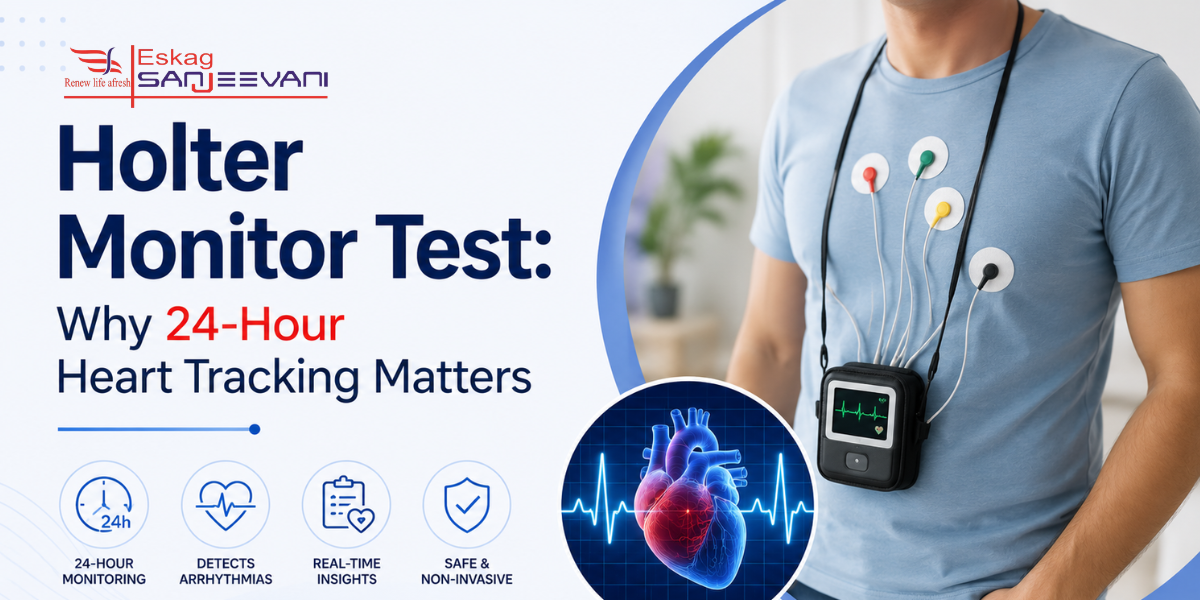
- What the device looks like: Three to five adhesive electrode patches connect via lead wires to a recorder about the size of a mobile phone, worn in a pouch around the neck or clipped to a belt. It is battery-powered, lightweight, and designed to be worn under clothing throughout normal daily activities.
- The activity diary is clinically essential: noting the exact time of every symptom, palpitations, dizziness, chest discomfort, allows the cardiologist to directly correlate each event with the recorded heart rhythm at that moment. Without the diary, much of the diagnostic value of the Holter data is lost.
- When Holter monitoring has limits: The 24-hour window still misses infrequent arrhythmias; a patient with monthly syncope is unlikely to have an episode during one day of recording. Extended patch monitoring of 7-14 days is the appropriate next step in such cases and is now available at select cardiac centres in India.
Why Your Doctor Orders a Holter Monitor Test
Holter monitoring is recommended when a standard ECG does not provide enough information, and in India, the scale of undetected cardiac arrhythmia makes it a clinically underutilised but critically important diagnostic tool.
- Arrhythmia detection: In a study of 23,847 Indian adults who underwent 24-hour Holter monitoring, AF was diagnosed in 17.4% of patients, with a median episode duration of just 13 minutes, making clinical visit detection virtually impossible [1].
- Syncope and unexplained dizziness: Holter monitoring is recommended when patients have syncope, near-syncope, or episodic dizziness without a clearly identified cause, and when these episodes cannot be directly linked to any concurrent rhythm abnormality in the recorded data.
- Treatment monitoring: For patients on antiarrhythmic medications or with pacemakers, Holter monitoring assesses whether treatment is controlling heart rhythm as intended, guiding dose adjustment or device reprogramming when it is not.
- Non-cardiac indications: Holter monitoring has demonstrated utility beyond cardiac settings, including stroke risk stratification and the differentiation of cardiac from non-cardiac causes of fatigue and breathlessness. Many patients may have asymptomatic arrhythmias detectable only by Holter monitoring.
- India-specific gap: Holter monitoring is not widely used in India due to access and cost barriers, leaving many patients with paroxysmal AF undiagnosed, untreated, and carrying a five-fold increased stroke risk.
Next, let’s understand the stepwise procedure for a 24-hour Holter monitor.
The 24-Hour Holter Monitor Test: Step-by-Step Procedure
The 24-hour Holter monitor test procedure is straightforward and non-invasive; nothing is inserted into your body, and the entire setup takes approximately 15-30 minutes at the diagnostic centre.
Step 1: Preparation Before the Test
Avoid applying lotions, oils, or powder to your chest on the day of the test, clean, dry skin improves electrode adhesion and signal quality. Men with chest hair may be asked to shave small areas at electrode sites. Wear loose, comfortable clothing; inform the technician of any adhesive allergies.
Step 2: Electrode Placement
A technician cleans specific chest areas with an alcohol wipe, then attaches 3–5 small adhesive electrode patches at precise positions on the chest wall. Each electrode detects the heart’s electrical signals and conducts them through lead wires to the recording device.
Step 3: Device Fitting
The lead wires connect to a small recorder, about the size of a mobile phone, worn in a pouch around the neck or clipped to a waistband. The technician confirms signal quality, demonstrates how to reattach electrodes if they loosen, and explains the activity diary.
Step 4: The Monitoring Period
Continue all normal daily activities throughout the 24-48 hours, walking, working, and sleeping. Keep the device dry at all times; avoid bathing, swimming, and high-voltage areas. Record every symptom, palpitations, dizziness, chest discomfort, in the diary with the exact time of occurrence.
Step 5: Device Return and Report
Return the device to the centre after the prescribed monitoring period. The technician will remove the electrodes and download the recorded data. A cardiologist analyses the full recording, correlates any arrhythmia events with your diary entries, and prepares a report typically available within 24-48 hours in India.
Also read: Preventive Health Check-up for Working Professionals in Kolkata.
Reading Your Holter Monitor Test Results
A Holter report does not simply say “normal” or “abnormal”, it provides a structured analysis of every heartbeat recorded over 24-48 hours, and understanding each component prevents misreading a routine report as alarming.
- Report Contents: Total heartbeats, minimum and maximum heart rate, arrhythmia events with timestamps, and ST-segment analysis are all documented, allowing the cardiologist to assess whether your symptoms had a measurable cardiac correlate.
- Common Findings: AF is identified by an irregularly irregular rhythm with absent P waves, the most common sustained arrhythmia on Holter recordings. In an AIIMS Rishikesh study of 101 Indian heart failure patients, AF was found in 24.75% of cases on holter monitoring [2].
- Heart Rate Variability: Holter monitoring provides HRV data, a non-invasive indicator of cardiovascular health and autonomic function. Reduced HRV is an independent predictor of cardiovascular events, yet it is rarely discussed with Indian patients during follow-up.
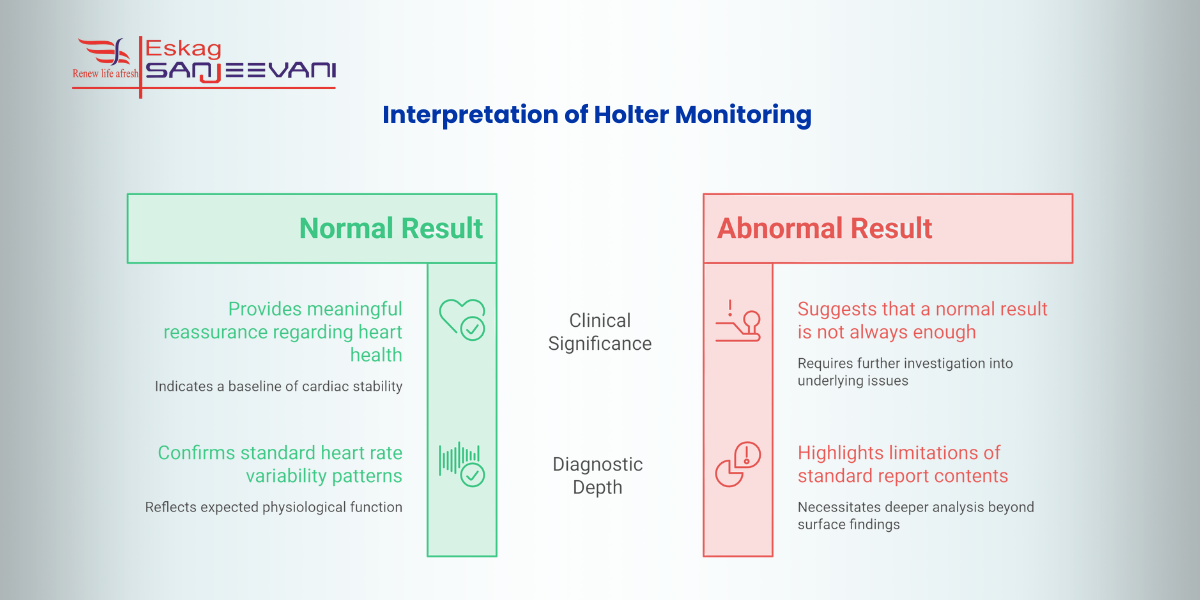
- Normal Result Is Meaningful: No significant arrhythmia detected, and symptoms not corresponding to an abnormal rhythm narrow the differential diagnosis, it directs the next investigation rather than ending the clinical pathway.
- Normal Result Is Not Always Enough: Only 35% of significant arrhythmias were detected within the first 24 hours in a European Heart Journal study, meaning 65% were missed by standard Holter duration. Extended patch monitors of 7-14 days are the appropriate next step for persistent unexplained symptoms.
Final Thoughts
A Holter monitor test is one of the most clinically useful cardiac investigations available, not because it is complex, but because it captures what a brief ECG cannot. If you have been referred for one, maintain your activity diary carefully; the correlation between your logged symptoms and the recorded rhythm is where most of the diagnostic value actually lives. Ask your cardiologist specifically whether a 24-hour window is sufficient for your symptom frequency, or whether extended monitoring is clinically warranted. If your result comes back normal but symptoms persist, a normal Holter does not close the investigation; it redirects it toward extended ambulatory monitoring. At Eskag Sanjeevani hospitals, where Holter monitoring includes cardiologist-interpreted reports and structured follow-up, the result you receive is a clinical starting point.

Microbiologist with over 2 years of experience in medical writing, specialising in evidence-based healthcare content.

Clinical experience in diagnosis, treatment, and evidence-based patient care across a range of conditions.
References
- Rao MS, Mullasari A, Hiremath JS, Sengottuvelu G, Jaiswal A, Jhala D, Makkar JS, Kalmath BC, Benjamin B, Dharmadhikari A, Tanna M, Khan A, Jain S, Sambasivam KA, Purnanand A, Raju NSR, Sarkar G, Prajapati H, Verberk WJ. Prevalence of atrial fibrillation on a 24-hour Holter in adult Indians. Indian Heart J. 2024 May-Jun;76(3):218-220. doi: 10.1016/j.ihj.2024.06.012. Epub 2024 Jun 14. PMID: 38878964; PMCID: PMC11328999.
- K MT, Dhar M, Bisht K, Kumar B. 24-Hour Holter Monitoring for Identification of Arrhythmias in Elderly Heart Failure Patients: A Single-Centre Study. Cureus. 2022 Nov 30;14(11):e32054. doi: 10.7759/cureus.32054. PMID: 36600840; PMCID: PMC9802010.
A Holter monitor records heart activity continuously for 24-48 hours during daily life; a standard ECG captures only a few seconds in a clinical setting. Intermittent arrhythmias that occur unpredictably are simply missed by ECG but captured by Holter monitoring.
Holter monitoring is recommended when palpitations, unexplained dizziness, syncope, or chest discomfort have not been explained by a standard ECG. It is also used to monitor treatment effectiveness in patients on antiarrhythmic medications or with pacemakers.
The test is completely non-invasive and painless; nothing is inserted into the body, and no electrical stimulation is applied to the patient. The only reported risk is mild skin irritation under the adhesive electrode patches, which resolves once electrodes are removed.
A normal result means no significant arrhythmia was detected, and logged symptoms did not correspond to an abnormal rhythm, useful clinical information, not an inconclusive test. It narrows the differential diagnosis and directs the next investigation rather than ending the clinical pathway.
Yes, a 24-hour window misses arrhythmias that do not occur during that specific period. A European Heart Journal study found only 35% of significant arrhythmias were detected within the first 24 hours. Extended patch monitoring for 7-14 days is the appropriate next step when symptoms persist after a normal result.