

 Medically Reviewed
When Antibiotics Fail: India's Drug Resistance Crisis Today
Every year, infections that were once simple to treat are becoming harder to cure. Antibiotics that doctors relied on for decades are losing their power, quietly, steadily, and in ways that most patients never see coming. In India, this problem is growing rapidly. Antibiotics are often taken without proper medical advice, used when they are not needed, or stopped too soon.
Overcrowded healthcare facilities and the use of antibiotics in livestock farming have added to the challenge. What was once seen as a future concern is now a reality. Doctors are finding it harder to treat common infections, patients are taking longer to recover, and treatment options are becoming more limited. Understanding why this is happening and what can be done to slow it down is the first step towards tackling the problem.
Key Takeaways
- Antibiotic resistance in India already contributes to an estimated 2.67 lakh deaths a year, with global projections reaching 10 million by 2050.
- Over-the-counter antibiotic sales without prescriptions, a common practice in India, remain one of the biggest causes of antibiotic resistance.
- Reversing antibiotic resistance is possible through stewardship programmes, regulatory reform, and changes in individual behaviour.
Quick Answer: Antibiotic resistance occurs when bacteria stop responding to medicines, turning once-treatable infections into serious health threats.

The Scale of India’s Antibiotic Resistance Crisis
India is among the countries most affected by antibiotic resistance, and the situation is becoming increasingly serious. With a large population, a high number of infectious diseases, and uneven access to healthcare, antibiotics are often overused or misused. As a result, many bacteria are becoming harder to treat. Experts warn that if this trend continues, common infections that were once easily cured may become much more difficult and sometimes impossible to treat [1].
Drug-resistant infections already claim hundreds of thousands of lives across the world each year. If current trends continue, the death toll could rise sharply over the coming decades, making antibiotic resistance one of the biggest threats to global health. India is among the countries carrying a large share of this burden. Drug-resistant infections are linked to tens of thousands of infant deaths every year, highlighting how deeply the problem affects vulnerable populations [2].
What makes the antibiotic resistance in India so serious is the scale at which drugs are failing. The ICMR’s 2024 AMRSN report found that Gram-negative bacteria accounted for 72% of all bloodstream infections in Indian hospitals. Routine antibiotics, fluoroquinolones, third-generation cephalosporins, and carbapenems are now showing declining effectiveness against some of the country’s most common bacterial infections.
| Antibiotic Class | Common Use | Resistance Concern in India |
| Fluoroquinolones | UTIs, typhoid | High resistance in E. coli and Salmonella |
| Third-gen cephalosporins | Pneumonia, sepsis | Rising failure rates in ICU settings |
| Carbapenems | Last-resort infections | Resistance emerging in Klebsiella |
| Colistin | Last-resort treatment | Use is restricted due to resistance risk |
| Azithromycin | Chest infections, typhoid | Resistance documented in typhoid cases |
The rise of antibiotic resistance in India is not inevitable. But understanding what drives it is the first step towards changing course.
What Is Antibiotic Resistance and How Does It Spread?
Antibiotic resistance develops through a process of natural selection. When bacteria are exposed to an antibiotic, especially at low doses or for short periods, the weakest bacteria die, but the resistant ones survive. These survivors multiply and pass on their resistance traits.
Resistance does not stay in one place. It spreads through three main routes:
- A person who carries resistant bacteria can pass them on through contact, contaminated water, or shared food prepared under poor hygienic conditions.
- Resistant bacteria in hospital settings spread between patients via contaminated surfaces, hands, and medical equipment that has not been properly sterilised.
- Antibiotic residues from pharmaceuticals, agriculture, and livestock enter rivers and groundwater, creating environmental reservoirs of resistant bacteria that reinfect communities.
- Resistant genes can transfer between different bacterial species, meaning resistance in one type of bacteria can jump to another entirely different pathogen in the gut.
- Rural-urban migration in India actively carries resistant bacteria from farming communities, where antibiotic use in livestock is widespread, into densely populated cities.
The fact that India is both a major antibiotic producer and one of the world’s highest antibiotic consumers creates a uniquely high-risk environment for the spread of resistance.
Also read: Critical Care Unit- Expert Life-Saving Hands
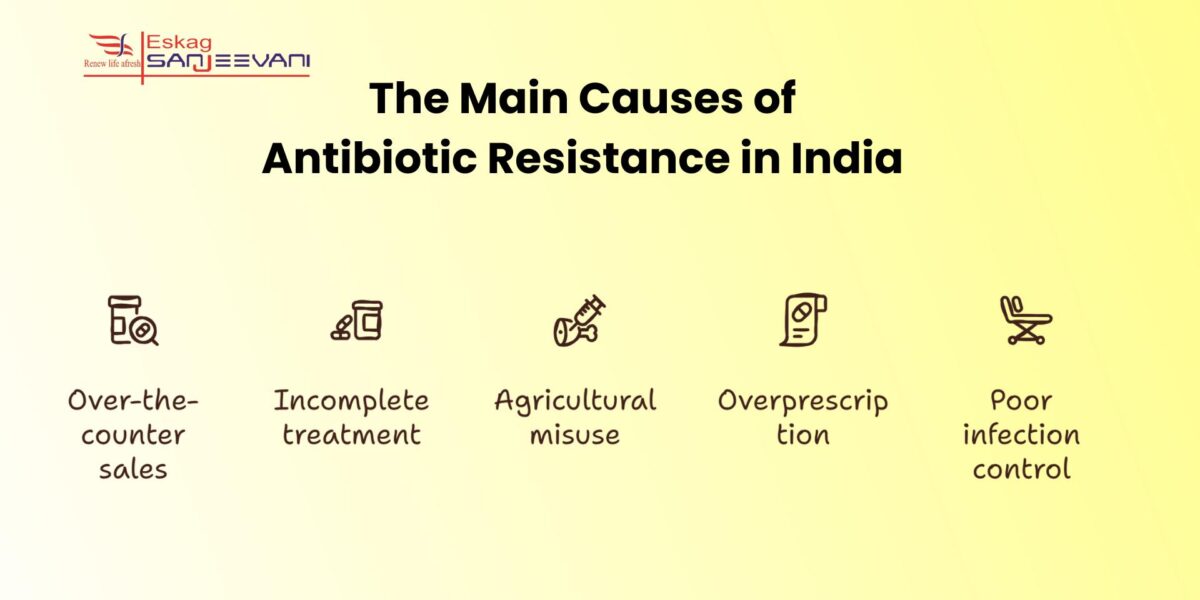
The Main Causes of Antibiotic Resistance in India
Several overlapping factors drive antibiotic resistance in India, many of which are deeply embedded in how healthcare is accessed and delivered across the country.
Over-the-counter antibiotic sales
India’s Schedule H1 regulations require a prescription for antibiotics, but enforcement remains inconsistent. In many pharmacies, especially in smaller towns and villages, antibiotics are sold freely without one. Research published in Cureus confirms that over-the-counter antibiotic sales without prescription remain particularly widespread in rural India, where access to licensed doctors is limited [1].
Incomplete treatment courses
Patients frequently stop their antibiotic course early once symptoms improve. This is one of the most direct causes of antibiotic resistance, as it leaves stronger bacteria alive and able to multiply. Awareness of why the full course of treatment matters remains low, especially in communities where cost is a barrier to completing it.
Antibiotic misuse in agriculture and livestock
India’s poultry and aquaculture industries have historically used antibiotics as growth promoters, not to treat disease, but to accelerate animal weight gain. This practice exposes vast numbers of bacteria to subtherapeutic antibiotic doses, creating ideal conditions for resistance to develop. The Drug Controller General of India banned Colistin as a growth promoter in animal feed following ICMR recommendations, but broader agricultural antibiotic use continues.
Overprescription by healthcare providers
People usually expect medicines that will help them recover quickly, and antibiotics are often seen as the answer. In situations where diagnostic tests are unavailable, delayed, or too costly, antibiotics may be prescribed before the exact cause of an illness is known. This can lead to their use for conditions such as the common cold or flu, even though these illnesses are caused by viruses and do not respond to antibiotics.
Poor hospital infection control
The problem is made worse when resistant bacteria spread within healthcare facilities. Overcrowded wards, poor infection-control practices, and gaps in hygiene can allow these germs to move from one patient to another. As a result, hospital-acquired infections have become a growing concern, especially in intensive care units where patients are already vulnerable.
Why India Bears a Disproportionate Burden
Several challenges within India’s healthcare system have made antibiotic resistance harder to control.
- A large informal healthcare sector allows antibiotics to be prescribed by untrained or unlicensed practitioners, often without proper diagnosis or oversight.
- Diagnostic laboratories capable of antibiotic susceptibility testing are concentrated in urban centres, leaving most patients in rural India treated empirically without culture confirmation.
- India is the world’s largest producer of generic antibiotics and supplies over 60% of global vaccine demand, yet domestic antibiotic consumption remains poorly regulated.
- Poor sanitation, unsafe water, and inadequate waste management increase the spread of infections and resistant bacteria within communities.
- Limited awareness leads many people to self-medicate, use leftover antibiotics, or take antibiotics without proper medical advice.
Recent research notes that India’s unique combination of disease burden, population density, and healthcare diversity places it at a critical juncture in the global fight against AMR [3].
Can You Reverse Antibiotic Resistance? What the Evidence Says
A common question is whether antibiotic resistance can be reversed. The short answer is: in some cases, yes. When antibiotic pressure is reduced significantly, certain bacteria gradually lose their resistance traits over time. This has been observed in past typhoid treatment cycles, where reducing fluoroquinolone use allowed some sensitivity to return.
However, reversal is slow, incomplete, and not guaranteed. The more practical goal is to prevent resistance from advancing further. Researchers and policymakers have identified several approaches to reversing antibiotic resistance or, at a minimum, dramatically slowing its spread.
- A hospital in western Maharashtra that implemented ICMR’s antimicrobial stewardship (AMS) programme from 2021 onwards saw significant reductions in the use of multiple high-risk antibiotics, including ceftriaxone and carbapenems, alongside improved patient outcomes [2].
- The ICMR has expanded its AMS programme to 20 tertiary care hospitals across India, aiming to monitor and reduce antibiotic misuse in the most high-risk clinical settings.
- The Drug Controller General of India has banned 40 inappropriate fixed-dose combination antibiotics on ICMR’s recommendation [4].
- India’s National Action Plan on AMR (NAP-AMR) Phase 2.0, covering 2025 to 2029, continues to expand surveillance, regulate prescribing, and promote a One Health approach linking human, animal, and environmental antibiotic management [5].
These policy steps show what is possible at scale, but systemic change only works when individual behaviour follows.
What You Can Do to Help Fight Antibiotic Resistance
Addressing the antibiotic resistance crisis is not solely the job of governments and hospitals. Individual behaviour is one of the most powerful levers available, especially in India, where self-medication is commonplace.
- Never purchase antibiotics from a pharmacy without a valid prescription, even if a pharmacist suggests one for minor symptoms.
- Always complete the full course of antibiotics prescribed by your doctor, even if you feel better before the medicine runs out.
- Do not share antibiotics with family members or save leftover tablets from a previous course for future use.
- Speak to your doctor if you are prescribed antibiotics for a cough, cold, or viral fever. These are viral infections that do not respond to antibiotics.
- Practise thorough handwashing with soap and water, especially before meals and after using the toilet, to reduce the spread of resistant bacteria in the community.

Microbiologist with over 2 years of experience in medical writing, specialising in evidence-based healthcare content.

Clinical experience in diagnosis, treatment, and evidence-based patient care across a range of conditions.
References
- Sharma, Abhishek, et al. “The Challenge of Antimicrobial Resistance in the Indian Healthcare System.” Cureus, vol. 15, no. 7, 21 July 2023,
- “The Challenge of Antimicrobial Resistance in the Indian Healthcare System.” Cureus, vol. 15, no. 7, 21 July 2023,
- Dixit, Avika, et al. “Antimicrobial Resistance: Progress in the Decade Since Emergence of New Delhi Metallo-β-Lactamase in India.” Indian Journal of Community Medicine: Official Publication of Indian Association of Preventive & Social Medicine, vol. 44, no. 1, 2019, pp. 4–8,
- Vijay, Sonam, et al. “Hospital-Based Antimicrobial Stewardship, India.” Bulletin of the World Health Organization, vol. 101, no. 1, 1 Jan. 2023, pp. 20–27A, 10.2471/blt.22.288797.
- Antimicrobial resistance in India: Integrating the response into health systems for Universal Health Coverage – ScienceDirect. Available at:
Antibiotic resistance happens when bacteria mutate and stop responding to medicines meant to kill them. This makes infections harder to treat, longer to recover from, and more likely to turn dangerous.
India carries one of the highest antibiotic resistance burdens globally due to factors like over-the-counter antibiotic sales, high antibiotic consumption, limited diagnostic access, and poor sanitation in many regions.
The most common causes include not completing antibiotic courses, self-medicating without a doctor’s advice, using antibiotics for viral infections like colds, and consuming food from animals given antibiotic growth promoters.
Complete reversal is rare, but reducing antibiotic use can restore some bacterial sensitivity over time. Evidence from Indian hospital stewardship programmes shows that rational prescribing measurably lowers resistance rates within months.
No. Stopping early leaves the strongest, most resistant bacteria alive to multiply. Always complete the full course as prescribed, even if symptoms improve well before the medicine finishes.