

 Medically Reviewed
Epidural Injection for Back Pain: How It Helps
Chronic back pain can negatively impact a person’s quality of life, making it difficult to move, sleep, and participate in daily activities, and for many Indian patients, oral medications and physiotherapy still leave underlying nerve root inflammation untreated. An epidural injection for back pain targets the inflammation directly, delivering a corticosteroid into the epidural space around the irritated nerve root. It is a non-surgical, minimally invasive daycare procedure, with no hospitalisation and no surgical recovery. The evidence is honest: modest short-term pain reduction that works best combined with active rehabilitation.
In this blog, we cover what an epidural injection for back pain is, the three approaches, the evidence, side effects, and when it is not the right choice.
Key Takeaways:
- Epidural steroid injections target nerve root inflammation directly, not the same as an obstetric epidural used during childbirth.
- The AAN 2025 systematic review of 90 RCTs found 24% more radiculopathy patients reported reduced pain at 3 months with ESI.
- A maximum of three ESIs per year is the accepted guideline; the relief window must be used for active physiotherapy.
Quick Answer: An epidural injection for back pain delivers corticosteroid directly into the epidural space to reduce nerve root inflammation, effective for radiculopathy and spinal stenosis at 3 months, performed under fluoroscopy as a daycare procedure.
Quick Links
What Is an Epidural Injection for Back Pain?
An epidural injection for back pain delivers corticosteroid medication directly into the epidural space, targeting inflammation at the specific nerve root causing your pain, rather than masking symptoms through oral medication.
- The epidural space is the area between the bones and discs of the spine that surrounds the spinal nerves. It is the space into which disc tissue herniates, causing nerve root inflammation. Delivering medication directly here targets the source of pain, not the downstream symptom.
- Corticosteroids inhibit the inflammatory cascade, reducing prostaglandin and leukotriene production at the nerve root. A local anaesthetic is combined to reduce perineural oedema and provide immediate pain relief while the steroid takes effect over 2-7 days.
- ESI is used for herniated disc, lumbar or cervical radiculopathy, spinal stenosis, and sciatica, all conditions where nerve root compression or irritation, not muscle strain, is driving the pain.
- ESI targets a specific nerve root for anti-inflammatory pain management; an obstetric epidural broadly blocks sensory and motor function for procedural anaesthesia. The two share a name and a space but serve entirely different clinical purposes.
- Low back pain affects 570 million people globally and is among the leading causes of disability in India, a figure confirmed by a 2024 systematic review of the global burden of musculoskeletal disorders. ESI is a frontline non-surgical intervention at most orthopaedic and pain management centres across Kolkata and India.
Three Types of Epidural Injections: Which Approach Does Your Doctor Use?
Not all epidural injections for back pain are delivered the same way; the three primary approaches differ in needle entry point, targeted structures, and which clinical presentations each is best suited for.
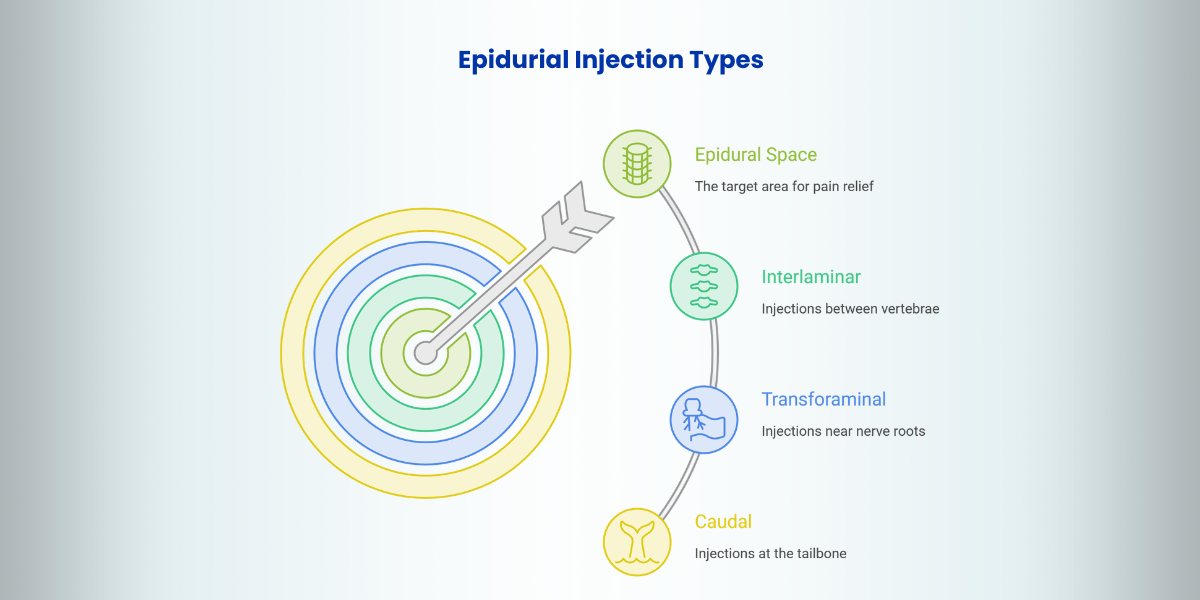
- Interlaminar: The needle enters between two adjacent vertebral laminae from the back of the spine, delivering medication to a broad dorsal epidural area. Best for central or multilevel lumbar pathology, bilateral lower back pain, and spinal stenosis affecting multiple levels.
- Transforaminal: The needle enters through the intervertebral foramen, placing medication directly adjacent to the targeted nerve root. The most precise approach is preferred for unilateral radiculopathy, focal disc herniation, and foraminal stenosis, where a single nerve root is the pain generator.
- Caudal: The needle enters through the sacral hiatus at the base of the spine, reaching the lower lumbar epidural space from below. Used for diffuse lower back pain, post-surgical scar tissue, and when interlaminar or transforaminal anatomy is too difficult to access.
- Fluoroscopy is non-negotiable: All three approaches require real-time X-ray guidance as the standard of care, and contrast dye confirms correct needle placement before the steroid is injected. ESIs performed without imaging guidance are associated with higher rates of incorrect needle placement.
In an Indian study from R.L. Jalappa Hospital, Karnataka, comparing transforaminal vs caudal ESI in 60 patients with lumbar radiculopathy, both approaches produced significant pain reduction at 6 months [1]. The approach your doctor selects is based on your MRI findings, symptom pattern, and spinal anatomy.
Does an Epidural Injection for Back Pain Actually Work?
The AAN 2025 systematic review of 90 randomised controlled trials found that ESIs probably reduce short-term pain in cervical and lumbar radiculopathies — with 24% more patients reporting reduced pain and 16% more reporting reduced disability at 3 months compared to those not receiving treatment. The number needed to treat was 4, meaning one in every four patients treated experienced meaningful benefit.
For Spinal Stenosis
For lumbar spinal stenosis, the evidence is weaker; ESIs possibly reduce short-term disability at 3 months and long-term disability at 6 months, but the review found no evidence of short-term pain reduction for stenosis. The benefit is in functional improvement, not necessarily pain score reduction, a clinically important distinction when setting patient expectations.
What ESI Does Not Do
ESI does not repair a herniated disc, widen a stenotic canal, or address the structural cause of nerve compression. The majority of studies report impressive short-term results within 4-12 weeks, but conflicting evidence exists regarding long-term effects, with some studies reporting reduced effectiveness over time and the need for repeated injections. ESI is a bridge to rehabilitation, not a permanent solution.
Indian Evidence
An Indian prospective study of 50 patients with lumbar disc herniation found mean VAS pain scores fell from 7.14 at baseline to 2.54 at 6 months with ESI, a clinically significant reduction. Functional outcome scores improved substantially across the cohort, supporting ESI as an effective non-surgical option in the Indian clinical context [2].
How to Use the Pain Relief Window
The temporary pain relief ESI provides is most clinically valuable when it enables active participation in physiotherapy; patients who use the pain-free period for structured rehabilitation consistently achieve better long-term outcomes than those who wait passively for the next injection. An ESI without a concurrent physiotherapy plan is a missed clinical opportunity.
Epidural Injection Side Effects: What Is Common and What Is Rare
Most patients who receive an epidural injection for back pain experience only minor, self-resolving side effects — but understanding the full spectrum from common to rare helps you recognise what is normal and what requires immediate medical attention.
- Steroid flare: A temporary increase in pain intensity occurs in the first 24-48 hours after injection, caused by the crystalline corticosteroid briefly irritating epidural tissue before the anti-inflammatory effect begins. Facial flushing occurs in under 5% of patients and resolves within 3 days. Both are benign and do not indicate procedure failure.
- Common self-resolving effects include temporary soreness at the injection site, insomnia for a few days from the steroid medication, and transient limb numbness that resolves within hours. These require no treatment.
- Blood glucose in diabetic patients: Corticosteroids can cause a transient elevation in blood glucose for 24-72 hours post-injection; patients must monitor blood glucose closely and may need dose adjustments during this window. This instruction is absent from most Indian pre-procedure counselling despite diabetes being a leading comorbidity in Indian back pain patients.
- Dural puncture: If the needle inadvertently punctures the dural membrane, CSF leakage can cause a severe positional headache, worse on sitting or standing and relieved by lying down. Incidence is approximately 0.8% with lumbar ESI and is treated with a blood patch procedure when conservative management fails.
Final Thoughts
An epidural injection for back pain is a well-evidenced, minimally invasive tool, but its value depends entirely on how the relief window it creates is used. Before agreeing to an ESI, confirm that nerve root involvement is documented on your MRI, that fluoroscopic guidance is standard at the centre, and that structured physiotherapy is part of the plan. If progressive symptoms like worsening leg weakness or bladder control issues are present, surgical evaluation is the correct pathway, not ESI.
At Eskag Sanjeevani, epidural steroid injections are performed under fluoroscopic guidance with pre-procedure MRI review and post-injection physiotherapy coordination.

Microbiologist with over 2 years of experience in medical writing, specialising in evidence-based healthcare content.

Clinical experience in diagnosis, treatment, and evidence-based patient care across a range of conditions.
References
- Noushad Cp N, Seenappa H, Js N, Thampi G. A Comparative Study of Transforaminal Epidural Steroid Injection (TFESI) Versus Caudal Epidural Steroid Injections (CESI) in the Management of Lumbar Radiculopathy. Cureus. 2025 Jun 8;17(6):e85582.
- Armon C, Narayanaswami P, Potrebic S, Gronseth G, Bačkonja MM, Cai VL, Dorman J, Gilligan C, Heller SA, Silsbee HM, Smith DB. Epidural Steroids for Cervical and Lumbar Radicular Pain and Spinal Stenosis Systematic Review Summary: Report of the AAN Guidelines Subcommittee. Neurology. 2025 Mar 11;104(5):e213361.
An epidural injection is the delivery of powerful anti-inflammatory medicine directly into the epidural space, the area outside the sac of fluid around your spinal cord. It is not the same as epidural anaesthesia given before childbirth; the epidural injection used for back pain is focused on reducing nerve root inflammation caused by disc herniation, sciatica, or spinal stenosis.
An epidural steroid injection reduces swelling and pressure on the irritated nerve roots causing your pain, and corticosteroids inhibit the inflammatory mediators released by a herniated disc into the epidural space. Pain relief from a lumbar epidural steroid injection most often lasts three months or more, though duration varies by condition and individual response.
Common epidural injection side effects include temporary injection site soreness, facial flushing, insomnia for a few days, and a short-term increase in pain intensity (steroid flare) in the first 48 hours. Serious epidural injection side effects, infection, epidural haematoma, and dural puncture headache are rare when the procedure is performed under fluoroscopic guidance with sterile technique.
Epidural injection uses in spine care include lumbar and cervical radiculopathy, herniated disc, spinal stenosis, sciatica, degenerative disc disease, and post-surgical pain management. ESI can also serve a diagnostic purpose; relief after injection confirms the epidural space as the pain source and guides further treatment planning.
A maximum of three epidural steroid injections per year is the widely accepted guideline; frequent repetition increases systemic steroid exposure and risks bone density loss and adrenal suppression. The pain-relief window each injection provides should be used for active physiotherapy, not passively waited out until the next injection is due.