ERCP
When your doctor mentions an ERCP test, it is natural to have questions. This procedure is one of the most sophisticated tools in modern gastroenterology. It allows doctors to treat conditions that once required major open surgery through an invasive approach.
At Eskag Sanjeevani, we prioritise your comfort and safety. We ensure that we explain every step of the ERCP procedure so you can approach your treatment with confidence.
What is the ERCP Full Form?
For many patients, the terminology is the first hurdle. The ERCP full form is Endoscopic Retrograde Cholangiopancreatography.
While the name is complex, the goal is simple:
- Endoscopic: The use of a thin flexible tube with a camera (endoscope).
- Retrograde: The direction in which the dye is injected (up into the ducts).
- Cholangio: Referring to the bile ducts.
- Pancreato: Referring to the pancreatic duct.
- Graphy: The specialised X-ray imaging used to see these ducts.
Why is an ERCP Test Recommended?
Unlike a standard endoscopy, which looks at the lining of the stomach, an ERCP allows our specialists at Eskag Sanjeevani to access the small “drainage pipes” of your liver and pancreas.
Our expert gastroenterologists use this procedure for the diagnosis and treatment of:
- Bile Duct Stones: Removing stones that have travelled from the gallbladder.
- Jaundice: Clearing blockages that cause yellowing of the skin and eyes.
- Strictures: Widening of narrowed ducts caused by inflammation or scarring.
- Tumours: Evaluating or bypassing blockages in the bile or pancreatic ducts.
- Pancreatitis: Managing complications related to chronic inflammation of the pancreas.
Understanding the ERCP Procedure
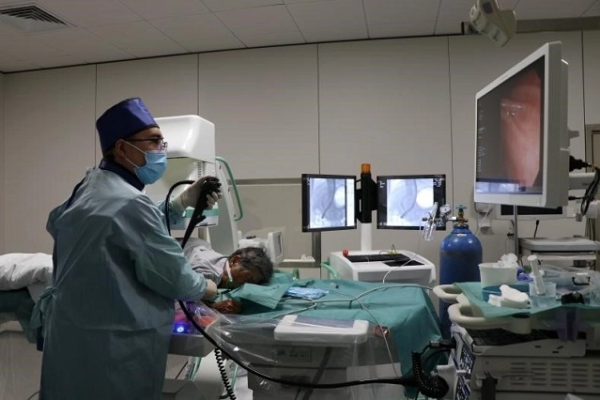
The ERCP procedure at Eskag Sanjeevani is performed in a specialised suite that combines endoscopy with live X-ray (fluoroscopy).
How it Works:
- Sedation: You will receive a sedative or general anaesthesia to make sure you stay asleep and pain-free during the procedure.
- Access: The doctor moves the endoscope through the mouth to the spot where the bile duct opens into the small intestine.
- Visualisation: A small catheter injects a special contrast dye into the ducts, which then appears on X-ray screens.
- Intervention: If a stone or blockage exists, the doctor can use special tools through the endoscope to take out the stone or place an ERCP stent.
The Role of an ERCP Stent
In many cases, a blockage cannot be cleared in one session, or the duct needs support to stay open. An ERCP stent is a small plastic or metal tube placed inside the duct to ensure that bile or pancreatic juices can flow. This relieves symptoms like pain and jaundice.
ERCP Cost in Kolkata and Why Choose Us?
We know that medical expenses are an essential consideration for families. When searching for the ERCP cost in Kolkata, patients often find a wide range of pricing. At Eskag Sanjeevani, we are committed to providing “value-based care.” Our costs are transparent, and we offer a level of technology and expert supervision that ensures the highest success rates, reducing the need for repeat procedures. Please connect with us to know more.
Why Choose Eskag Sanjeevani?
- Top Gastroenterologists: Our team consists of trained interventional endoscopists.
- Modern Imaging: We use high-definition fluoroscopy for pinpoint accuracy.
- Post-Op Monitoring: Dedicated recovery bays with specialised nursing care for post-ERCP observation.
Explore Our ERCP at Eskag Sanjeevani Hospitals Kolkata
Trusted care and convenient access for all your healthcare needs.
Visit us at: www.eskagsanjeevani.com
Call to learn more about our ERCP
Frequently Asked Questions on: ERCP
It is a hybrid. While it is an ERCP test because it uses imaging to diagnose, it is a treatment procedure (a “non-surgical surgery”) because it allows doctors to fix the problem.
An ERCP takes between 30 and 90 minutes, depending on the complexity of the stones or the need for an ERCP stent.
No. Because you are under sedation or anaesthesia, you will not feel any pain during the procedure. You may experience a mild sore throat or bloating for a few hours afterwards.
While safe, the most common complication is “post-ERCP pancreatitis” (pancreas inflammation). At Eskag Sanjeevani, we use preventive measures and medications to reduce this risk to the lowest possible percentage.
You must have an empty stomach (fasting for at least 8 hours). You must also inform our team about any blood-thinning medications you are on.