

 Medically Reviewed
Hernia Surgery Options: What Your Surgeon Must Tell You
Being diagnosed with a hernia can feel alarming, especially when surgery is recommended before you fully understand what the procedure actually involves. Many patients delay treatment out of fear, not realising that a manageable hernia today can become a strangulated emergency requiring urgent intervention without warning. Hernia repair surgery has evolved significantly, with laparoscopic and open approaches delivering comparable long-term outcomes when performed by experienced surgeons using appropriate mesh reinforcement. Choosing the right surgeon, understanding your surgical options, and knowing what recovery realistically entails directly determines whether your repair will hold for life.
In this blog, we’ll cover when surgery becomes necessary, which repair approach suits your hernia, cost factors, recovery protocols, and the questions your surgeon must answer before you consent.
Key Takeaways:
- Hernia repair surgery is necessary when hernias cause symptoms, increase in size, or risk incarceration and strangulation requiring emergency intervention.
- Open, laparoscopic, and robotic approaches deliver comparable recurrence rates below 4%; surgeon experience and hernia complexity determine the appropriate technique.
- Post-operative compliance, including lifting restrictions, constipation prevention, and wound care, directly determines whether the mesh repair holds over the long term.
Quick Answer: Hernia repair surgery removes herniated tissue through open, laparoscopic, or robotic approaches using mesh reinforcement; surgery is advised when hernias cause symptoms, grow progressively, or risk strangulation, cutting off blood supply to trapped tissue.
Quick Links
- What Is a Hernia?
- Hernia Surgery Symptoms: When Should You See a Surgeon?
- When Is Hernia Repair Surgery Necessary?
- Types of Hernia Surgery: Which Option Is Right for You?
- Hernia Surgery Cost: What Influences the Final Expense?
- Post Hernia Surgery Care: Recovery Tips That Matter
- Why Choose Eskag Sanjeevani for Hernia Surgery?
What Is a Hernia?
A hernia develops when an internal organ or fatty tissue pushes through a weak spot in the muscle or connective tissue that normally contains it. Most hernias occur in the abdominal wall and may appear as a bulge that becomes more noticeable during coughing, lifting, bending, or straining. Common types include inguinal, femoral, umbilical, incisional, and hiatal hernias. While some hernias cause only mild discomfort at first, they usually do not resolve without treatment and may increase in size over time. Inguinal hernias account for more than 75% of all abdominal wall hernias and remain the most common form worldwide [1].
Hernia Surgery Symptoms: When Should You See a Surgeon?
While not every hernia requires immediate hernia repair surgery, certain symptoms suggest that surgical evaluation should not be delayed.
Here are some of the symptoms that you must know:
- Growing Bulge: A lump in the groin, abdomen, or near a previous surgical scar that becomes more prominent during standing, coughing, or lifting may indicate a progressing hernia.
- Activity-Related Pain: Pain that worsens with exercise, bending, coughing, or lifting often suggests that the hernia is placing greater strain on surrounding tissues.
- Persistent Pressure: Many patients report a dragging sensation in the abdomen or groin that worsens after prolonged standing or during daily activities.
- Non-Reducible Hernia: A bulge that remains trapped outside the abdominal wall may indicate incarceration and requires prompt surgical assessment.
- Emergency Symptoms: Severe pain, nausea, vomiting, or skin colour changes may signal a strangulated hernia, a medical emergency that requires immediate treatment.
Suggested read: Common Procedures That Are Now Performed as Day-Care.
When Is Hernia Repair Surgery Necessary?
Hernia repair surgery is usually advised when a hernia causes symptoms, increases in size, or carries a risk of trapped tissue or reduced blood supply.
- Pain or Discomfort: Surgery may be needed when pain affects walking, work, exercise, coughing, or routine movement.
- Growing Hernia: A hernia that becomes larger over time is less likely to remain manageable with observation alone.
- Trapped Hernia: If the bulge cannot be pushed back, it may indicate incarceration and needs urgent surgical review.
- Strangulation Risk: Sudden pain, vomiting, fever, or a change in skin colour may signal reduced blood supply and require emergency care.
- Limited Daily Life: Surgery becomes more relevant when the hernia restricts activity, sleep, travel, or physical work.
Understanding when surgery is necessary sets the stage for choosing which hernia repair approach best suits your specific clinical situation.
Types of Hernia Surgery: Which Option Is Right for You?
The right hernia repair surgery depends on hernia type, size, location, patient fitness, surgeon expertise, and whether the procedure is elective or emergency, with all three main approaches delivering comparable long-term recurrence rates below 4% [2].
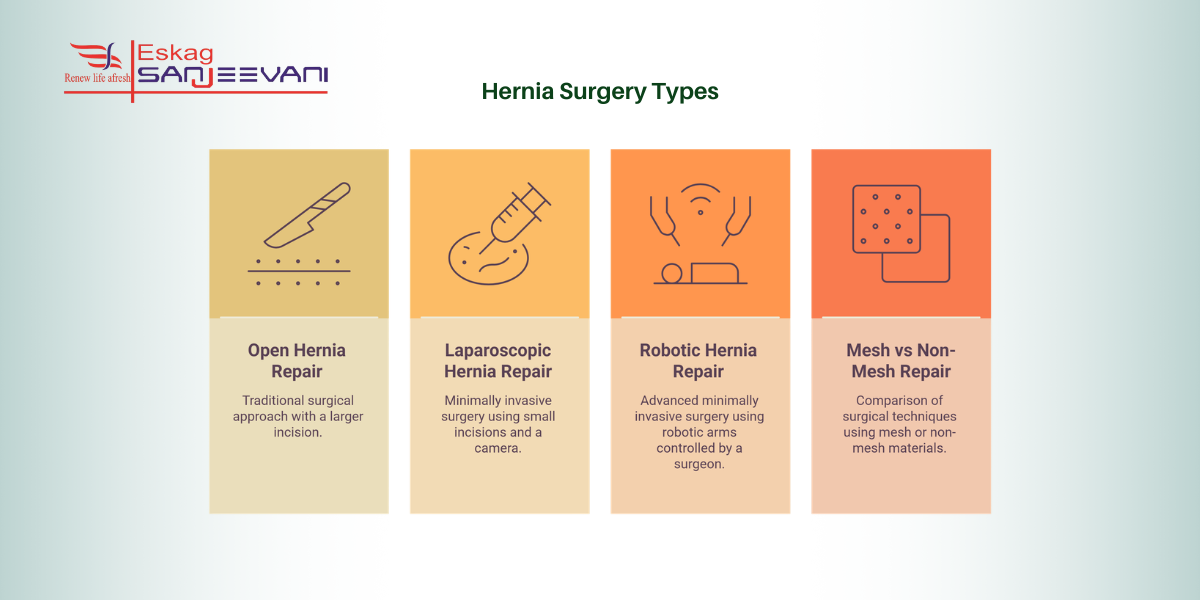
1. Open Hernia Repair
Open hernia repair involves a single incision directly over the hernia site, allowing the surgeon to push tissue back and reinforce the wall with mesh or sutures. It remains the standard approach for large, recurrent, or complicated hernias where direct visualisation improves surgical control. Patients with significant comorbidities, including heart disease and chronic lung conditions, are more commonly treated through open repair due to lower anaesthetic demand and surgical simplicity.
2. Laparoscopic Hernia Repair
Laparoscopic repair uses three to four small incisions through which a camera and instruments access the hernia internally from behind the abdominal wall. European Hernia Society guidelines specifically recommend laparoscopic repair for improved postoperative pain outcomes compared with open surgery, particularly for bilateral and recurrent inguinal hernias. Patients return to normal activities faster than with open surgery, making laparoscopic repair the preferred choice for working-age patients requiring minimal downtime.
3. Robotic Hernia Repair
Robotic-assisted repair offers magnified three-dimensional visualisation and seven degrees of instrument freedom, improving precision in complex anatomical dissections. Outcomes including complication rates below 1% and readmission rates below 2% are statistically equivalent across open, laparoscopic, and robotic approaches [3]. However, robotic repair carries longer operative time and higher procedural costs, making it most appropriate for complex ventral hernias requiring precise fascial reconstruction rather than straightforward inguinal cases.
4. Mesh vs Non-Mesh Repair
Mesh reinforcement significantly reduces recurrence rates across all surgical approaches compared to suture-only primary repair. Non-mesh repair is reserved for specific situations including contaminated surgical fields, paediatric cases, or small umbilical hernias where tissue quality supports primary closure without synthetic reinforcement. Patients should ask their surgeon specifically whether mesh is planned and which type of mesh will be used, as the choice of material affects long-term outcomes and the risk of chronic pain.
Beyond choosing the right surgical approach, understanding what drives hernia surgery cost helps you plan confidently without financial surprises.
Hernia Surgery Cost: What Influences the Final Expense?
Hernia repair surgery cost in India varies significantly based on surgical approach, hernia complexity, surgeon experience, facility standards, and mesh type, making direct cost comparisons between facilities meaningless without understanding what each quote actually includes.
| Cost Factor | Lower Cost | Approximate Range |
| Open Repair | Government hospital | ₹18,000-₹50,000 |
| Laparoscopic Repair | Standard private facility | ₹40,000-₹1,50,000 |
| Robotic Repair | Not widely available | ₹1,00,000-₹2,60,000+ |
| Mesh Type | Basic polypropylene | ₹5,000-₹25,000 additional |
| Pre-operative Tests | Basic blood tests, ultrasound | ₹2,000-₹8,000 |
West Bengal residents holding a Swasthya Sathi Card can avail cashless hernia repair surgery up to ₹5 lakh per family annually at empanelled hospitals across the state, eliminating out-of-pocket expenses.
Post Hernia Surgery Care: Recovery Tips That Matter
Post-hernia surgery care directly determines whether the repair holds long-term, with patient compliance during the 4-6 week healing window significantly reducing the risk of recurrence, wound complications, and chronic pain development.
- Wound Care: Keep the incision clean and dry; showering is permitted 36 hours post-surgery. Do not pick at skin glue or Steri-Strips, as they will flake off naturally within 10-14 days. Report increasing redness, swelling, discharge, or fever above 38°C immediately.
- Activity Restrictions: Avoid lifting objects heavier than 5-7 kg for at least two weeks following hernia repair surgery. Short 5-10-minute walks multiple times daily prevent blood clots without straining the repair. Return to desk work within 1-2 weeks; manual labour requires a minimum of 4-6 weeks.
- Constipation Prevention: Straining during bowel movements directly increases pressure on the mesh repair and increases the risk of early recurrence. Consume high-fibre foods and maintain a daily fluid intake of 2-3 litres from day two onward. Use stool softeners during the first week as directed by your surgeon.
- Nutrition: Prioritise protein-rich foods including fish, eggs, paneer, and dal to support wound healing. Avoid alcohol, excessive caffeine, and ultra-processed foods as these increase inflammation and slow recovery.
- Warning Signs: Sudden worsening pain, fever, nausea, new bulge, or increasing scrotal swelling after inguinal hernia repair requires immediate surgical review. Attend all follow-up appointments at 7-14 days and 6 weeks post-surgery regardless of recovery appearance.
Also read: Why Laparoscopic Surgery is the Standard of Care in 2026?
Why Choose Eskag Sanjeevani for Hernia Surgery?
Eskag Sanjeevani’s General Surgery department performs evidence-based hernia repair across the Baghbazar, Baranagar, and Khardah hospitals, combining laparoscopic surgical expertise with modular laminar-flow operation theatres equipped with laparoscopic towers and advanced anaesthesia workstations, ensuring the highest infection-control standards. The surgical team includes specialists holding MS, DNB, FMAS, FIAGES, and FALS qualifications with individual experience ranging from 4 to 37 years, covering straightforward inguinal repairs through complex incisional and recurrent hernias requiring advanced mesh reconstruction. Pre-operative planning utilises integrated 128-Slice CT scan, 1.5 Tesla MRI, and ultrasonography for detailed abdominal wall mapping before every procedure.
Final Thoughts
A hernia that causes symptoms will not resolve without hernia repair surgery; delaying consultation allows the defect to enlarge and increases the risk of strangulation, requiring emergency intervention. Schedule a surgical evaluation promptly if you notice a persistent bulge, activity-related pain, or a non-reducible lump that cannot be pushed back manually. Ask your surgeon specifically which technique they recommend, their personal case volume for that approach, and whether mesh is planned. Follow post-operative instructions precisely during the 4-6-week healing window, as this period determines the durability of long-term repair more than the surgery itself. Facilities like Eskag Sanjeevani offer experienced general surgeons with laparoscopic capabilities, advanced imaging, and cashless Swasthya Sathi coverage across multiple hospitals in Kolkata.

Microbiologist with over 2 years of experience in medical writing, specialising in evidence-based healthcare content.

Clinical experience in diagnosis, treatment, and evidence-based patient care across a range of conditions.
References
- Abebe MS, Tareke AA, Alem A, Debebe W, Beyene A. Worldwide magnitude of inguinal hernia: Systematic review and meta-analysis of population-based studies. SAGE Open Med. 2022 Nov 22;10:20503121221139150. doi: 10.1177/20503121221139150. PMID: 36457844; PMCID: PMC9706054.
- Lorenz WR, Holland AM, Adams AS, Mead BS, Scarola GT, Kercher KW, Augenstein VA, Heniford BT. Open versus laparoscopic versus robotic inguinal hernia repair: A propensity-matched outcome analysis. Surgery. 2025 Mar;179:108895. doi: 10.1016/j.surg.2024.08.054. Epub 2024 Oct 28. PMID: 39472265.
- Solaini L, Cavaliere D, Avanzolini A, Rocco G, Ercolani G. Robotic versus laparoscopic inguinal hernia repair: an updated systematic review and meta-analysis. J Robot Surg. 2022 Aug;16(4):775-781. doi: 10.1007/s11701-021-01312-6. Epub 2021 Oct 5. PMID: 34609697; PMCID: PMC9314304.
Laparoscopic repair takes 45-90 minutes; open repair takes 30-75 minutes, depending on hernia complexity. Most repairs use general anaesthesia, though spinal or local anaesthesia with sedation is occasionally used for straightforward inguinal cases.
Long-term recurrence rates remain below 4% with mesh repair across all three surgical approaches. Recurrence risk increases with obesity, smoking, chronic coughing, and lifting during the 4-6 week healing window before mesh fully integrates.
Elective hernia repair carries low mortality risk; emergency strangulation surgery in elderly patients carries significantly higher complication rates. Laparoscopic repair reduces exposure to general anaesthesia, making it preferable for patients with cardiac or pulmonary comorbidities.
Desk workers return within 1-2 weeks after laparoscopic repair; manual labourers require 4-6 weeks minimum. Core exercise, heavy lifting, and strenuous activity require specific surgical clearance at the 6-week follow-up appointment.
Untreated hernias rarely resolve and typically enlarge progressively without intervention. The primary risk is strangulation, where trapped tissue loses blood supply, requiring emergency surgery carrying significantly higher complication rates than planned elective repair.