

 Medically Reviewed
Heart Failure Isn’t a Heart Attack: Know the Difference
A heart attack develops when a blockage in a coronary artery interrupts the heart’s blood supply. And without proper treatment, it can be incurable [1]. In India, cardiovascular disease accounts for 45% of all deaths in the 40–69 age group. Yet, most people cannot tell the difference between a heart attack and heart failure, or either from cardiac arrest [5]. The three are routinely used as if they mean the same thing. They do not. Each is a distinct medical event with different causes, warning signs, and treatments. Confusing them can cost critical time. A multi-centre Indian registry found that among young patients with coronary artery disease, nearly half had diabetes and almost as many had hypertension, conditions that silently drive both conditions [4]. Knowing the difference is the first step to acting on time.
Key Takeaways
- A heart attack is usually caused by a blocked blood vessel in the heart. Heart failure means the heart is still beating but cannot pump enough blood to the rest of the body.
- Cardiac arrest ṭākes place when the heart suddenly stops beating. It is a medical emergency that must be treated and needs immediate CPR.
- In India, hypertension, diabetes, tobacco use, and obesity are the four most prevalent risk factors driving both conditions in younger adults.
Quick Answer: A heart attack suddenly blocks blood flow to the heart; heart failure means the heart starts to lose its ability to pump blood properly.
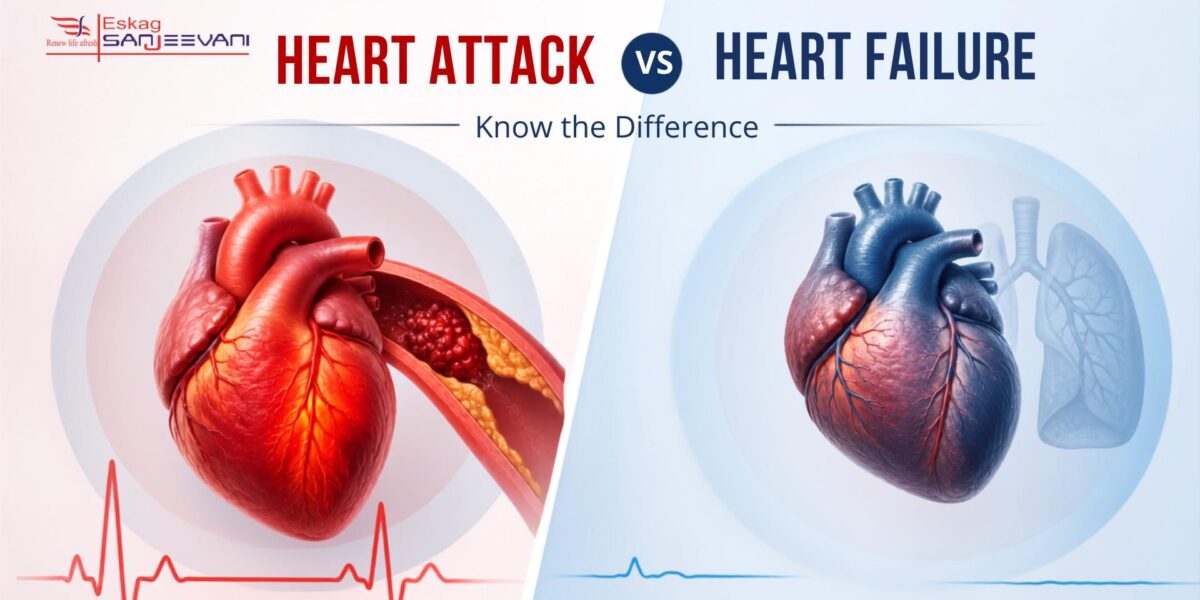
What Is a Heart Attack?
A heart attack, known as a myocardial infarction in medical terms, happens when a blood vessel in the heart gets blocked [1]. Think of it as a plumbing crisis: the pipes supplying the heart get cut off.
In most cases, a heart attack is caused by fatty deposits that slowly build up inside the arteries supplying the heart. When a plaque ruptures, it triggers a blood clot that blocks the artery. Less commonly, a sudden tightening of the artery wall, a coronary spasm, or a tear inside the artery (spontaneous coronary artery dissection) can also cause a heart attack [1].
The critical point: the heart is still beating. The heart needs a proper flow of blood to keep working. If the blockage is not cleared quickly, the heart can be damaged.
What Is Heart Failure?
Heart failure does not mean the heart has stopped. It means the heart muscle has become too weak or too stiff to pump enough blood to meet the body’s needs [2].
Think of it as a mechanical problem: the pump itself is failing, not the pipes. Unlike a heart attack, heart failure develops gradually, over months or years [3].
There are two main types:
- Systolic heart failure (HFrEF): The heart muscle is too weak to squeeze properly and pump blood out.
- Diastolic heart failure (HFpEF): The heart is too stiff to fill properly before the next beat.
In the early stages, there may be no symptoms at all. When symptoms do appear, they worsen progressively as the heart grows weaker. With the right treatment, medications, lifestyle changes, and, in some cases, surgery, symptoms can improve significantly, and pumping function can be partially restored.
Also read: Heart Attack in Youth: Why Young Indians Are Getting It at 35
Heart Attack vs Heart Failure vs Cardiac Arrest
This three-way confusion is one of the biggest content gaps in public health education in India. Here is a clear comparison:
| Heart Attack | Heart Failure | Cardiac Arrest | |
| What it is | Sudden blockage of blood supply to the heart | Heart cannot pump enough blood | Heart stops beating entirely |
| Onset | Sudden | Gradual (chronic) | Sudden |
| Is the heart still beating? | Yes | Yes | No |
| Type of problem | Circulation (plumbing) | Mechanical (pump) | Electrical |
| First response | Call emergency services immediately | See a cardiologist promptly | CPR and AED immediately |
Cardiac arrest is a purely electrical problem; a disruption of the heart’s rhythm causes it to stop beating. A heart attack and cardiac arrest are not the same. Most heart attacks do not stop the heart, but some can.
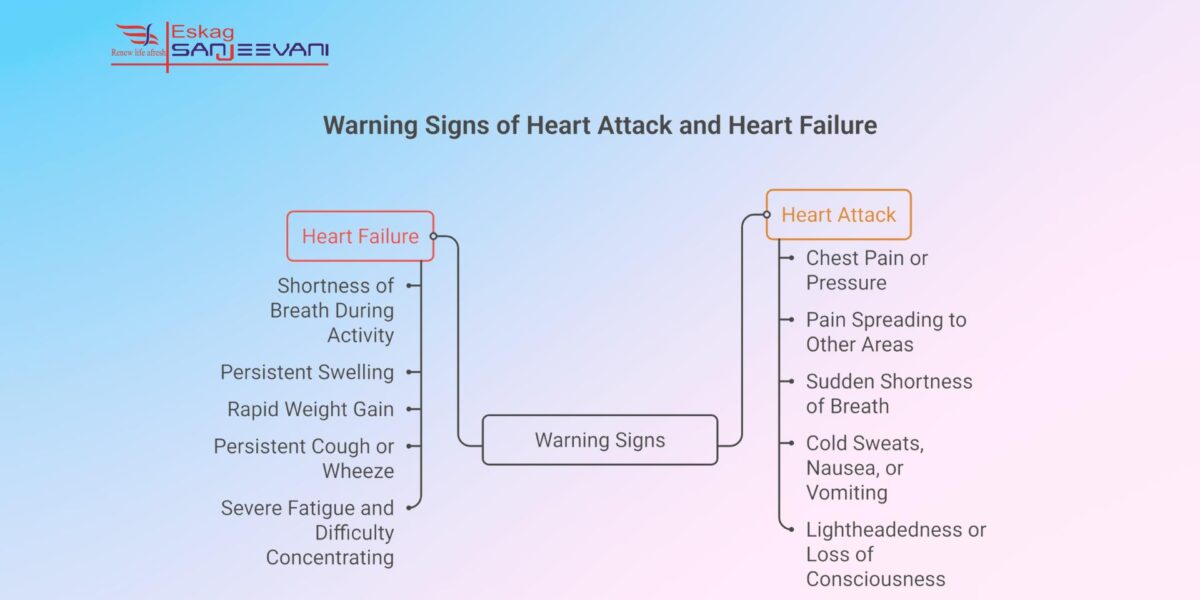
Warning Signs of a Heart Attack
The signs of a heart attack vary from person to person. Common warning signs include:
- Chest pain or pressure, described as squeezing, tightness, or a heavy weight, is the most common sign of a heart attack
- Pain that spreads to the jaw, neck, arms, upper back, or stomach, often dismissed as muscle pain or acidity
- Sudden shortness of breath, even without physical exertion or any strenuous activity
- Cold sweats, nausea, or vomiting; these symptoms are especially common in women and in people with diabetes
- Lightheadedness or sudden loss of consciousness, a sign that the heart is no longer pumping adequately
One important note for Indian readers: people with diabetes are more likely to experience a silent heart attack, one with no chest pain at all. Unusual fatigue, mild indigestion, or brief neck discomfort may be the only warning. Do not dismiss these.
Warning Signs of Heart Failure
Heart failure symptoms tend to build slowly, which is exactly why they get ignored:
- Shortness of breath during routine activity, climbing stairs, walking short distances, or when lying flat at night
- Persistent swelling in the legs, ankles, and feet caused by fluid retention in the body
- Rapid, unexplained weight gain over just a few days as fluid accumulates in the body
- A persistent cough or wheeze, sometimes producing white or pink mucus, that does not go away
- Severe fatigue and difficulty concentrating; even mild tasks feel exhausting for the person
If you or a family member has been noticing ankle swelling or worsening breathlessness and attributing it to old age or weakness, please do not wait.
What Causes Each Condition?
Both conditions share the same root triggers, but the path from risk factor to diagnosis differs.
| Shared risk factors | More specific to heart attack | More specific to heart failure |
| Coronary artery disease | Plaque rupture and clot formation | Scar tissue from a prior heart attack |
| High blood pressure | Coronary artery spasm | Heart valve disease |
| Diabetes | Spontaneous coronary artery dissection | Irregular heart rhythms (arrhythmias) |
| Obesity | Sedentary lifestyle and high cholesterol | Viral infections and myocarditis |
| Tobacco use | Family history of early heart disease | Sleep apnea |
In a large multi-centre Indian registry of 997 premature coronary artery disease patients across 22 centres, the leading risk factors were hypertension (49%), diabetes (44%), tobacco use (39%), and obesity or overweight (56%) [4]. Nearly half also had a family history of premature heart disease. These are not abstract statistics; they reflect the real profile of cardiac patients walking into hospitals like Eskag Sanjeevani in Kolkata every week.
How to Avoid a Heart Attack and Reduce Heart Failure Risk
Prevention for both conditions overlaps almost entirely:
- Keep your blood pressure and blood sugar under control by getting them checked regularly.
- If you smoke or use tobacco, try to quit. It can slowly damage your heart and blood vessels.
- Follow a heart-healthy diet. Eat more fruits, vegetables, whole grains, and healthy fats. Cut down on salty, oily, and packaged foods.
- Stay active every day. Even a 30-minute walk can help keep your heart healthy.
- Ask if heart disease runs in your family. If it does, talk to your doctor about getting checked earlier.
The CADY registry also found that psychosocial stress was a significant factor in over half of premature CAD patients in India. Managing chronic stress is not optional; it is cardiac care.
When Should You See a Cardiologist?
Do not wait for a dramatic chest-clutching moment. See a cardiologist promptly if you notice any of the following:
- Chest discomfort or pressure that comes and goes, even if mild or brief, and has not been evaluated.
- Ankle or leg swelling that is new, worsening, or does not improve after a night’s rest.
- Breathlessness that has gradually worsened over weeks, especially at rest or when lying flat.
- Rapid or irregular heartbeat with accompanying dizziness, fatigue, or faintness
- Sudden weight gain of several kilograms within a few days with no clear dietary cause.
Recognising these warning signs early is important, but a timely consultation is only the first step. Your cardiologist may recommend a few tests to identify the underlying cause and decide on the most appropriate treatment.
Wrapping Up
A heart attack and heart failure share the same risk factors but demand completely different responses. Heart failure develops silently; a heart attack strikes fast. Understanding the difference between heart attack vs heart failure, and where cardiac arrest fits in, could be what helps you or someone you love act in time.
At Eskag Sanjeevani, our cardiology team, including Dr Avijit Banerjee and Prof. Dr Biswajit Majumder, uses a full range of cardiac diagnostics to assess your heart’s condition. This includes ECG and echocardiogram (ECHO), 24-hour Holter monitoring, and CT coronary angiography — all available under one roof.
If you notice warning signs or have concerns about your heart health, do not delay. Early evaluation can make a significant difference in preventing serious complications.

Microbiologist with over 2 years of experience in medical writing, specialising in evidence-based healthcare content.

Clinical experience in diagnosis, treatment, and evidence-based patient care across a range of conditions.
References
- Mayo Clinic. “Heart Attack.” 2023.
- Mayo Clinic. “Heart Failure.” 2025.
- Staff, Cedars-Sinai. “Heart Attack, Cardiac Arrest, Heart Failure: What’s the Difference?” Cedars-Sinai, 7 Oct. 2025.
- Iyengar SS, Gupta R, Ravi S, Thangam S, Alexander T, Manjunath CN, Keshava R, Patil CB, Sheela A, Sawhney JPS. Premature coronary artery disease in India: coronary artery disease in the young (CADY) registry. Indian Heart J.
A heart attack happens when blood cannot reach part of the heart because an artery gets blocked. Heart failure means the heart is no longer strong enough to pump blood properly. A heart attack comes on suddenly, while heart failure usually gets worse little by little.
Heart failure has no complete cure, but with the right treatment, medications, lifestyle changes, and in some cases surgery or devices, symptoms can improve substantially and pumping function can be partially restored. Some causes, such as an irregular heart rhythm or a faulty valve, may even be correctable.
No. A heart attack is a different problem, a blocked artery. Cardiac arrest is an electrical problem; the heart stops beating entirely. Heart attacks usually do not lead to cardiac arrest, though cardiac arrest can be triggered by a heart attack.
Many people dismiss early signs of a heart attack as acidity, muscle pain, or fatigue. Key signs to watch include recurring chest tightness, pain spreading to the jaw or arm, unusual breathlessness at rest, and cold sweats. In people with diabetes, a heart attack may occur with no chest pain at all.
Both conditions can affect your heart in a big way, but there is a lot you can do to lower the risk. Keep your blood pressure and blood sugar under control, take your medicines on time, eat a heart-healthy diet, stay active, and avoid tobacco. If someone in your family has had heart disease, do not skip regular health check-ups.