

 Medically Reviewed
ICU vs HDU: What's the Difference and When Do You Need Each One?
When a loved one is admitted to a hospital in a critical condition, you may hear the terms ICU and HDU used almost interchangeably, but they are not the same. Both units provide a higher level of care than a general ward, yet they differ significantly in staffing, equipment, and the types of patients they treat. In India, where critical care infrastructure continues to evolve, understanding this distinction matters. A nationwide study of over 14,859 mechanically ventilated patients found that ICU care was associated with a 7.2% lower 30-day mortality rate compared to HDU care [1]. Knowing which unit is appropriate for a patient can directly influence outcomes.
Key Takeaways
- The ICU and HDU are both related to critical care, but the ICU provides higher-level monitoring, specialist staffing, and it supports life.
- ICU admission is connected with better survival results for patients that require artificial ventilation or organ support.
- The choice between ICU and HDU depends on a patient’s severity of illness, the interventions required, and the resources available at the treating facility.
Quick Answer: The ICU offers intensive 24-hour specialist care; the HDU provides an intermediate level between the ICU and general ward.
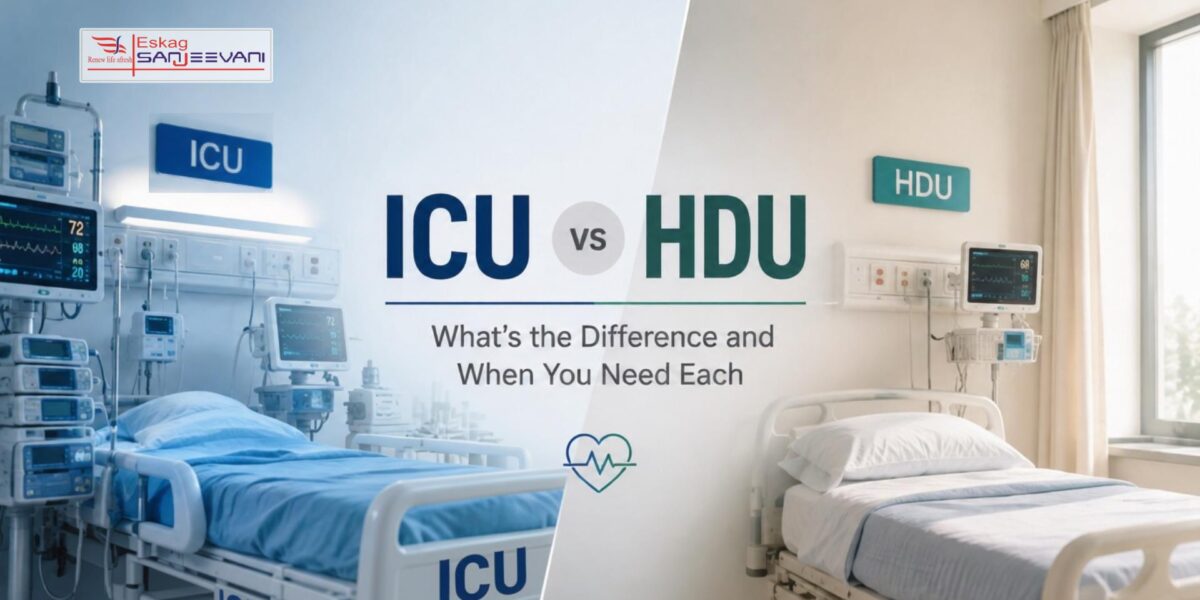
What Is an ICU?
ICU, or the intensive care unit, is the highest level of inpatient care available in a hospital. It is needed for patients with life-threatening conditions and require continuous monitoring and attention.
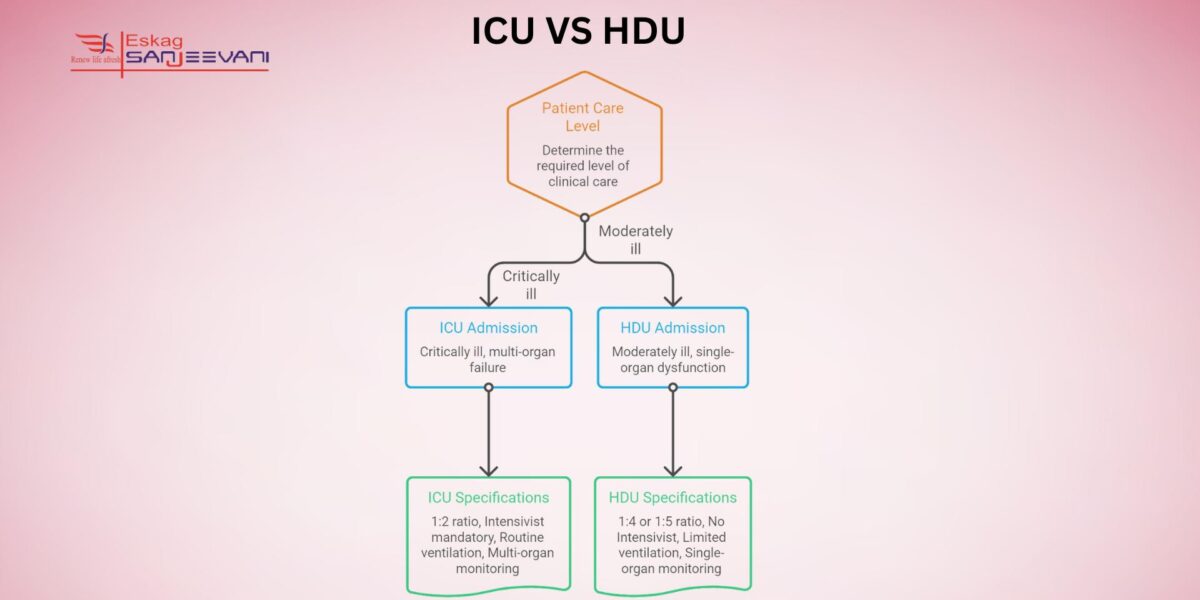
Key features of an ICU include:
- Round-the-clock physician coverage with at least two full-time intensivists managing patient care daily.
- A nurse-to-patient ratio of 1:2, ensuring close observation and rapid response to any changes in condition.
- Advanced life-support equipment, including mechanical ventilators, dialysis machines, and haemodynamic monitoring systems.
- Capacity to manage multiple failing organ systems simultaneously, including respiratory, cardiac, and renal failure.
- Immediate access to emergency procedures such as extracorporeal membrane oxygenation (ECMO) and renal replacement therapy.
Patients admitted to the ICU are typically those in septic shock, multi-organ failure, post-cardiac arrest, or requiring invasive mechanical ventilation following major surgery or severe pneumonia.
What Is an HDU?
The high-dependency unit (HDU), also called an intermediate care unit or step-down unit, sits between the ICU and the general ward in terms of care intensity. It suits patients who are too unwell for a general ward but do not require the full resources of an ICU.
Key features of an HDU include:
- A lower nurse-to-patient ratio of 1:4 or 1:5, compared to the ICU’s 1:2 ratio.
- No mandatory requirement for on-site intensivists, though specialist physicians may be available.
- Monitoring capability for patients with single-organ dysfunction or those recovering from critical illness.
- Suitability for patients who have been stepped down from the ICU and are stable but still need close observation.
- Lower cost per patient day compared to ICU admission, making it a resource-efficient option for appropriate cases.
HDUs are increasingly common globally, and in countries such as India and the United Kingdom, regulations require HDUs to be located within the same hospital as an ICU.
ICU vs HDU: Key Differences at a Glance
The following table shows the difference between ICU ad HDU:
| Feature | ICU | HDU |
| Nurse-to-patient ratio | 1:2 | 1:4 or 1:5 |
| Intensivist requirement | Mandatory | Not required |
| Mechanical ventilation | Routinely managed | Limited capability |
| Level of monitoring | Continuous, multi-organ | Continuous, single-organ |
| Typical patient | Critically ill, multi-organ failure | Moderately ill, single-organ dysfunction |
In simple words, an ICU is for patients who need more care and close watching. An HDU is for patients who are sick but do not need the same level of support.
Does It Matter Whether a Patient Goes to the ICU or HDU?
For many conditions, the distinction is clinically significant. A large comparative study of 14,859 mechanically ventilated patients with pneumonia found that those treated in the ICU had a 30-day in-hospital mortality rate of 24.0%, compared to 31.2% for those treated in the HDU, a statistically significant difference of 7.2 percentage points [1]. The survival advantage was most pronounced in the first few days of admission, pointing to the critical importance of early, intensive monitoring and intervention.
However, outcomes are not universally better in the ICU for every condition. A separate study examining patients with sepsis-associated acute kidney injury who required continuous kidney replacement therapy found no significant difference in in-hospital mortality between those treated in the ICU and those treated in the HDU, after adjustment for patient characteristics [2]. This suggests that for certain well-defined interventions with standardised protocols, the HDU may deliver comparable outcomes, particularly when nursing resources are flexibly allocated to the sickest patients within the unit.
The two key factors that appear to drive better ICU outcomes are:
- Higher nurse-to-patient ratios, which allow more vigilant monitoring and faster responses to deterioration.
- The presence of intensivists, whose specialised expertise in managing complex, rapidly changing conditions reduces delays in implementing current standards of care.
When Does a Patient Need the ICU?
A patient is likely to need ICU-level care when one or more of the following apply:
- They require invasive mechanical ventilation to support breathing due to respiratory failure or severe pneumonia.
- They are in septic shock and need vasopressors alongside close haemodynamic monitoring.
- They have two or more organ systems that are failing simultaneously and require active support.
- They have undergone major surgery with a high risk of post-operative complications requiring immediate intervention.
- They need continuous kidney replacement therapy or extracorporeal membrane oxygenation.
When Is the HDU Sufficient?
An HDU admission may be appropriate when:
- A patient has single-organ dysfunction that does not require invasive ventilation or multiple life-support therapies.
- They are recovering from ICU-level illness and are stable enough to be stepped down but still need more monitoring than a general ward provides.
- They require close observation following a procedure or surgery of moderate complexity.
- The clinical team determines that their condition is unlikely to deteriorate rapidly and does not require intensivist-led management.
- They are awaiting transfer to an ICU bed that is not immediately available.
Wrapping Up
The ICU and HDU serve distinct roles within a hospital’s critical care system. The ICU provides the most intensive level of support, with specialist staffing and a higher nurse-to-patient ratio that is associated with meaningfully better survival for patients requiring mechanical ventilation. The HDU offers a clinically valuable intermediate level of care for patients who are seriously ill but do not need the full resource intensity of an ICU. For families navigating a medical crisis, understanding this difference helps in asking the right questions and advocating for appropriate care. At Eskag Sanjeevani, our critical care team assesses every patient’s condition carefully to determine the right level of support from the moment of admission.

Microbiologist with over 2 years of experience in medical writing, specialising in evidence-based healthcare content.

Clinical experience in diagnosis, treatment, and evidence-based patient care across a range of conditions.
References
- Ohbe H, Sasabuchi Y, Yamana H, Matsui H, Yasunaga H. Intensive care unit versus high-dependency care unit for mechanically ventilated patients with pneumonia: a nationwide comparative effectiveness study. Lancet Reg Health West Pac. 2021 Jul 5;13:100185. doi: 10.1016/j.lanwpc.2021.100185. PMID: 34527980; PMCID: PMC8350066.
- Miyamoto Y, Ohbe H, Inokuchi R, Fushimi K, Doi K, Yasunaga H. Intensive Care Unit versus High-Dependency Care Unit for Patients with Sepsis-Associated Acute Kidney Injury Requiring Continuous Kidney Replacement Therapy: An Observational Nationwide Database Study. Blood Purif. 2026;55(5):287-295. doi: 10.1159/000550916. Epub 2026 Feb 9. PMID: 41662327; PMCID: PMC13038235.
HDU stands for high-dependency unit. It is a hospital ward that provides a level of care between the general ward and the ICU, suited to patients who need close monitoring but not full intensive care support.
Yes. If a patient’s condition deteriorates in the HDU, they can be transferred to the ICU for a higher level of intervention. In one large study, around 3% of HDU patients were subsequently transferred to the ICU after admission.
Yes. ICU care costs more per day due to higher staffing ratios, specialist physician involvement, and the use of advanced equipment. HDUs are designed in part to provide cost-effective critical care for patients who do not require the full intensity of an ICU.
After major surgery, patients at high risk of complications are admitted to the ICU for close monitoring and immediate intervention. Those recovering from less complex procedures with stable vital signs may be admitted to the HDU, where they receive regular observation without the full resource intensity of an ICU.
HDUs are more common in larger hospitals and tertiary care centres. In India and the UK, guidelines recommend co-locating HDUs within hospitals that also have an ICU to allow rapid transfer when a patient’s condition worsens.