
 Medically Reviewed
Iron Deficiency in Women: Why 57% of Indian Women Are Anaemic
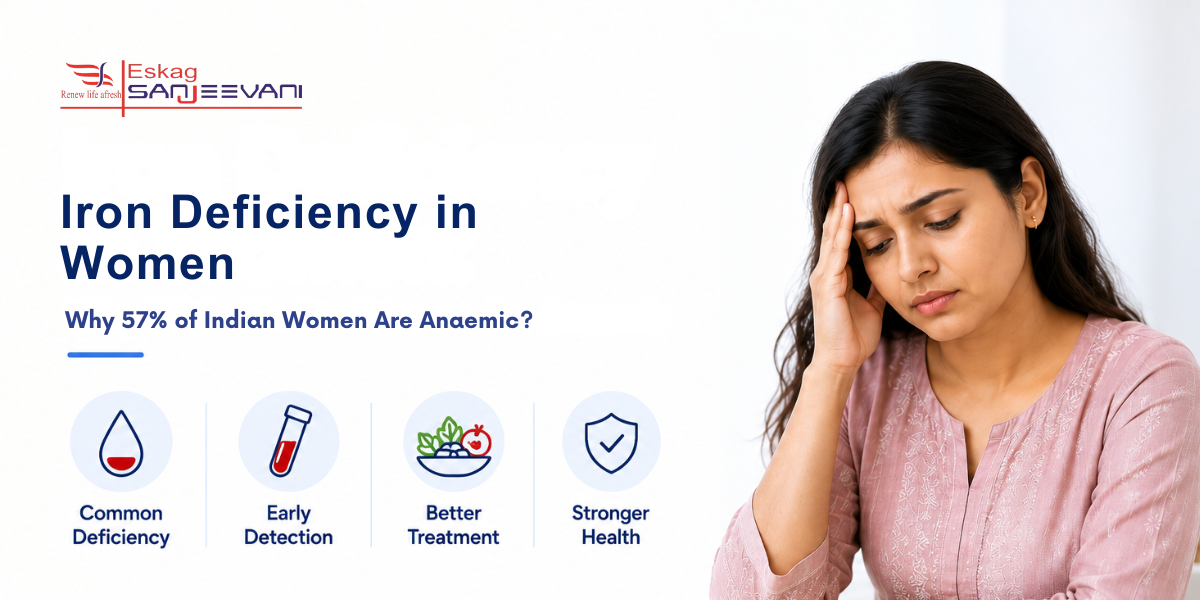
According to the National Family Health Survey-5 (2019-21), 57% of Indian women aged 15-49 years suffer from anaemia. Iron deficiency is the primary culprit behind this alarming statistic [1]. This means more than half of India’s reproductive-age women are living with a condition that silently drains their energy, compromises their immunity, and impacts their quality of life. Iron deficiency in women has become so normalised that prolonged fatigue, hair loss, and difficulty concentrating are dismissed as inevitable parts of life. The reality is that iron deficiency is not just a health issue; it’s a barrier to women’s productivity and their ability to care for their families.
This article will help you understand this condition, recognise its symptoms early, and take action to transform your health and restore the vitality you deserve.
Key Takeaways
- Iron deficiency affects 57% of Indian women aged 15-49 years, making it the most common nutritional deficiency in the country.
- Early detection through simple blood tests (ferritin, haemoglobin, and transferrin saturation) can prevent progression to severe anaemia and its complications
- Iron deficiency in women is highly treatable through dietary changes, supplementation, or medical interventions tailored to your specific needs
- Untreated iron deficiency during pregnancy increases the risk of premature delivery, low birth weight, and long-term developmental issues in children
Quick answer: Iron deficiency in women causes fatigue, hair thinning, dizziness and poor concentration; blood tests can confirm low iron stores and anaemia.
- Understanding Iron Deficiency: What It Means for Your Body
- Iron Deficiency Causes: Identifying the Root of Your Problem
- How to Test for Iron Deficiency: Essential Tests for Iron Deficiency Diagnosis
- Iron Deficiency Treatment
- Symptoms You Should Never Ignore
- Iron Deficiency Test at Eskag Sanjeevani Hospitals
Understanding Iron Deficiency: What It Means for Your Body
Iron is not just another mineral; it is the foundation of your body’s oxygen delivery system. Every red blood cell in your body contains haemoglobin, a protein that carries oxygen from your lungs to every tissue and organ. Iron is the critical component that allows haemoglobin to bind and transport oxygen. When your body lacks sufficient iron, your red blood cells cannot carry enough oxygen, leading to a cascade of symptoms.
Iron deficiency develops in stages. Initially, your body consumes its iron stores without affecting haemoglobin levels, called iron deficiency without anaemia. Many women experience symptoms at this stage but remain undiagnosed because their blood tests appear “normal”. As the deficiency progresses, haemoglobin levels drop, and iron deficiency anaemia develops. At this point, symptoms become more pronounced and harder to ignore.
Why Indian Women Are Particularly Vulnerable?
The 57% prevalence of anaemia among Indian women is not coincidental. Several interconnected factors create a perfect storm for iron deficiency in this population:
- Heavy menstrual bleeding remains the leading cause of iron loss in reproductive-age women. Many Indian women experience prolonged or excessive periods due to hormonal imbalances or underlying gynaecological conditions.
- Vegetarian and vegan dietary patterns, common in many Indian communities, rely on non-heme iron from plant sources, which is absorbed less efficiently than heme iron from animal products.
- Phytates, oxalates, and tannins found in traditional Indian foods like tea and coffee inhibit iron absorption when consumed with iron-rich meals.
- Socioeconomic disparities mean many women lack access to iron-rich foods, healthcare screening, and timely treatment.
- Pregnancy and breastfeeding dramatically increase iron demands, yet many Indian women enter pregnancy already iron-deficient.
Iron Deficiency Causes: Identifying the Root of Your Problem
Iron deficiency causes fall into three main categories: increased blood loss, inadequate dietary intake, and impaired absorption.
Blood Loss as the Primary Culprit
Heavy menstrual bleeding is the most common cause of iron deficiency in women of reproductive age. If you lose more than 80 millilitres of blood during your menstrual period (roughly equivalent to soaking through more than 16 regular pads or 8 super-absorbent pads), you are losing more iron than your diet can replace [4]. Conditions like fibroids, polyps, hormonal imbalances, and bleeding disorders can cause excessive menstrual bleeding.
Dietary Deficiency: The Role of What You Eat
Your body cannot manufacture iron; it must come from food. Many Indian women fall short of these targets due to:
- Limited access to iron-rich foods like meat, fish, and poultry.
- Reliance on plant-based iron sources without understanding how to optimise their absorption.
- Consuming tea or coffee with meals, which blocks iron absorption.
- Skipping meals or following restrictive diets.
Malabsorption: When Your Gut Cannot Process Iron
Even if you consume adequate iron, your body must absorb it efficiently. Conditions affecting your gastrointestinal tract can impair iron absorption:
- Coeliac disease damages the intestinal lining, reducing nutrient absorption
- Inflammatory bowel disease causes chronic inflammation and blood loss
- Atrophic gastritis reduces stomach acid necessary for iron dissolution
- Proton pump inhibitors and antacids decrease stomach acidity, hindering iron absorption
- Bariatric surgery reduces the absorptive surface area of your intestines
How to Test for Iron Deficiency: Essential Tests for Iron Deficiency Diagnosis
Diagnosing iron deficiency usually requires more than one blood test. Your doctor may use the following results together to assess iron stores and determine whether anaemia is present.
| Test | Typical Value Suggesting Deficiency Or Anaemia | What It Tells You |
| Haemoglobin (Hb) | <12 g/dL in non-pregnant women | Indicates anaemia. |
| Serum Ferritin | <15.1 µg/L in apparently healthy adults; <70.4 µg/L with infection or inflammation [2] | Reflects the body’s stored iron. |
| Transferrin Saturation (TSAT) | <20% [3] | Shows how much transferrin is carrying iron. |
| MCV (Mean Corpuscular Volume) | <80 fL | Measures the average size of red blood cells. |
How Can I Check My Iron Level at Home?
Home testing can help you decide whether you need a proper iron assessment, but it cannot replace laboratory testing.
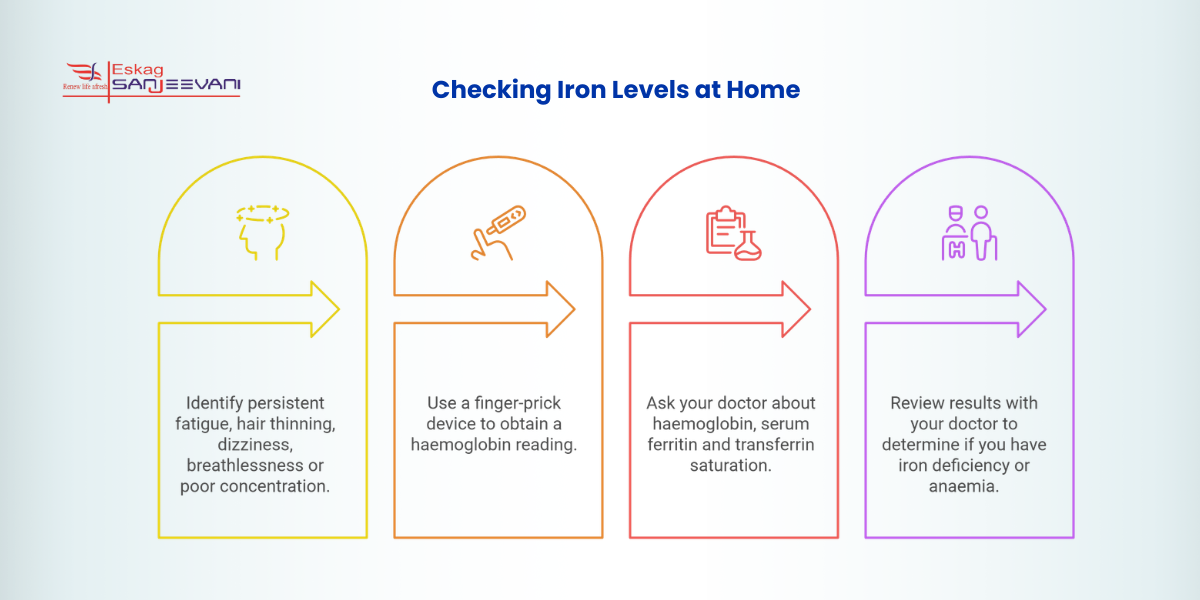
Step 1: Check for possible symptoms: Persistent fatigue, hair thinning, dizziness, breathlessness or poor concentration can indicate iron deficiency, but these symptoms can have other causes.
Step 2: Use a home haemoglobin test, if available: Finger-prick devices can provide a haemoglobin reading. A low result can suggest anaemia, but normal haemoglobin does not rule out depleted iron stores.
Step 3: Get a laboratory iron profile: For a reliable assessment, ask your doctor about haemoglobin, serum ferritin and transferrin saturation. Ferritin is a key marker of stored iron, while inflammation can affect its level.
Step 4: Discuss the results with your doctor: Do not start iron supplements based only on a home result. Your doctor can determine whether you have iron deficiency, anaemia or another condition and identify its underlying cause.
Iron Deficiency Treatment
Iron deficiency treatment depends on the severity of deficiency, the cause of iron loss, and whether anaemia is present. The aim is to restore iron stores and address the reason for the deficiency so it does not recur.
Iron deficiency treatment depends on the severity of deficiency, the cause of iron loss, and whether anaemia is present. The aim is to restore iron stores and address the reason for the deficiency so it does not recur.
Dietary Changes
- Choose iron-rich foods such as leafy greens, lentils, beans, fortified grains, meat, poultry and fish.
- Combine plant-based iron sources with vitamin C-rich foods such as citrus fruits, tomatoes and capsicum to improve absorption.
- Keep tea, coffee and calcium supplements away from iron-rich meals because they can reduce iron absorption.
- Do not rely on diet alone when blood tests show significant anaemia or depleted iron stores.
Oral Iron Supplements
- Take iron as prescribed, preferably away from meals when tolerated.
- Taking it with food reduces nausea or stomach discomfort.
- Alternate-day dosing may improve absorption and reduce gastrointestinal side effects in some patients.
- Constipation, nausea and abdominal discomfort are common side effects.
Intravenous Iron
Intravenous iron is considered when oral iron is ineffective, poorly tolerated, not adequately absorbed, or when iron replacement is needed more rapidly. It can be useful in selected patients with significant iron deficiency, ongoing blood loss, certain gastrointestinal conditions or situations where oral treatment is unsuitable.
Symptoms You Should Never Ignore
Iron deficiency can affect energy, appearance, concentration and appetite. Some symptoms develop gradually and may be overlooked.
| Symptom Group | What You May Notice |
| Physical symptoms | Persistent fatigue, weakness, shortness of breath during activity, dizziness, lightheadedness or palpitations. |
| Appearance changes | Pale skin, pale nail beds or inner eyelids, brittle or spoon-shaped nails, hair thinning and a smooth or sore tongue. |
| Cognitive and emotional symptoms | Difficulty concentrating, poor memory, brain fog, irritability and mood changes. |
| Unusual cravings | Pica, such as a persistent craving for ice, clay, dirt or other non-food substances, can occur with iron deficiency. |
Iron Deficiency Test at Eskag Sanjeevani Hospitals
Eskag Sanjeevani Hospitals recognises that iron deficiency is not merely a laboratory abnormality. Our specialised department offers iron deficiency tests via the 24/7 NABL-accredited pathology and haematology investigation services, including serum ferritin, transferrin saturation, and advanced markers like soluble transferrin receptor. For patients requiring intravenous iron therapy, Eskag Sanjeevani Hospitals provides modern IV iron formulations administered by trained healthcare professionals in a safe, monitored environment.
Final Thoughts
Iron deficiency in women requires more than correcting low haemoglobin. Identifying the cause, restoring iron stores and preventing recurrence are essential. Review your diet, menstrual blood loss, medicines and other possible sources of iron loss with your doctor. At Eskag Sanjeevani Hospitals, patients can access haematology consultation, iron-status testing and personalised treatment based on their results. The team can also assess underlying causes such as heavy menstrual bleeding or gastrointestinal blood loss. Early evaluation helps determine whether dietary changes, oral iron or intravenous iron is appropriate for your condition.

Microbiologist with over 2 years of experience in medical writing, specialising in evidence-based healthcare content.

Clinical experience in diagnosis, treatment, and evidence-based patient care across a range of conditions.
References
- Jeevan J, Karun KM, Puranik A, Deepa C, Mk L, Barvaliya M. Prevalence of anaemia in India: a systematic review, meta-analysis and geospatial analysis. BMC Public Health. 2025 Apr 4;25(1):1270.
- Evidence and recommendations. (2020). [online] www.ncbi.nlm.nih.gov. World Health Organization.
- Fletcher, A., Forbes, A., Svenson, N. and Wayne Thomas, D. (2021). Guideline for the laboratory diagnosis of iron deficiency in adults (excluding pregnancy) and children. British Journal of Haematology, 196(3), pp.523-529.
- CeMCOR. (2025a). Very heavy menstrual flow – CeMCOR. [online] Available at: https://cemcor.ubc.ca/resources/very-heavy-menstrual-flow/.
Heavy menstrual bleeding, low dietary iron intake, pregnancy and breastfeeding increase iron needs. Vegetarian diets provide mainly non-haem iron, which is absorbed less efficiently, while tea and coffee with meals can further reduce absorption.
The blog does not identify one fruit as the richest source of iron. Citrus fruits are useful because their vitamin C content helps the body absorb iron from plant-based foods.
Iron deficiency can cause fatigue, weakness, breathlessness, dizziness, hair thinning, brittle nails, difficulty concentrating and palpitations. If it progresses to anaemia, haemoglobin falls, and symptoms can become more pronounced.
NFHS-5 reported that 57% of Indian women aged 15–49 years have anaemia. Iron deficiency is a major contributor to anaemia, although not every case of anaemia is caused by iron deficiency.
No single food can rapidly correct iron deficiency. Iron-rich foods such as meat, poultry, fish, lentils, beans, leafy greens and fortified grains, combined with vitamin C-rich foods, improve dietary iron intake and absorption.