

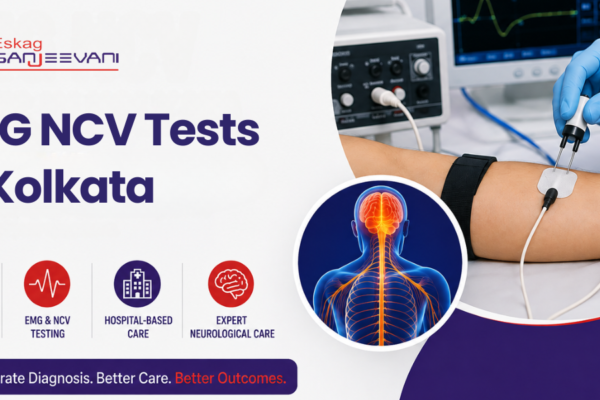
Comprehensive EMG & NCV Services at Eskag Sanjeevani Hospital
If your doctor has advised an EMG, NCV, or combined EMG NCV test, get your recommended nerve and muscle testing at Eskag Sanjeevani Hospitals, Kolkata. Our facility provides EMG and NCV testing with access to hospital-based neurological care.
Our EMG and NCV services help assess nerve and muscle function and support doctors in finding the cause of symptoms such as numbness, tingling, weakness, and persistent limb pain.
EMG and NCV Testing at Eskag Sanjeevani Hospitals
An EMG NCV test combines two related assessments:
- Electromyography (EMG): It is a test that records the electrical activity of muscles. It helps assess how muscles are working and whether symptoms may be linked to nerve or muscle problems.
- Nerve Conduction Velocity (NCV): This test measures how quickly electrical signals travel through the nerves. It can help identify nerve damage, compression, or other changes in nerve function.
Generally, a combined EMG and NCV test takes 40 to 90 minutes to complete; however, the exact duration might vary depending on the requirements.
Here’s a detailed breakdown of the time associated with the EMG NCV Test.
| Step | Time |
| Check-in & skin prep | 5 to 10 min |
| Nerve conduction study (NCV) | 15 to 30 min |
| Muscle test (EMG), if needed | 15 to 40 min |
| Wrap-up & preliminary results | 5 to 10 min |
What Happens During the Electromyography Procedure?
During NCV testing, small electrodes are placed on the skin, and mild electrical signals are used to assess nerve responses.
Before the test:
You may be asked to change into clothing that allows easy access to the area being tested. The skin should be clean and free from creams, oils, or lotions, as these can affect electrode contact. Tell the medical team about any medicines you take, especially blood thinners, and inform them if you have a pacemaker or other implanted electrical device.
During the test:
For an NCV test, small electrodes are placed on the skin over selected nerves and muscles. A mild electrical impulse is delivered to the nerve, and the electrodes record the nerve responses.
During EMG, a fine needle electrode is inserted into selected muscles to record their electrical activity.
After the test:
You can usually return to your normal activities after the test, unless your doctor or the medical team advises otherwise. You may have mild soreness or bruising at the needle insertion sites after EMG, which generally settles on its own.
Is the EMG NCV test painful? No. Most people feel mild tingling or a quick pinch. It’s over fast, and you can go straight back to your normal daily routine.
Factors Affecting Nerve Conduction Velocity
- Age: Nerve conduction velocity and signal amplitude may naturally decrease with age.
- Body temperature: Cold skin can slow nerve conduction and prolong response latencies.
- Height: Taller individuals may have longer nerve pathways, which can increase conduction time.
- Diabetes: Long-term high blood glucose can damage peripheral nerves and contribute to diabetic peripheral neuropathy.
- Poor glucose control: Persistently elevated blood glucose may be associated with slower nerve conduction and reduced signal strength.
- Abnormal blood lipid levels: Metabolic changes in blood lipids may increase the risk of peripheral nerve dysfunction.
- Obesity: Higher body weight is associated with an increased risk of peripheral neuropathy, particularly in people with diabetes.
- High blood pressure: Hypertension may also be associated with a higher risk of peripheral nerve damage.
- Kidney problems: Reduced kidney function and raised urea levels can affect nerve function and may influence nerve conduction measurements.
When Do You Need an EMG/NCV Test?
- Numbness, tingling, or burning
- Muscle weakness, cramps, or unexplained pain
- Nerve compression or injury
- Peripheral neuropathy
- Spine-related nerve symptoms
- Muscle or neuromuscular disorders
- Suspected ALS (Amyotrophic lateral sclerosis)
- Suspected Guillain-Barré Syndrome (GBS)
- Severe carpal tunnel syndrome
Why Choose Eskag Sanjeevani for EMG NCV Testing?
- Accreditations: Our Eskag Sanjeevani Hospitals are NABH accredited and empanelled to Government schemes such as WBHS and CGHS.
- Hospital-based testing: Get your investigation within a hospital setting with access to related medical services when required.
- Neurological care: Your test is supported by the hospital’s neurological care team.
- Comprehensive testing: EMG and NCV, or both, can be performed based on your doctor’s prescription.
Book your EMG NCV test at Eskag Sanjeevani Hospitals today.
Explore Our EMG & NCV at Eskag Sanjeevani Hospitals Kolkata
Trusted care and convenient access for all your healthcare needs.
Visit us at: www.eskagsanjeevani.com
Call to learn more about our EMG & NCV
Frequently Asked Questions on: EMG & NCV
An EMG NCV test checks how well your nerves and muscles are working. Doctors may recommend it for symptoms such as numbness, tingling, weakness, muscle pain, nerve compression, or suspected nerve disorders.
You may feel mild discomfort during the test. NCV may cause a brief tingling or electrical sensation, while EMG may cause a quick pinch when the fine needle is inserted into the muscle. Mild soreness or bruising may occur afterward.
A combined EMG NCV test usually takes about 40 to 90 minutes, depending on how many nerves and muscles need to be checked. Some tests may take longer if more areas need to be examined.
Keep the skin clean and avoid applying creams, lotions, or oils before the test. Wear loose, comfortable clothing and tell your doctor if you take blood thinners or have a pacemaker or other implanted electrical device. You usually do not need to fast unless your doctor gives you different instructions.
The test can help doctors identify problems with nerves or muscles, including nerve compression, peripheral nerve damage, and some muscle or neuromuscular disorders. The results are interpreted along with your symptoms and other medical tests to determine the likely cause.