

 Medically Reviewed
Typhoid in Monsoon: Which Blood Tests Confirm It
The monsoon in Kolkata brings more than just relief from the heat. Waterlogged lanes, flooded drains, and contaminated tap water create the ideal setting for typhoid to spread. Typhoid remains a serious public health problem across most developing countries, with an estimated incidence of 540 per 100,000 population [3].
Every monsoon, many parts of Kolkata face flooding, and clean water often gets contaminated. This makes typhoid much more common during the rainy season. For many families, it is a health problem they may have to deal with every year. If you or someone at home has had a fever for more than three days, getting the right blood test at the right time can help find the cause early and start the right treatment sooner.
Key Takeaways
- Typhoid is caused by Salmonella Typhi. It spreads through dirty food and water, and the risk becomes much higher during the monsoon.
- The Typhidot test helps in finding IgM antibodies during the first week of fever, helping doctors detect typhoid without waiting too long.
- Blood culture remains the gold standard for typhoid diagnosis but takes 2 to 7 days; it is best used alongside rapid serological tests to improve accuracy.
Quick Answer: To confirm typhoid during the monsoon, doctors may recommend a Typhidot test, TUBEX test, or blood culture. The best test depends on how long the fever has been present.
- Why Typhoid in Monsoon Is a Bigger Risk in Kolkata
- How Typhoid Fever Presents: Symptoms to Watch
- Monsoon Fever Needs More Than Paracetamol
- Blood Tests for Typhoid: Which One Does What
- When to Get Which Test: A Practical Guide for Kolkata Patients
- The Drug Resistance Problem in Indian Typhoid
- Prevention of Typhoid Fever During Monsoon in Kolkata
- When to Consult a Doctor?
Why Typhoid in Monsoon Is a Bigger Risk in Kolkata
Kolkata sits in a low-lying delta region. During monsoon, areas like Tiljala, Topsia, Behala, and Chetla regularly face waterlogging. Sewage lines overflow and mix with drinking water sources. Street food like phuchka, cutlets, jhalmuri, etc. is prepared in areas where maintaining hygiene is difficult during heavy rain.
Salmonella Typhi spreads through what researchers call the “4 Fs”: flies, fingers, faeces, and fomites [1]. Any of these can reach your food or water in monsoon conditions without you knowing. Unlike dengue or malaria, typhoid does not need a mosquito. A single contaminated cup of water or an unwashed hand is enough.
Rainfall between 11° and 35° N latitude, which includes West Bengal, is directly connected to higher typhoid cases [1]. Climate change is making this pattern worse, with heavier rainfall increasing flooding and compromising water safety each year.
How Typhoid Fever Presents: Symptoms to Watch
Typhoid fever usually starts with a mild fever. The fever goes up a little more each day. By the third or fourth day, it can reach 38–40°C. It is often lower in the morning and higher in the evening.
Other common signs include:
- Persistent headache and body weakness that do not improve with paracetamol alone
- Loss of appetite, often with a coated white tongue and mild abdominal bloating
- Constipation in adults, though children may have loose motions more often
- Dull abdominal pain, particularly around the navel area
- Dry cough or mild sore throat in some patients, especially in the early days
Note: typhoid symptoms look similar to viral fever in monsoon, dengue, and malaria. Fever alone cannot tell you which infection you have. A blood test for typhoid is the only way to know for certain.
Monsoon Fever Needs More Than Paracetamol
Many patients in Kolkata wait four to five days before getting tested. This is a common pattern across South Asia, where it is routine to try home remedies or over-the-counter medicines first. The problem is that delay allows typhoid to progress to complications.
If typhoid is left untreated, the risk of intestinal perforation, internal bleeding, and sepsis rises significantly complications that usually appear two to three weeks into the illness. Getting a typhoid fever blood test done by day three or four of fever means treatment can start earlier and recovery is much faster.
Doctors at Eskag Sanjeevani consistently see this pattern during the monsoon season. A viral fever during the monsoon may settle within three to four days without antibiotics. Typhoid will not. If the fever has not broken by day three, testing is the right next step.
Also read: Monsoon Fever Symptoms: Dengue, Typhoid, and Rat Fever Explained
Blood Tests for Typhoid: Which One Does What
There is no single perfect test for typhoid. Each test has a window, a period in the illness when it performs best. Understanding the difference helps you know what your doctor is ordering and why. Eskag Sanjeevani offers a full range of diagnostic services including blood tests, cultures, and rapid serological panels.
The Widal Test: Widely Used But Limited
The Widal test has been around since the late 19th century. It measures antibody levels against the O and H antigens of Salmonella Typhi. In Kolkata clinics and small diagnostic centres, it is still the most commonly available typhoid test, mainly because it is inexpensive.
However, research comparing multiple typhoid diagnostics found the Widal test had only 61–64% sensitivity and showed significant variation depending on where and how it was performed [2]. Two labs testing the same sample can give different results. The Widal test is also unreliable as a single reading in endemic areas like Kolkata, because many people carry background antibody levels from previous exposure or past illness.
For the Widal test to be truly meaningful, results from two blood samples taken 10–14 days apart should ideally show a four-fold rise in antibody titre [3]. In practice, most patients want an answer within a day or two, which is exactly why rapid tests have become more useful.
Best used: As a secondary supporting test, not as the sole basis for a typhoid diagnosis.
The Typhidot Test: Faster and More Reliable
The Typhidot test works differently. It detects IgM and IgG antibodies against a specific outer membrane protein of Salmonella Typhi. This antigen is specific to typhoid and does not cross-react with other infections the way the Widal test can.
In comparative studies, the Typhidot showed 79% sensitivity and 89% specificity [2]. More importantly, IgM antibodies, which the Typhidot detects, appear earlier in the illness than the agglutinins the Widal test looks for. This means the Typhidot can give a positive result even in the first week of fever.
There is one important nuance. In areas with high ongoing typhoid exposure like dense urban pockets of Kolkata, some people have residual IgG from a past infection. This IgG can sometimes mask IgM in a re-infection. An upgraded version called the Typhidot-M inactivates this background IgG, allowing IgM to be detected clearly. Evaluations of the Typhidot-M showed it outperformed even the blood culture method in sensitivity and speed [3].
Best used: From day four to seven of fever onwards, as a rapid, reliable confirmation test.
The TUBEX Test: Useful When Available
The TUBEX is a semiquantitative test that detects IgM antibodies against the O9 antigen of Salmonella Typhi. Studies showed it has 78% sensitivity and 94% specificity [2]. It is one of the simplest tests to run and gives a result in about three minutes. Its limitation is that it may produce a false positive in patients with recent non-typhoidal Salmonella infections.
Best used: Where available, as a rapid IgM-based alternative or complement to the Typhidot.
Blood Culture: The Gold Standard
Blood culture remains the most definitive way to diagnose typhoid. It directly isolates the Salmonella Typhi bacteria from blood. It is 100% specific; a positive result means typhoid, with no ambiguity. It also tells your doctor which antibiotics the bacteria respond to, which is crucial given rising drug resistance in India.
The catch is sensitivity and time. A single blood culture is positive in only about half the tests done of typhoid cases in endemic areas. Results take two to seven days. Multiple samples and larger volumes (7 mL) improve the chance of detection.
Best used: From the first week of fever, ideally before antibiotics are started; combined with Typhidot for faster decisions.
Test Accuracy at a Glance
| Test | Sensitivity | Specificity | Best Timing | Result Time |
| Widal Test | 61–64% | 76–100% | Week 2 onwards | 5 min–overnight |
| Typhidot (IgM/IgG) | 79% | 89% | Week 1 onwards | 1–3 hours |
| Typhidot-M | >93% | High | Week 1 onwards | Within 3 hours |
| TUBEX | 78% | 94% | Week 1 onwards | 3 minutes |
| Blood Culture | 50–66% | 100% | First week | 2–7 days |
All figures sourced from published comparative studies in endemic settings. [1,2,3]
When to Get Which Test: A Practical Guide for Kolkata Patients
The timing of your test matters as much as the type of test. All serological tests for typhoid, Widal, Typhidot, TUBEX, showed their highest sensitivity when blood was collected in the second week of illness [2]. But waiting until week two is not always the right call.
Here is a practical guide:
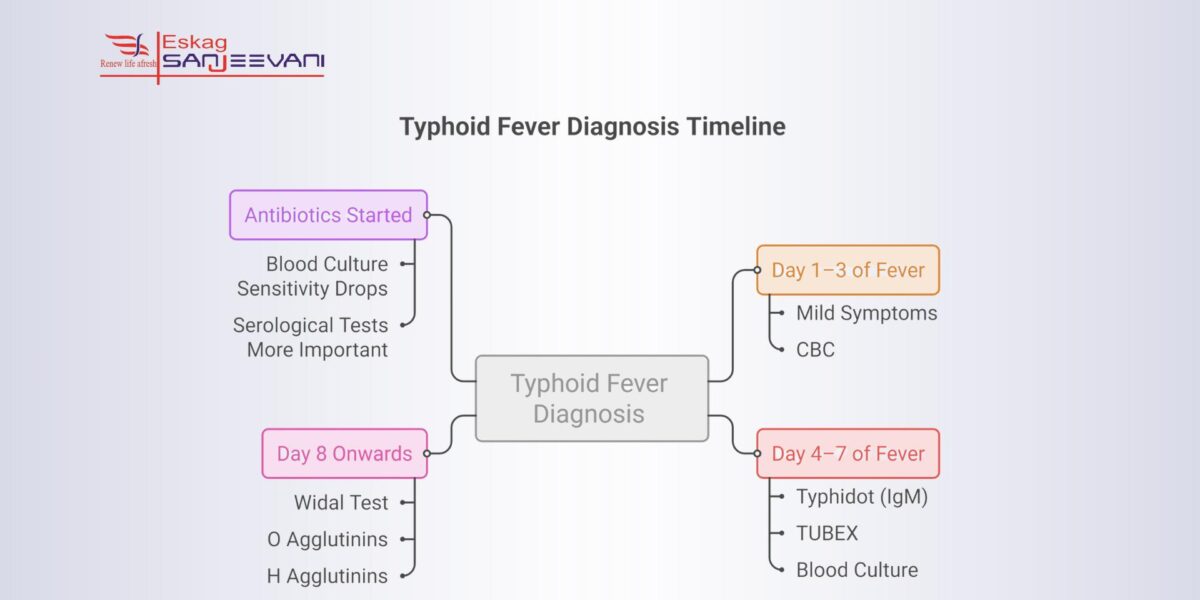
- Day 1–3 of fever: If symptoms are mild, your doctor may advise a CBC and wait to see if fever persists before ordering typhoid-specific tests.
- Day 4–7 of fever: This is when the Typhidot (IgM) and TUBEX become most useful. A blood culture should also be drawn at this stage, ideally before antibiotics are started.
- Day 8 onwards: The Widal test becomes more reliable here, as O and H agglutinins typically appear around day eight and day ten to twelve, respectively. Blood culture sensitivity also begins to fall after the first week.
- If antibiotics have already been started: Blood culture sensitivity drops significantly. Serological tests like Typhidot become more important in this scenario.
The Drug Resistance Problem in Indian Typhoid
Salmonella Typhi in South Asia has a high rate of fluoroquinolone resistance. This means ciprofloxacin, a commonly prescribed antibiotic for fever in India, may not work against the strain causing your infection. Doctors across West Bengal are increasingly seeing cases that do not respond to first-line antibiotics.
This is exactly why blood culture is not just an academic exercise. A culture-positive result allows the lab to test antibiotic sensitivity, so your doctor can prescribe the right medicine instead of guessing. Untreated or wrongly treated typhoid in monsoon can progress to intestinal perforation, a surgical emergency.
At Eskag Sanjeevani, the internal medicine team follows the same approach: pair a rapid serological test for early results with a blood culture to guide antibiotic choice and avoid unnecessary drug exposure.
Prevention of Typhoid Fever During Monsoon in Kolkata
Prevention of typhoid fever works at two levels: what you eat and drink, and how you protect yourself before the season begins.
Food and water precautions
- Drink water only from sealed bottles or water that has been boiled and stored in a covered container.
- Avoid street food sold near waterlogged areas during the monsoon; the contamination risk is highest there.
- Do not eat raw salads, unpeeled fruit, or food that has been left out and reheated.
- Wash hands with soap before all meals and after using the toilet, especially during the monsoon when surfaces carry more contamination.
Vaccination
Two types of typhoid vaccine are available in India: the Vi polysaccharide vaccine (a single injectable dose, suitable from age 2) and the oral Ty21a capsule series. Typhoid conjugate vaccines, which offer longer protection and can be given from six months of age, are now part of India’s immunisation agenda [1]. Vaccination does not replace food and water precautions but adds a meaningful layer of protection.
When to Consult a Doctor?
Most cases of typhoid in the monsoon are manageable with early treatment. But some signs mean you should not wait:
- Fever above 39°C for more than three days despite paracetamol.
- Severe abdominal pain that gets worse when you move
- Confusion, unusual drowsiness, or not making sense while talking
- Signs of bleeding, blood in stools, dark tarry stools, or vomiting blood
- Pregnancy with ongoing fever: typhoid in pregnancy carries a one-in-six miscarriage risk.
These are warning signs of complicated typhoid. Eskag Sanjeevani’s internal medicine department and emergency services are equipped to handle typhoid complications including intestinal perforation, with round-the-clock surgical backup.
Conclusion
Typhoid in monsoon is preventable, diagnosable, and treatable, but only if you act early. A blood test for typhoid taken by day four or five of a persistent fever gives your doctor the information needed to start the right treatment. The Typhidot test gives a result within hours. Blood culture confirms the diagnosis and guides antibiotic choice.
Do not wait for a fever to break on its own if it has lasted more than three days. Speak to the best medicine doctor in Kolkata at Eskag Sanjeevani for a proper assessment and the right tests because, in the monsoon, the cost of guessing is too high.

Microbiologist with over 2 years of experience in medical writing, specialising in evidence-based healthcare content.

Clinical experience in diagnosis, treatment, and evidence-based patient care across a range of conditions.
References
- Bhandari, Jenish, et al. “Typhoid Fever.” StatPearls Publishing, 10 Aug. 2022.
- Olsen, S. J., et al. “Evaluation of Rapid Diagnostic Tests for Typhoid Fever.” Journal of Clinical Microbiology, vol. 42, no. 5, 1 May 2004, pp. 1885–1889,
- Ismail, Asma. “New Advances in the Diagnosis of Typhoid and Detection of Typhoid Carriers.” The Malaysian Journal of Medical Sciences: MJMS, vol. 7, no. 2, July 2000, p. 3,
Yes, typhoid is usually curable if treated early with the right medicines. Finish the full course of antibiotics even if you start feeling better.
Typhoid is more common during the monsoon because dirty water and food can get contaminated more easily. It can happen at any time of the year.
Yes, but only if the water is clean and safe to drink. Always drink boiled, filtered, or bottled water.
Eat soft, freshly cooked foods like rice, khichdi, soup, bananas, and curd. Avoid spicy, oily, raw, and street food until you recover.
Typhoid becomes serious if high fever lasts for many days or there is severe stomach pain, confusion, or bleeding. Get medical help immediately if these happen.