
 Medically Reviewed
Thyroid Profile Test Guide: Understand High TSH vs Low TSH
Approximately 4.2 crore people in India are affected by thyroid disorders, with hypothyroidism impacting 1 in 10 adults, yet many remain undiagnosed due to non-specific symptoms that mimic common health complaints [1]. A thyroid profile test is your first line of defence in understanding whether your fatigue, weight changes, or mood fluctuations stem from thyroid dysfunction or other causes.
This comprehensive guide helps Indian patients navigate thyroid testing, interpret results, and understand the critical difference between high TSH vs low TSH levels.
Key Takeaways
- TSH (thyroid-stimulating hormone) is the most sensitive marker of thyroid function, with a normal range typically 0.4-4.0 mIU/L in India, though individual set-points vary significantly.
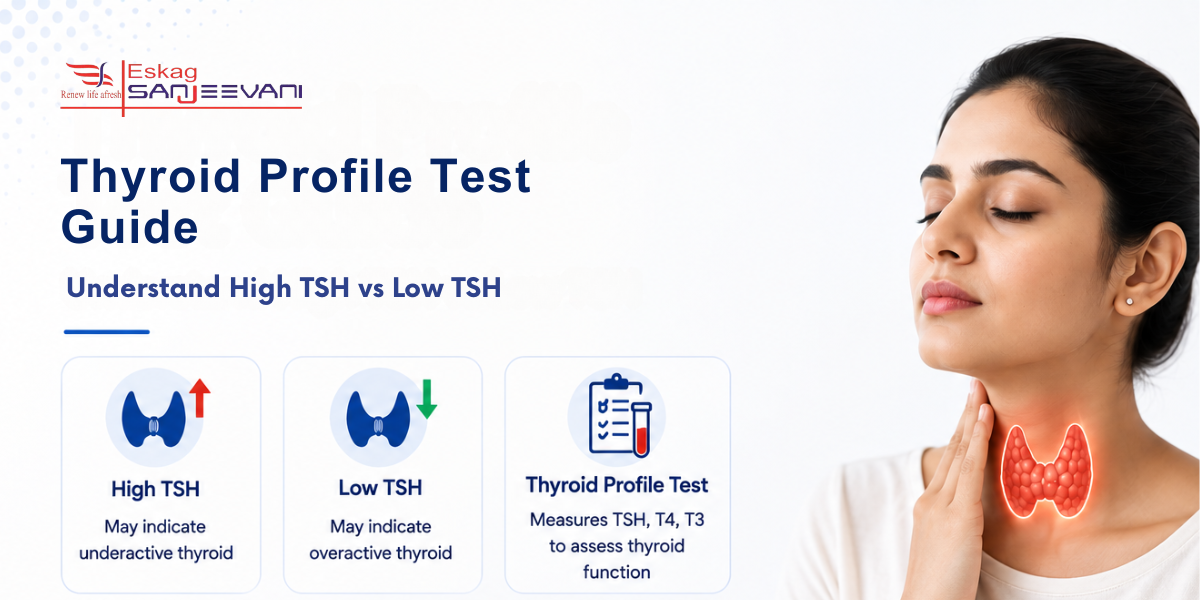
- High TSH combined with low free T4 indicates primary hypothyroidism (underactive thyroid), while low TSH with high free T4 suggests hyperthyroidism (overactive thyroid).
- Subclinical thyroid dysfunction (where TSH is abnormal but T4 remains normal) affects 3.9-8.5% of the population and requires careful monitoring before treatment.
Quick answer: A thyroid profile test measures TSH and thyroid hormones to identify underactive or overactive thyroid function and guide further evaluation.
- Understanding Thyroid Function and TSH
- Thyroid Test Results Chart: Normal Ranges in India
- High TSH vs Low TSH: Know Hypothyroidism and Hyperthyroidism
- Low TSH Symptoms: When to Seek Medical Attention
- Thyroid Profile Test at Home: Convenience and Accuracy
- Subclinical Thyroid Dysfunction: The Grey Zone
- Factors Affecting Thyroid Test Results
- Interpreting Contradictory Results
- Comprehensive Thyroid Care at Eskag Sanjeevani Hospitals
Understanding Thyroid Function and TSH
Your thyroid gland operates through a sophisticated feedback system involving the hypothalamus, pituitary gland, and thyroid itself. The pituitary releases thyroid-stimulating hormone (TSH), which signals your thyroid to produce two main hormones: thyroxine (T4) and triiodothyronine (T3). These hormones regulate metabolism, energy production, and countless bodily functions.
The relationship between TSH and thyroid hormones is logarithmic, not linear. This means small changes in T4 or T3 levels trigger massive changes in TSH. For example, a 2-fold change in free T4 can result in a 100-fold change in TSH in the opposite direction. This amplified relationship makes TSH an exceptionally sensitive marker for detecting early thyroid dysfunction, often revealing problems before T4 levels fall outside the normal range.
Why TSH is the Primary Screening Test?
TSH is considered the gold standard first-line test because:
- It detects thyroid dysfunction earlier than T4 or T3 measurements.
- TSH changes occur before thyroid hormone levels become abnormal.
- A normal TSH has a high negative predictive value for ruling out primary thyroid disease.
- It’s cost-effective and standardised across laboratories in India.
However, TSH alone has limitations. In pituitary or hypothalamic disease, TSH may appear normal despite abnormal thyroid hormone levels. Additionally, medications, acute illness, and pregnancy can temporarily alter TSH without indicating true thyroid dysfunction.
Thyroid Test Results Chart: Normal Ranges in India
Understanding reference ranges is essential for interpreting your thyroid profile test results.
In India, standard reference ranges are:
| Thyroid Marker | Normal Range | Unit |
| TSH | 0.4 – 4.0 | mIU/L |
| Free T4 | 9.0 – 25.0 | pmol/L |
| Free T3 | 3.5 – 7.8 | pmol/L |
| Total T4 | 5.0 – 12.0 | μg/dL |
However, these population-based ranges mask an important clinical reality: each individual has a personal “set-point” for thyroid hormones that remains relatively stable. A TSH of 3.5 mIU/L might be abnormally high for someone whose baseline is 1.0 mIU/L, even though both fall within the normal range. This individual variation explains why some patients feel symptomatic despite “normal” test results [2].
High TSH vs Low TSH: Know Hypothyroidism and Hyperthyroidism
Interpret TSH levels alongside free T4 and your symptoms, as high TSH usually points to an underactive thyroid, while low TSH can indicate an overactive thyroid.
High TSH: Understanding Hypothyroidism
High TSH indicates your pituitary is working harder to stimulate an underactive thyroid gland. This occurs in two forms:
- Overt Hypothyroidism occurs when TSH is elevated (typically >8.0 mIU/L), and free T4 is low. This represents clear thyroid failure requiring immediate treatment with levothyroxine replacement. Symptoms include fatigue, weight gain, cold intolerance, constipation, dry skin, and depression.
- Subclinical Hypothyroidism presents with mildly elevated TSH (4.6-8.0 mIU/L) while free T4 remains normal. This affects 3.9-8.5% of the population and represents early thyroid dysfunction. The Whickham survey showed that 52% of patients with an initial TSH of 5.0-9.9 mIU/L spontaneously normalised over 31.7 months, while only 5.6% progressed to overt hypothyroidism [3]. However, those with positive thyroid peroxidase (TPO) antibodies showed a 4.3% annual progression rate to overt disease.
Low TSH: Understanding Hyperthyroidism
Low TSH indicates your pituitary is suppressing thyroid stimulation because thyroid hormones are already elevated. This also occurs in two forms:
- Overt Hyperthyroidism presents with suppressed TSH (typically <0.03 mIU/L) and elevated free T4 and/or free T3. Symptoms include palpitations, anxiety, tremor, heat intolerance, weight loss despite good appetite, and frequent bowel movements. In India, Graves’ disease and toxic multinodular goitre are the primary causes.
- Subclinical Hyperthyroidism shows suppressed TSH (0.05-0.4 mIU/L) with normal free T4 and T3. This affects 0.2-0.9% of the population. The Thyroid Epidemiology, Audit, and Research Study (TEARS) found that only 0.5-0.7% of patients with baseline TSH of 0.1-0.4/L progressed to overt hyperthyroidism over 2-7 years, while 50-72% remained subclinically hyperthyroid or spontaneously normalised [3].
Low TSH Symptoms: When to Seek Medical Attention
Low TSH symptoms vary depending on whether you have subclinical or overt hyperthyroidism:
- Palpitations and irregular heartbeat (most concerning symptom)
- Persistent anxiety or nervousness
- Tremor in hands
- Excessive sweating
- Unintentional weight loss
- Heat intolerance
- Frequent bowel movements or diarrhea
- Muscle weakness
- Sleep disturbances
If you experience palpitations or chest discomfort alongside low TSH, seek immediate medical evaluation. Subclinical hyperthyroidism with fully suppressed TSH carries a threefold increased risk of atrial fibrillation within 10 years, and a recent meta-analysis found increased risk of coronary heart disease mortality and total mortality from endogenous subclinical hyperthyroidism [4].
Thyroid Profile Test at Home: Convenience and Accuracy
Modern Indian diagnostic labs now offer thyroid tests at home through certified phlebotomists who collect blood samples at your residence.
Home testing service provides several advantages:
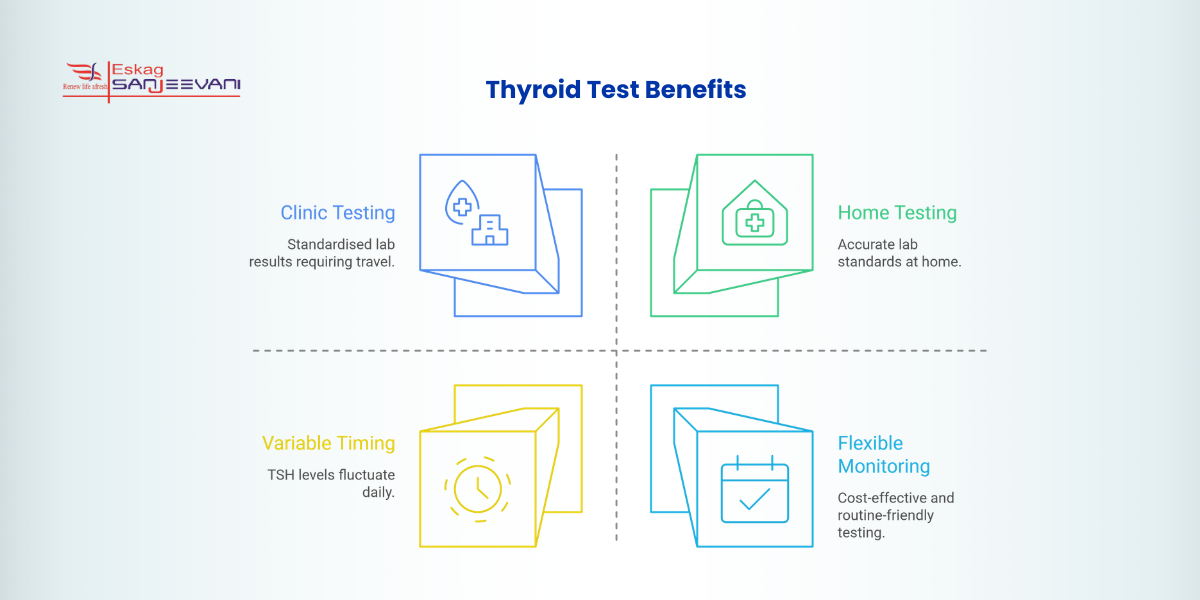
- Accessibility: Home collection eliminates travel time and waiting-room stress, which is especially beneficial for elderly patients, those with mobility issues, or busy professionals.
- Standardisation: Certified labs maintain the same quality standards as clinic-based testing. Results are processed in accredited laboratories using standardised assays.
- Cost-Effectiveness: At-home thyroid profile tests are often comparatively cheaper than lab-based testing.
- Timing Flexibility: TSH follows a daily pattern, with levels generally higher overnight and in the early morning and lower later in the day. For consistent thyroid monitoring, morning collection at a similar time is preferable; a sample collected at 3 pm, when TSH is at its nadir, can produce a different result.
- Convenience for Monitoring: Patients on thyroid replacement therapy can easily schedule follow-up tests without disrupting daily routines.
However, ensure your chosen lab is NABL-accredited and uses standardised assay methods. Free T4 measurements vary significantly between labs, so consistency matters when tracking changes over time.
Subclinical Thyroid Dysfunction: The Grey Zone
Subclinical thyroid dysfunction represents the most challenging diagnostic scenario. These patients have abnormal TSH but normal free T4 (or T3), creating uncertainty about whether treatment is necessary.
For Subclinical Hypothyroidism
Treatment is clearly indicated in pregnancy, women planning pregnancy, and those with TSH >10 mIU/L. For TSH between 4.6-8.0 mIU/L in non-pregnant patients, current guidelines recommend reassessment after 3-6 months before initiating therapy. Positive TPO antibodies increase the likelihood of progression and may favour earlier treatment.
For Subclinical Hyperthyroidism
Treatment depends on TSH level and clinical context. Fully suppressed TSH (<0.03 mIU/L) warrants evaluation and possible treatment, especially in elderly patients, those with cardiac disease, or postmenopausal women at risk for osteoporosis. Subnormal-detectable TSH (0.04-0.4 mIU/L) typically requires only monitoring, as spontaneous normalisation occurs in 50-72% of cases.
Note for Patients Reading a Thyroid Report: What Are TPO Antibodies?
TPO antibodies are antibodies directed against thyroid peroxidase, an enzyme needed to produce thyroid hormones. The anti-thyroid peroxidase antibody (TPOAb) test helps identify autoimmune thyroid disease, particularly Hashimoto’s thyroiditis.
A positive TPO antibody result means the immune system is reacting against thyroid tissue.
Factors Affecting Thyroid Test Results
Several factors can temporarily alter thyroid function tests without indicating true thyroid disease:
- Medications: Amiodarone, lithium, interferon-alpha, and checkpoint inhibitors can induce thyroid dysfunction. Estrogen therapy increases thyroid-binding globulin, affecting total T4 but not free T4. Proton pump inhibitors and iron supplements impair T4 absorption.
- Acute Illness: During hospitalisation or severe infection, TSH may be transiently suppressed or elevated. Defer thyroid testing 2-3 weeks after acute illness resolution.
- Pregnancy: TSH reference ranges change by trimester. First trimester TSH should be 0.1-2.5 mIU/L, second trimester 0.2-3.0 mIU/L, and third trimester 0.3-3.5 mIU/L. Universal thyroid screening in early pregnancy is increasingly recommended in India.
- Circadian Variation: TSH follows a circadian rhythm, with peak levels in the early morning (8-9 AM) and lowest in the late afternoon (3 PM). This variation can cause TSH to fluctuate by 0.95-2.0 mIU/L, affecting clinical decisions.
- Iodine Status: In iodine-replete regions like most of urban India, hypothyroidism predominates. In historically iodine-deficient areas, thyroid autonomy and hyperthyroidism are more common.
Interpreting Contradictory Results
Occasionally, thyroid test results do not follow the expected pattern, such as high free T4 with normal or elevated TSH. These results need clinical review because medicines, acute illness, assay interference and uncommon thyroid or pituitary disorders can produce unusual combinations.
- Free T4 vs total T4: Free T4 is generally preferred because it reflects the hormone available to tissues and is less affected by changes in thyroid-binding proteins than total T4.
- Free T3 in routine testing: Free T3 is rarely needed for initial thyroid screening because TSH and free T4 usually provide enough information to assess primary thyroid dysfunction.
- When T3 is useful: T3 testing becomes more relevant when hyperthyroidism is suspected, but free T4 is normal, particularly when TSH is suppressed, and symptoms suggest excess thyroid hormone.
- Other causes: Assay interference, thyroid hormone resistance, pituitary disorders and medicines can also produce unexpected results.
If your thyroid results do not match your symptoms, your doctor may repeat the tests, review medicines or refer you to an endocrinologist for further assessment.
Comprehensive Thyroid Care at Eskag Sanjeevani Hospitals
At Eskag Sanjeevani Hospitals, thyroid evaluation combines specialist endocrinology care with hospital-based diagnostic support. The hospitals are NABH-accredited, while the pathology laboratory is NABL-accredited and operates 24×7.
- NABL-accredited thyroid testing: The pathology laboratory provides hormonal and biochemical investigations, with digital reports delivered through email or WhatsApp.
- Thyroid hormone and antibody testing: Thyroid evaluation can include TSH, free T4, free T3, total T4, total T3, and thyroid antibody tests, depending on clinical requirements.
- Turnaround time: Routine laboratory tests such as blood sugar and CBC are generally processed within a few hours. More specialised investigations may take around 24-48 hours.
- Specialist endocrinology care: The Diabetology and Endocrinology department provides diagnosis and management of thyroid and other hormonal disorders, including complex cases.
- Home sample collection: Patients can arrange blood sample collection at home, which can make regular thyroid monitoring easier.
Conclusion
If your thyroid results are abnormal, start by checking the TSH and free T4 values against the reference range on your report. Note any symptoms, medicines, pregnancy status and recent illness before discussing the results with your doctor. Keep previous thyroid reports and use the same laboratory when possible, so you can compare changes consistently over time. If you take any medicine, follow your prescribed testing schedule and inform your doctor before the blood test. Do not change your dose based on one result. At Eskag Sanjeevani Hospitals, endocrinology and laboratory services can support further evaluation when thyroid results remain unclear or abnormal.

Microbiologist with over 2 years of experience in medical writing, specialising in evidence-based healthcare content.

Clinical experience in diagnosis, treatment, and evidence-based patient care across a range of conditions.
References
- Unnikrishnan AG, Menon UV. Thyroid disorders in India: An epidemiological perspective. Indian J Endocrinol Metab. 2011 Jul;15(Suppl 2):S78-81.
- Koulouri O, Gurnell M. How to interpret thyroid function tests. Clin Med (Lond). 2013 Jun;13(3):282-6.
- Gosi, S.K.Y. and Garla, V.V. (2019). Subclinical hypothyroidism. [online] Nih.gov. StatPearls Publishing.
- Collet TH, Gussekloo J, Bauer DC, den Elzen WP, Cappola AR, Balmer P, Iervasi G, Åsvold BO, Sgarbi JA, Völzke H, Gencer B, Maciel RM, Molinaro S, Bremner A, Luben RN, Maisonneuve P, Cornuz J, Newman AB, Khaw KT, Westendorp RG, Franklyn JA, Vittinghoff E, Walsh JP, Rodondi N; Thyroid Studies Collaboration. Subclinical hyperthyroidism and the risk of coronary heart disease and mortality. Arch Intern Med. 2012 May 28;172(10):799-809.
A commonly used adult TSH reference range is around 0.40-4.0 mIU/L, but laboratories may report slightly different ranges based on their testing method and population. Always interpret your result using the reference range printed on your report.
A normal TSH does not exclude every thyroid disorder. Conditions such as central hypothyroidism can cause low free T4 despite a normal or mildly abnormal TSH, so persistent symptoms may require additional testing.
TSH is usually rechecked 6-8 weeks after starting or changing the dose. Once the dose is stable, testing is generally done annually unless symptoms or other clinical factors require earlier monitoring.
A family history increases the risk of thyroid disorders, particularly autoimmune conditions such as Hashimoto’s disease and Graves’ disease. Testing is worth discussing with your doctor if you have a first-degree relative with thyroid disease or develop symptoms such as unexplained weight changes, fatigue or palpitations.
For consistent monitoring, it is generally preferable to have the blood sample collected before your morning levothyroxine dose. Taking the medicine shortly before testing can temporarily raise free T4 and affect interpretation.