

 Medically Reviewed
Blood Test Report: How to Read CBC, LFT, KFT, Lipid Profile
A blood test report can reveal important changes in your blood cells, blood glucose, cholesterol and organ function. This is particularly relevant in India, where an estimated 7.7 crore adults over 18 years have type 2 diabetes, while nearly 25 million have prediabetes [1]. However, an abnormal value does not automatically indicate disease. The meaning depends on your symptoms, medical history, medicines and the reference range used by the laboratory.
This guide explains how to read common CBC, blood glucose, LFT, KFT and lipid profile results and when abnormal findings need medical review.
Key Takeaways
- A CBC evaluates red blood cells, white blood cells, haemoglobin and platelets, helping doctors assess anaemia, infection and other blood-related conditions.
- LFTs and KFTs assess different aspects of liver and kidney function, but abnormal results need clinical interpretation rather than self-diagnosis.
- A lipid profile measures cholesterol and triglycerides. LDL, HDL and triglyceride levels help assess cardiovascular risk alongside other risk factors.
Quick answer: A blood test report shows complete blood count (CBC), blood glucose, liver function tests (LFT), kidney function tests (KFT), and lipid profile
- What Is a Blood Test Report and How Should You Read It?
- CBC Test Full Form and How to Read the Results
- How to Read Blood Glucose and Diabetes Tests?
- LFT and KFT Test: What Do They Show?
- How to Read an Advanced Lipid Profile Test?
- When Should You Consult a Doctor About Your Blood Test Report?
- Blood Test Services at Eskag Sanjeevani Hospitals
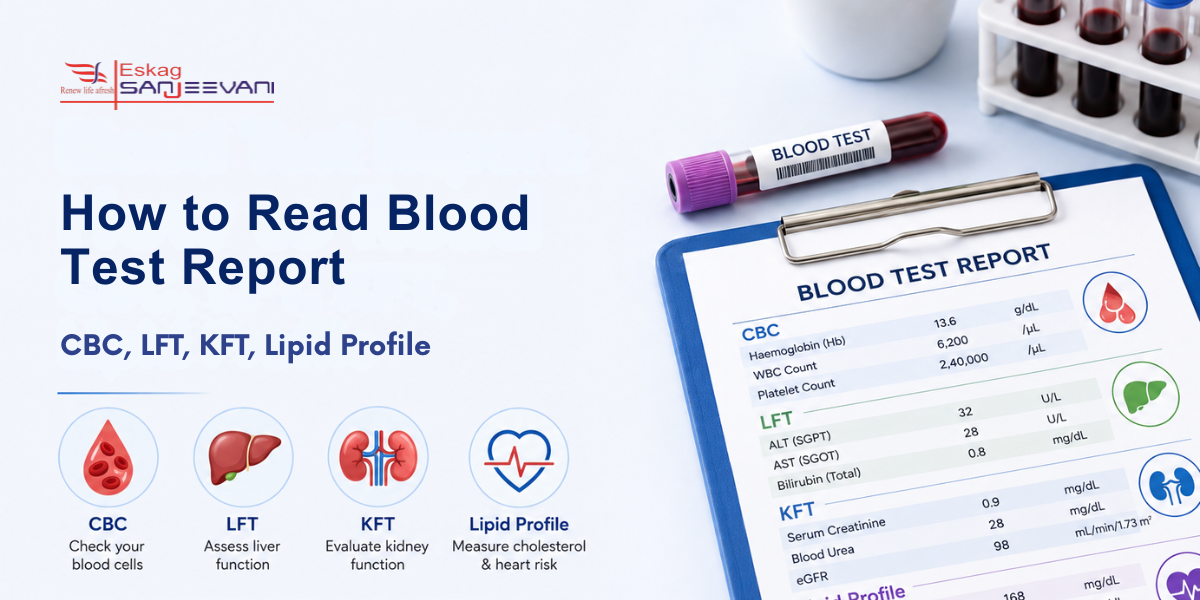
What Is a Blood Test Report and How Should You Read It?
A blood test report lists the substances measured in your blood, the result obtained, the unit used and a reference range. Some reports also flag results as high, low or outside the laboratory’s usual range.
Start by checking the test name and what it measures. Then compare your result with the reference range given on your report. Avoid using ranges from other websites because different pathology laboratories may use different testing methods and reference ranges.
Read a blood test report in context. Age, sex, pregnancy, medicines, hydration, recent illness, fasting status and existing medical conditions can affect some results.
Go through the following table to learn how to read a blood test report:
| Report section | What it tells you |
| Test name | Identifies the substance or measurement being assessed |
| Result | Shows your measured value |
| Unit | Indicates how the result is expressed |
| Reference range | Shows the range used by that laboratory for comparison |
| Flag | Indicates that the result is outside the laboratory’s stated range |
| Previous result | Helps compare the current value with earlier testing, when available |
For example, a haemoglobin value belongs to a CBC, while creatinine is commonly included in kidney function assessment. LDL cholesterol belongs to a lipid profile. If your blood test report contains several abnormal values, a General Medicine specialist can review the results alongside your symptoms, medical history and previous reports.
CBC Test Full Form and How to Read the Results
The full form of the CBC test is complete blood count. It measures different types of blood cells and related measurements. It is one of the most commonly performed blood tests and can help doctors investigate conditions such as anaemia, infections and abnormalities affecting blood cells.
Red Blood Cells and Haemoglobin
Red blood cells carry oxygen around the body. Haemoglobin is the oxygen-carrying protein inside these cells. Low haemoglobin can occur with anaemia. The CBC also includes:
- Haematocrit, which indicates the proportion of blood made up by red blood cells.
- MCV, which indicates the average size of red blood cells.
- MCH and MCHC, which provide information about the haemoglobin content of red blood cells.
- RDW, which shows variation in red blood cell size.
See the table below for common adult CBC reference values [3]:
| CBC | Typical adult reference range | What it indicates |
| Haemoglobin (Hb) | Men: 13-18 g/dL
Women: 12-16 g/dL |
Oxygen-carrying capacity of blood |
| Red blood cell count (RBC) | Men: 4.6-6.2 million/µL
Women: 4.2-5.4 million/µL |
Number of red blood cells |
| Haematocrit (Hct) | Men: 40-54%
Women: 36-48% |
Percentage of blood made up of red blood cells |
| White blood cell count (WBC) | 4,500-11,000/µL | Cells involved in immune response |
| Platelet count | 150,000-400,000/µL | Helps blood clot normally |
| MCV | 80-100 fL | Average size of red blood cells |
| MCH | 27-32 pg/cell | Average amount of haemoglobin in each red blood cell |
| MCHC | 32-36 g/dL | Concentration of haemoglobin inside red blood cells |
| RDW | 11.5-15% | Variation in red blood cell size |
White Blood Cells
White blood cells are involved in the body’s immune response. A raised white blood cell count can occur with infections and inflammation, although medicines, stress and other conditions can also affect the result. The normal range in adults is within 4,500-11,000 cells/µL.
Platelets
Platelets help the blood form clots. A low platelet count can increase the risk of bleeding in some situations, while a high count can occur with several conditions, including inflammation or iron deficiency. The typical adult range for platelets is 150,000-400,000 cells/µL.
How to Read Blood Glucose and Diabetes Tests?
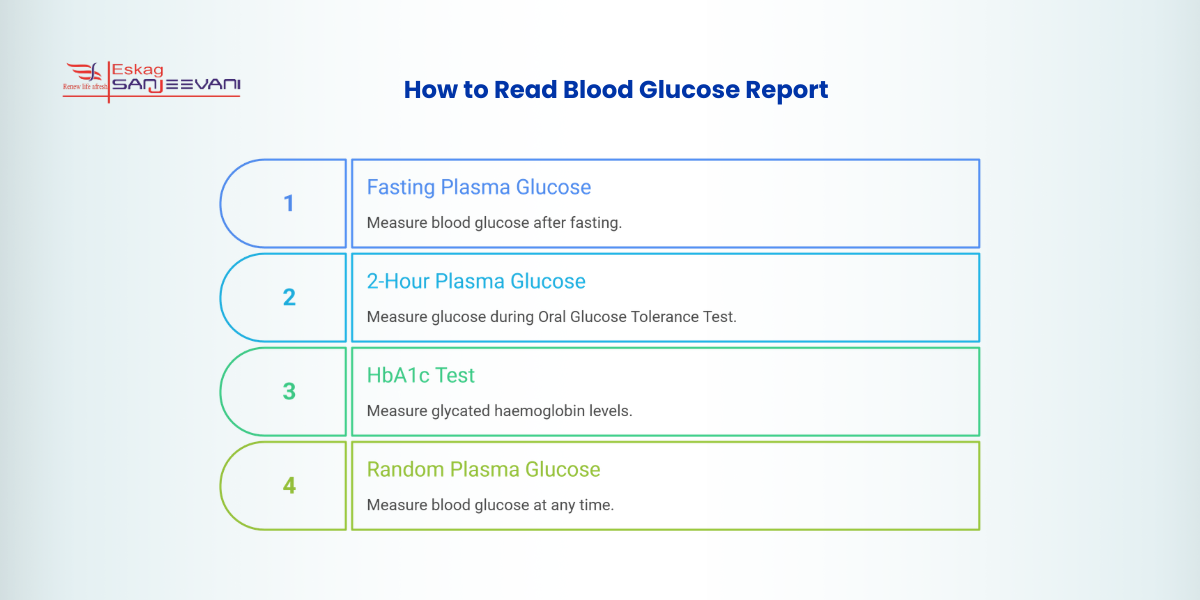
Blood glucose testing measures the amount of glucose in your blood at a specific time. In India, this is particularly relevant because WHO estimates that 77 million adults over 18 years have type 2 diabetes, while nearly 25 million have prediabetes. More than half of people with diabetes are estimated to be unaware of their condition [2].
The main tests used to assess blood glucose include:
Fasting Plasma Glucose (FPG)
Normal: <100 mg/dL
Measures blood glucose after at least 8 hours of fasting. A value of 100-125 mg/dL falls within the prediabetes range, while ≥126 mg/dL is for diabetes.
2-Hour Plasma Glucose during Oral Glucose Tolerance Test (OGTT)
Normal: <140 mg/dL
Measures glucose two hours after consuming a standard 75 g glucose solution. A value of 140-199 mg/dL indicates impaired glucose tolerance, while ≥200 mg/dL meets the diagnostic threshold for diabetes when confirmed.
HbA1c (Glycated Haemoglobin)
Normal: <5.7%
Reflects average blood glucose over approximately the previous 2-3 months. An HbA1c of 5.7-6.4% is in the prediabetes range, while ≥6.5% meets the diagnostic threshold for diabetes when confirmed.
Random Plasma Glucose
≥200 mg/dL with typical symptoms
A random glucose measurement can support a diagnosis of diabetes when it reaches 200 mg/dL or above and is accompanied by typical symptoms such as excessive thirst, frequent urination or unexplained weight loss.
LFT and KFT Test: What Do They Show?
LFT and KFT test results provide information about two different organ systems. LFT refers to liver function tests, while KFT commonly refers to kidney function tests.
LFT: Liver Function Test
A group of blood tests used to assess liver health and identify patterns that suggest liver or bile duct problems.
- ALT (Alanine Aminotransferase): Normal: 7-56 U/L
An enzyme that can rise when liver cells are injured.
- AST (Aspartate Aminotransferase): Normal: 10-40 U/L
An enzyme found in the liver and other tissues. Raised levels can occur with liver or muscle injury.
- ALP (Alkaline Phosphatase): Normal: 44-147 U/L
Can increase with certain liver, bile duct and bone conditions.
- Bilirubin: Normal: 0.1-1.2 mg/dL
A substance formed during the breakdown of red blood cells and processed by the liver.
- Albumin: Normal: 3.5-5.0 g/dL
A protein made by the liver. Low levels can occur with several liver and non-liver conditions.
- Total Protein: Normal: 6.0-8.3 g/dL
Measures the total amount of major proteins in the blood, including albumin and globulins.
- GGT (Gamma-Glutamyl Transferase): Normal: 9-48 U/L
An enzyme that can help assess certain liver and bile duct abnormalities.
KFT: Kidney Function Test
KFT stands for Kidney Function Test. It is a group of blood tests used to assess kidney filtration, waste removal and electrolyte balance.
- Serum Creatinine: Normal: 0.6-1.3 mg/dL
A waste product removed mainly by the kidneys.
- Blood Urea: Normal: 15-45 mg/dL
Measures urea, a waste product formed when the body breaks down protein.
- eGFR (Estimated Glomerular Filtration Rate): Normal: ≥90 mL/min/1.73 m² [4]
Estimates how efficiently the kidneys filter blood. An eGFR below 60 that persists for at least three months can indicate chronic kidney disease.
- Sodium (Na⁺): Normal: 135-145 mmol/L
Helps assess fluid and electrolyte balance.
- Potassium (K⁺): Normal: 3.5-5.0 mmol/L
An important electrolyte needed for normal nerve and muscle function.
How to Read an Advanced Lipid Profile Test?
An advanced lipid profile test measures different types of cholesterol and fats in the blood. The exact parameters included can vary by pathology lab and test package.
For a standard adult lipid profile, commonly used values include:
Step 1: Check Total Cholesterol and LDL
- Total Cholesterol: <200 mg/dL is generally considered desirable. It shows the overall amount of cholesterol in your blood.
- LDL-C (Low-Density Lipoprotein Cholesterol): <100 mg/dL is generally considered optimal. LDL can contribute to plaque build-up in the arteries.
Step 2: Check HDL and Triglycerides
- HDL-C (High-Density Lipoprotein Cholesterol): ≥40 mg/dL in men and ≥50 mg/dL in women. HDL helps transport cholesterol towards the liver.
- Triglycerides: <150 mg/dL. Higher levels can occur with diabetes, obesity, alcohol use and other metabolic conditions.
Step 3: Check Non-HDL Cholesterol
- Non-HDL Cholesterol: <130 mg/dL is generally desirable. It represents cholesterol carried by several potentially harmful lipoproteins.
When Should You Consult a Doctor About Your Blood Test Report?
Discuss your report with a doctor if several results are outside the reference range, an abnormality persists, or the result is associated with new symptoms.
Medical review is particularly important when abnormal results occur with:
- Discontinued tiredness or weakness
- Unexplained weight loss or weight gain
- Yellowing of the skin or eyes
- Swelling of the legs or face
- Changes in urine output
- Persistent fever
- Unusual bleeding or bruising
- Chest pain or breathlessness
- Repeatedly high blood glucose or blood pressure
Bring previous blood test reports to the consultation if available. They allow the doctor to compare results over time rather than assessing one report in isolation.
Blood Test Services at Eskag Sanjeevani Hospitals
When you need a blood test, getting an accurate report is only the first step. At Eskag Sanjeevani Hospitals, patients can access 24×7, NABL-accredited pathology services for routine and specialised investigations, including CBC, blood glucose, lipid profiles and kidney function tests.
Final Thoughts
A blood test report provides important information about your health, but it does not provide a diagnosis on its own. CBC results help assess blood cells and haemoglobin, while LFTs and KFTs provide information about liver and kidney function. Lipid testing helps assess cardiovascular risk. At Eskag Sanjeevani Hospitals, patients can access NABH-accredited hospital-based diagnostic services and a well-equipped pathology laboratory. If your blood test results are abnormal or difficult to understand, consult the Medicine department or explore the doctor directory for appropriate medical guidance.

Microbiologist with over 2 years of experience in medical writing, specialising in evidence-based healthcare content.

Clinical experience in diagnosis, treatment, and evidence-based patient care across a range of conditions.
References
- Draft second national essential diagnostics list. (2025b). [online] Available at:
- WHO (n.d.). Diabetes – India. [online] www.who.int. Available at: https://www.who.int/india/health-topics/diabetes.
- Brihi, J. El and Pathak, S. (2024). Normal and abnormal complete blood count with differential. [online]
- American Kidney Fund (2021). Blood test: eGFR | American Kidney Fund. [online]
A blood test report shows measured values for specific substances, cells or proteins in your blood. The results are compared with the reference range provided by the laboratory.
CBC stands for complete blood count. It measures red blood cells, white blood cells, platelets, haemoglobin and several related measurements.
LFTs measure substances such as liver enzymes, bilirubin and proteins. Doctors use the pattern of results to assess possible liver or bile duct problems.
A KFT commonly includes creatinine and urea, and some panels also measure electrolytes and report eGFR. The exact tests vary between laboratories.
Not necessarily. The appropriate lipid tests depend on your cardiovascular risk and the reason for testing. Your doctor can decide whether additional lipid measurements are useful.
Yes. Some results can change because of temporary illness, dehydration, medicines or other factors. Your doctor may repeat the test when appropriate.