

 Medically Reviewed
What is Cervical Spondylosis? Symptoms, Causes and Treatment
Prolonged neck pain, stiffness or pain spreading into the arm can sometimes be linked to cervical spondylosis. It occurs when age-related changes affect the discs, joints and bones in the neck. These changes are common, but they do not always cause symptoms. Studies reveal that more than 85% of people over 60 show cervical spondylosis changes [1]. The condition can often be managed without surgery, but symptoms suggesting nerve or spinal cord compression need medical assessment.
This guide explains what is cervical spondylosis, its causes and symptoms, and how doctors diagnose it.
Key Takeaways
- Cervical spondylosis is common with age. Indian Government treatment guidelines report a lifetime prevalence of 48.5%, with peak prevalence in the 40-49 age group.
- Neck pain may occur without nerve involvement. Arm pain, numbness, tingling, or weakness can indicate nerve-root compression, while walking or hand-coordination problems may suggest spinal cord involvement.
- A meta-analysis found degenerative changes on MRI in 64.5% of asymptomatic individuals across the included studies, showing why scan findings must be matched with symptoms and examination.
- What Is Cervical Spondylosis?
- What Are the Symptoms of Cervical Spondylosis?
- What Causes Cervical Spondylosis and Who is More Likely to Develop It?
- How Is Cervical Spondylosis Diagnosed?
- Does an MRI Always Mean Your Cervical Spondylosis Is Severe?
- How Is Cervical Spondylosis Treated?
- Cervical Spondylosis Treatment at Eskag Sanjeevani Hospitals
What Is Cervical Spondylosis?
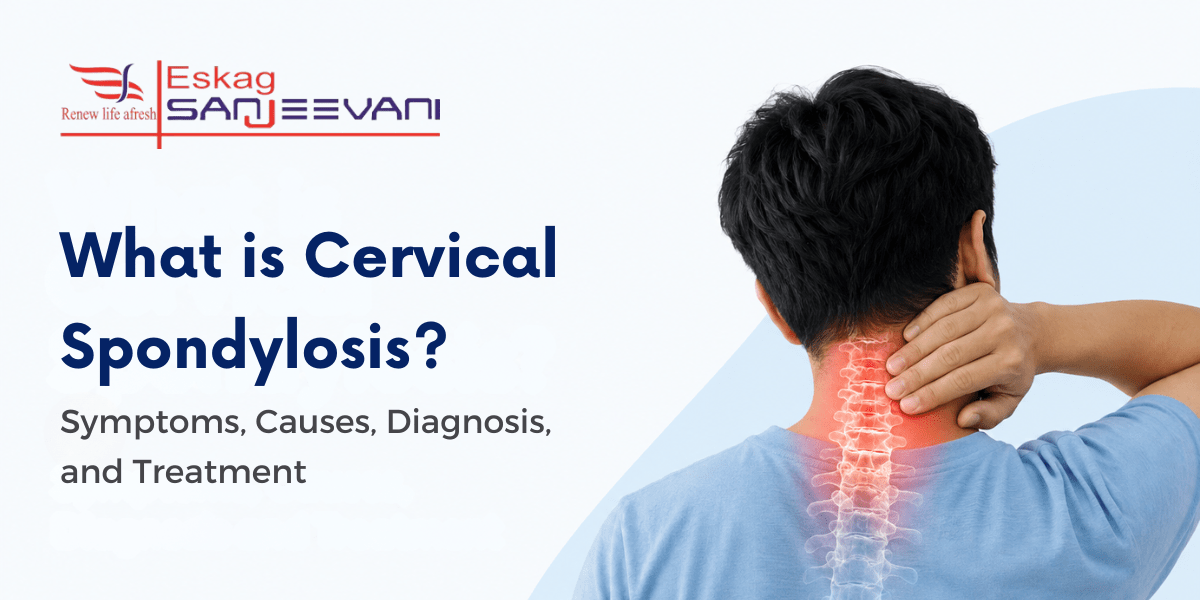
Cervical spondylosis is age-related degeneration of the structures in the cervical spine, which is the part of the spine in your neck. The discs between the vertebrae lose water and height over time. The joints also degenerate, and bone spurs (also called osteophytes) can develop. These changes reduce movement in the neck and, in some patients, narrow the spaces around nerves or the spinal cord.
Cervical spondylosis can therefore present in different ways:
- Neck pain and stiffness: Degeneration mainly affects the neck structures.
- Cervical radiculopathy: A nerve root becomes compressed, causing symptoms that often travel into the shoulder, arm or hand.
- Cervical myelopathy: The spinal cord becomes compressed, which affects hand coordination, balance, walking and strength.
What Are the Symptoms of Cervical Spondylosis?
Symptoms depend on which structures are affected.
Neck Pain and Stiffness
The most common symptoms include:
- Neck pain
- Neck stiffness
- Reduced neck movement
- Pain around the shoulders
- Headaches around the back of the neck
Symptoms of Nerve Compression
A compressed cervical nerve can cause symptoms beyond the neck. Patients often experience:
- Pain travelling from the neck into the shoulder or arm
- Tingling in the arm or hand
- Numbness
- Weakness in the arm or hand
- Changes in reflexes
The location of these symptoms can help the doctor identify which nerve may be involved.
Symptoms of Spinal Cord Compression
Spinal cord compression is more serious than uncomplicated neck pain. Possible symptoms include:
- Difficulty with buttons, writing, or other fine hand movements
- Clumsy hands
- Balance problems
- Difficulty walking
- Weakness or numbness in the arms or legs
- Changes in coordination
- Bladder or bowel problems in advanced cases
Heads-up: New bladder or bowel control problems, particularly with weakness or walking difficulties, require urgent assessment because they can indicate significant spinal cord involvement.
What Causes Cervical Spondylosis and Who is More Likely to Develop It?
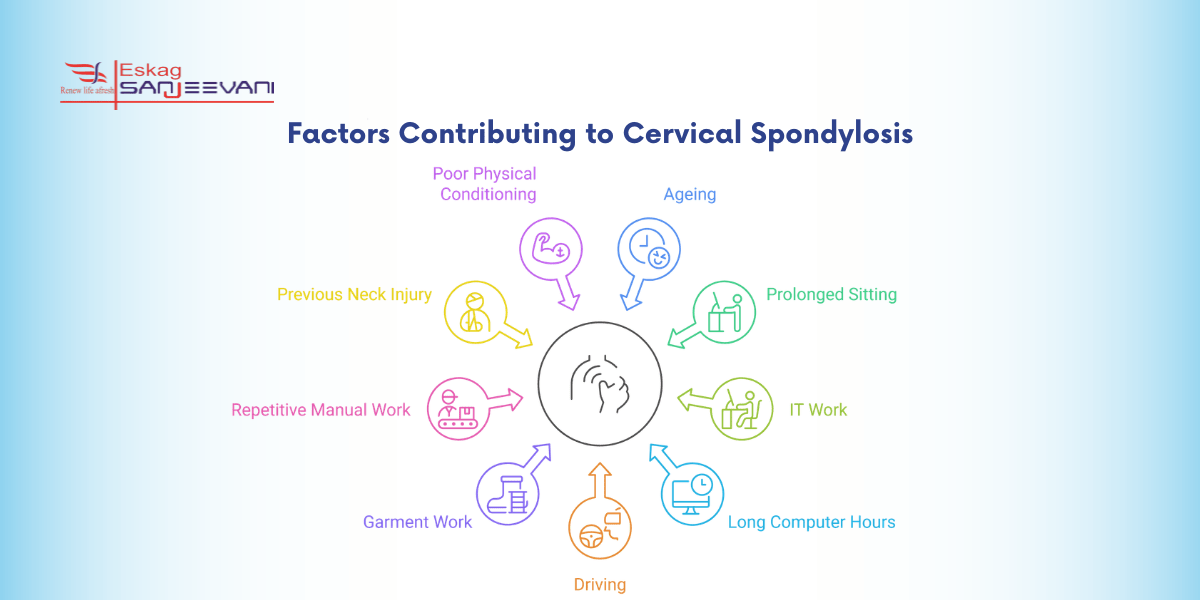
Cervical spondylosis mainly develops because the discs, joints and bones in the neck undergo age-related wear. However, some work and lifestyle factors add repeated stress to the cervical spine.
- Ageing: Disc dehydration and wear increase with age, making degenerative changes more common.
- Prolonged sitting: Sitting for long periods, especially with the head bent forward, places sustained strain on the neck muscles and cervical spine.
- IT and desk-based work: Indian research among desk workers found a one-year prevalence of work-related neck pain of 28.3% [2]. Poor posture, inadequate breaks and incorrect screen height were important workplace factors.
- Long hours at a computer: Extended computer use increases neck strain, particularly when the screen is poorly positioned or breaks are infrequent.
- Driving: Professional drivers spend several hours in a fixed sitting position, with prolonged neck and shoulder loading. Repeated exposure to these postures contributes to neck pain and stiffness.
- Garment and tailoring work: Tailors and garment workers often spend long periods with the neck bent forward while doing detailed, repetitive work.
- Repetitive manual work: Repeated lifting, carrying, pushing, or pulling increases mechanical stress on the neck and upper back.
- Previous neck injury: Earlier trauma often affects the cervical spine and contributes to later degenerative changes.
- Poor physical conditioning: Weak neck and upper-back muscles reduce support for the cervical spine and make prolonged postures harder to tolerate.
How Is Cervical Spondylosis Diagnosed?
Diagnosis starts with your symptoms and a physical examination. Doctors mainly examine the patient’s:
- Neck movement
- Muscle strength
- Sensation
- Reflexes
- Hand coordination
- Walking and balance
The following tests are most commonly used to assess cervical spondylosis signs and symptoms.
| Test | What It Shows |
| X-ray | Disc-space narrowing, bone spurs and other bony changes |
| MRI | Discs, nerves, spinal cord and areas of compression |
| CT scan | Detailed information about bones and the spinal canal |
| EMG/nerve conduction studies | Helps assess nerve function when the diagnosis is uncertain |
Key insight: Indian Government guidelines identify X-rays as an initial investigation in appropriate patients and MRI as an important investigation when radiculopathy or myelopathy is suspected.
Special Test For Cervical Spondylosis
Doctors use specific physical examinations to find out cervical spondylosis causes:
- Spurling’s test: The doctor gently positions and compresses the neck to see whether it reproduces pain or other symptoms radiating into the arm.
- Shoulder abduction test: The patient places the affected arm over the head. Relief of radiating arm symptoms suggests cervical nerve-root compression.
- Lhermitte’s sign: Bending the neck forward may trigger a brief electric-shock-like sensation down the spine or into the arms or legs. It can occur with cervical spinal cord involvement, but it is not specific to cervical spondylosis.
Does an MRI Always Mean Your Cervical Spondylosis Is Severe?
In simple terms, no. Degenerative changes can appear on an MRI even when a person has no symptoms. A meta-analysis covering 5,059 asymptomatic individuals found degenerative multilevel disc changes in 64.5% of participants [3].
Another systematic review estimated asymptomatic cervical spinal cord compression in 24.2% of healthy individuals [4].
How Is Cervical Spondylosis Treated?
Treatment depends on your symptoms and whether a nerve or the spinal cord is involved.
Medicines
Doctors often prescribe the following medicines, depending on the patient’s condition:
- Pain-relieving medicines
- Anti-inflammatory medicines
- Muscle relaxants
- Medicines for nerve-related pain
Physiotherapy
Physiotherapy is commonly used for persistent neck symptoms, alongside the below-mentioned exercises:
- Neck mobility exercises
- Strengthening exercises
- Upper-back exercises
- Posture correction
- Activity modification
Lifestyle and Daily Activity
You do not necessarily need to stop normal activity because of cervical spondylosis. Helpful measures include:
- Take regular breaks during prolonged sitting.
- Keep your computer screen at a comfortable height.
- Avoid staying in one neck position for long periods.
- Maintain regular physical activity.
- Follow exercises recommended by your physiotherapist.
- Avoid smoking.
Cervical Spondylosis Treatment at Eskag Sanjeevani Hospitals
Eskag Sanjeevani Hospitals provides specialist care for patients with cervical spondylosis, from evaluation of chronic neck pain to assessment of nerve and spinal cord symptoms.
If you are wondering how to cure cervical spondylosis permanently, our Orthopaedics department provides musculoskeletal care, while the Neurology department can assess symptoms such as numbness, weakness, altered sensation, and other signs of nerve involvement.
What Should You Do If You Have Cervical Spondylosis?
A diagnosis on an X-ray or MRI does not by itself determine how serious your condition is. Your symptoms, neurological examination and scan findings need to be considered together.
At Eskag Sanjeevani Hospitals, patients can access orthopaedic, neurology and spine care within a multispeciality hospital setting. If you are searching for the best medicine doctor in Kolkata, explore Eskag Sanjeevani Hospitals’ doctor directory to schedule a consultation.

Microbiologist with over 2 years of experience in medical writing, specialising in evidence-based healthcare content.

Clinical experience in diagnosis, treatment, and evidence-based patient care across a range of conditions.
References
- Kuo, D.T. and Tadi, P. (2023). Cervical spondylosis. [online] PubMed. Treasure Island (FL): StatPearls Publishing.
- Darivemula, S.B., Goswami, K., Gupta, S.K., Salve, H., Singh, U. and Goswami, A.K. (2016). Work-related neck pain among desk job workers of tertiary care hospital in New Delhi, India: Burden and determinants. Indian Journal of Community Medicine: Official Publication of Indian Association of Preventive & Social Medicine.
- Banerjee A, Mowforth OD, Nouri A, Budu A, Newcombe V, Kotter MRN, Davies BM. The Prevalence of Degenerative Cervical Myelopathy-Related Pathologies on Magnetic Resonance Imaging in Healthy/Asymptomatic Individuals: A Meta-Analysis of Published Studies and Comparison to a Symptomatic Cohort. J Clin Neurosci.
- Smith SS, Stewart ME, Davies BM, Kotter MRN. The Prevalence of Asymptomatic and Symptomatic Spinal Cord Compression on Magnetic Resonance Imaging: A Systematic Review and Meta-analysis. Global Spine J.
Yes. A compressed cervical nerve can cause pain, tingling, numbness or weakness that travels from the neck into the arm and hand.
The age-related structural changes cannot usually be reversed. However, symptoms can often be controlled with appropriate treatment, exercise and activity changes.
Yes, if the spinal cord is compressed. Leg weakness, balance problems or difficulty walking can indicate cervical myelopathy and need medical assessment.
No. The need for MRI depends on your symptoms and examination. It is particularly useful when nerve or spinal cord compression is suspected.
Yes. Many patients are managed with medicines, physiotherapy, exercise and activity modification. Surgery is mainly considered when neurological problems are significant, progressive or do not improve with appropriate non-surgical treatment.
Most cases are not dangerous and can be managed without surgery. However, symptoms such as progressive weakness, hand clumsiness, balance problems or difficulty walking may indicate spinal cord involvement and require prompt assessment.