

 Medically Reviewed
Kidney Biopsy: When and Why Doctors Recommend One
A kidney biopsy removes a small sample of kidney tissue for laboratory examination. Doctors may recommend it when blood tests, urine tests and scans cannot explain the cause of kidney damage. The findings can identify the type of kidney disease, show how much damage has occurred and help guide treatment. In India, kidney biopsies are commonly used when doctors suspect glomerular diseases, unexplained kidney failure or other conditions affecting kidney tissue.
This article will give you a clear picture of kidney biopsy, its indications, process, and other nuances.
Key Takeaways
- Kidney biopsy can identify specific kidney diseases that routine blood and urine tests and imaging may not confirm, including lupus nephritis, membranous nephropathy, and IgA nephropathy.
- Indian biopsy studies show different disease patterns across patient groups. One Central India study of 800 biopsies found glomerular disorders in 5% of cases, with lupus nephritis accounting for 17.4%.
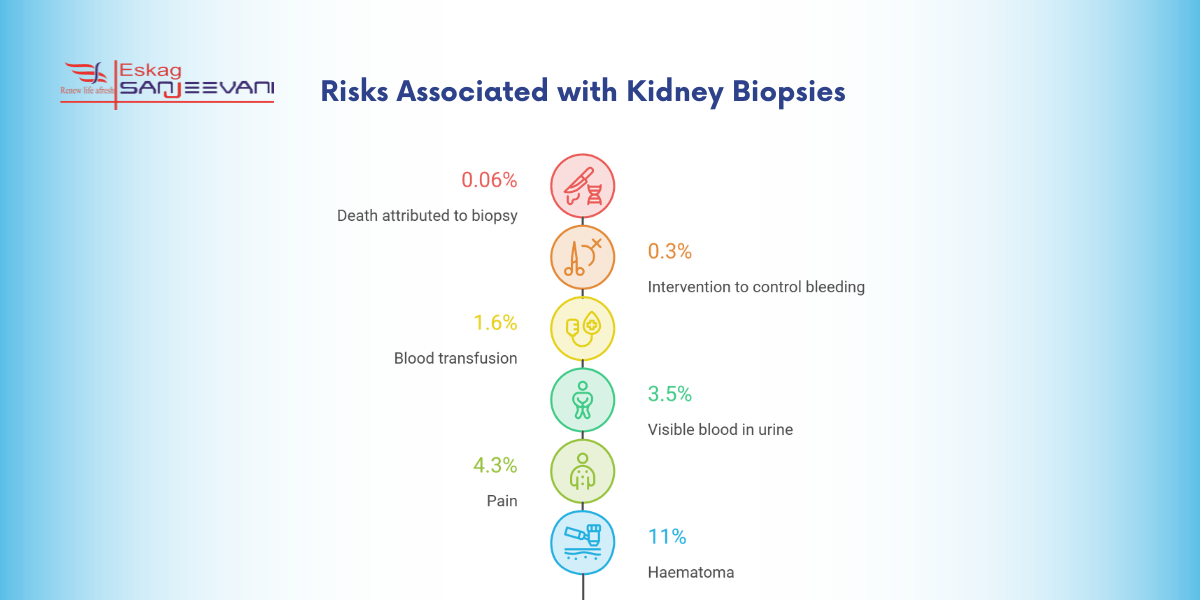
- Bleeding is the main risk, but serious complications are uncommon. A meta-analysis of 118,064 native kidney biopsies reported blood transfusion in 6%, bleeding-control intervention in 0.3%, and biopsy-related death in 0.06% .
- What Is A Kidney Biopsy?
- Kidney Biopsy Indications: When Is It Recommended?
- When May A Kidney Biopsy Be Delayed Or Avoided?
- What Do Indian Kidney Biopsy Studies Show?
- Kidney Biopsy Procedure: How Is It Performed?
- Is a kidney biopsy painful?
- How Long Does It Take To Get Kidney Biopsy Results?
- What Are The Risks Of A Kidney Biopsy?
- When Should You Contact A Doctor After A Kidney Biopsy?
- Kidney Biopsy at Eskag Sanjeevani Hospitals

What Is A Kidney Biopsy?
A kidney biopsy involves removing one or more tiny pieces of kidney tissue. A pathologist then examines the tissue under a microscope to look for signs of disease or damage. There are different kinds of kidney biopsies; a few of the most commonly used ones are the following:
- Percutaneous biopsy: A needle passes through the skin into the kidney. This is the most common approach.
- Ultrasound-guided biopsy: Ultrasound helps the doctor guide the needle to the kidney.
- CT-guided biopsy: CT imaging is used when ultrasound guidance is unsuitable.
- Transjugular biopsy: The kidney is reached through a vein. It is considered safer in selected patients with higher bleeding risk.
Kidney Biopsy Indications: When Is It Recommended?
Doctors do not recommend a biopsy for everyone with abnormal kidney test results. The decision depends on the suspected disease and whether the result could change treatment. Common kidney biopsy indications include:
- Persistent protein in urine: A biopsy identifies the kidney disease causing significant or unexplained protein loss.
- Blood in urine: Persistent blood in urine requires tissue examination when a kidney disorder is suspected.
- Unexplained kidney dysfunction: A biopsy helps to investigate a sudden or progressive decline in kidney function.
- Rapidly progressive kidney disease: A biopsy helps to figure out the diseases causing rapid loss of kidney function.
- Kidney disease linked to systemic conditions: Diseases affecting several organs can also damage the kidneys.
When May A Kidney Biopsy Be Delayed Or Avoided?
A kidney biopsy is avoided if the patient has the following symptoms:
- Uncontrolled blood pressure: High blood pressure can increase bleeding risk.
- Bleeding or clotting problems: Abnormal clotting needs assessment and correction before biopsy.
- Blood-thinning medicines: Medicines such as anticoagulants and some antiplatelet drugs may need review.
- Small or shrunken kidneys: A biopsy provides limited useful tissue and carries additional concerns.
- Certain kidney infections: Active infection needs treatment first.
What Do Indian Kidney Biopsy Studies Show?
Indian studies show that the diseases found on biopsy vary between patient groups and regions.
A two-centre study from Central India analysed 800 kidney biopsies. Glomerular disorders accounted for 90.5% of cases. Lupus nephritis was the most common diagnosis at 17.4%, followed by membranous nephropathy at 15.5%, minimal change disease at 13.7% and IgA nephropathy at 13.2% [3].
An earlier South Indian study of 1,849 biopsies found nephrotic syndrome was the most common reason for biopsy, accounting for 49% of cases. Chronic renal failure accounted for 13.6%, while rapidly progressive renal failure accounted for 12% [4].
Kidney Biopsy Procedure: How Is It Performed?
The usual kidney biopsy procedure is a percutaneous (passed or performed through the skin) biopsy performed with imaging guidance.
Before the Procedure
The doctor reviews your medicines, blood pressure, kidney function, and blood-clotting tests. Tell the medical team if you take blood thinners, aspirin, or other medicines that can affect bleeding. Do not stop any prescribed medicine without medical advice.
Here are a few checks and precautions tabulated below that can help reduce risks and ensure the procedure is performed safely.
| Preparation | What you should do |
| Medicines | Tell your doctor about blood thinners, aspirin, painkillers and supplements. Do not stop any medicine without medical advice. |
| Blood tests | You may need blood tests to check haemoglobin and blood clotting. |
| Blood pressure | Your blood pressure should be controlled before the procedure. |
| Fasting | Follow the hospital’s instructions about eating and drinking before the biopsy. |
| Transport | Arrange for someone to accompany you if sedation is planned or advised by the hospital. |
| Medical history | Inform the medical team about previous bleeding problems, allergies, infections, or kidney surgery. |
During the Procedure
You usually lie on your stomach for a native kidney biopsy. The skin over the kidney is cleaned, and local anaesthetic is given to numb the area. Ultrasound is commonly used to locate the kidney and guide the needle. The doctor then passes a biopsy needle through the skin to collect small tissue samples. The procedure itself is usually completed within a short period, but preparation and observation take additional time.
After the Procedure
You are monitored for several hours. The team checks your blood pressure, pulse, and urine for signs of bleeding. Some patients can go home after observation. Others may need overnight monitoring based on their medical condition and bleeding risk.
Is a kidney biopsy painful?
A local anaesthetic is used to numb the biopsy area. You may feel a brief sting from the anaesthetic, followed by pressure when the biopsy needle is used.
Mild soreness can occur afterwards and usually improves over the next few days.
How Long Does It Take To Get Kidney Biopsy Results?
Routine kidney biopsy results take several days (often takes 7 to 10 days). Some cases requiring additional laboratory tests extend the reporting time. In urgent situations, a preliminary report is often made for the initial treatment.
What Are The Risks Of A Kidney Biopsy?
Bleeding is the main risk because the kidneys receive a high blood supply. A systematic review and meta-analysis of 118,064 native kidney biopsies estimated:
- Pain: 3%
- Haematoma: 11%
- Visible blood in urine: 5%
- Blood transfusion: 6%
- Intervention to control bleeding: 3%
- Death attributed to biopsy: 06% [6]
When Should You Contact A Doctor After A Kidney Biopsy?
Seek medical attention if you develop:
- Heavy or persistent blood in the urine
- Blood clots in the urine
- Increasing or severe pain
- Fever (over 100 degree celsius)
- Dizziness or fainting
- Difficulty passing urine
- Increasing swelling, redness, or bleeding at the biopsy site
Kidney Biopsy at Eskag Sanjeevani Hospitals
If you are searching for the best nephrologist in Kolkata, consider Eskag Sanjeevani’s expert nephrology team, their clinical experience and access to relevant diagnostic and hospital services. Eskag Sanjeevani Hospitals has a dedicated nephrology department with nephrologists practising across its Baghbazar, Baranagar and Khardah hospitals.
You can also review the hospital’s nephrology services and doctor directory before scheduling a consultation.
Final Thoughts
kidney biopsy is not needed for every kidney problem. Doctors usually recommend it when blood tests, urine tests and imaging cannot clearly identify the cause of kidney damage, or when knowing the exact diagnosis could change treatment. The biopsy can show patterns such as inflammation, immune deposits and scarring that routine tests cannot provide. For patients looking for the best nephrologist in Kolkata, Eskag Sanjeevani Hospitals’ specialist nephrology team offers appropriate pre-procedure assessment, biopsy services, pathology support and post-procedure monitoring.

Microbiologist with over 2 years of experience in medical writing, specialising in evidence-based healthcare content.

Clinical experience in diagnosis, treatment, and evidence-based patient care across a range of conditions.
References
- Indian Journal of Nephrology. “Histopathological Spectrum of Kidney Biopsy in Central India: A Two Center Retrospective Study.”
Indian Journal of Nephrology: Central India Kidney Biopsy Study - Indian Journal of Nephrology. “Pattern of biopsy-proven renal disease in a single center of south India: 19 years experience.”
Indian Journal of Nephrology: South India Kidney Biopsy Study - Poggio ED, et al. “Systematic Review and Meta-Analysis of Native Kidney Biopsy Complications.” Clinical Journal of the American Society of Nephrology.
PubMed: Kidney Biopsy Complications Meta-analysis
Not necessarily. A biopsy may be considered when kidney function declines without a clear cause or when other findings suggest a specific kidney disease.
Sometimes. The need for a biopsy depends on the amount and persistence of protein, kidney function, other test results, and the suspected disease.
High blood pressure can increase bleeding risk. Doctors may need to control blood pressure before proceeding with the biopsy.
Yes, but diabetes alone does not mean a biopsy is required. A biopsy may be considered when kidney findings are unusual or suggest another disease in addition to diabetic kidney disease.
Follow the instructions given by your hospital. Eating and drinking instructions can vary depending on the procedure, sedation and your medical condition.
Most patients need a period of rest after the procedure. Strenuous activity and heavy lifting are generally avoided for about two weeks unless the treating doctor advises otherwise.