

 Medically Reviewed
Pacemaker Surgery: Who Needs It and How It Works
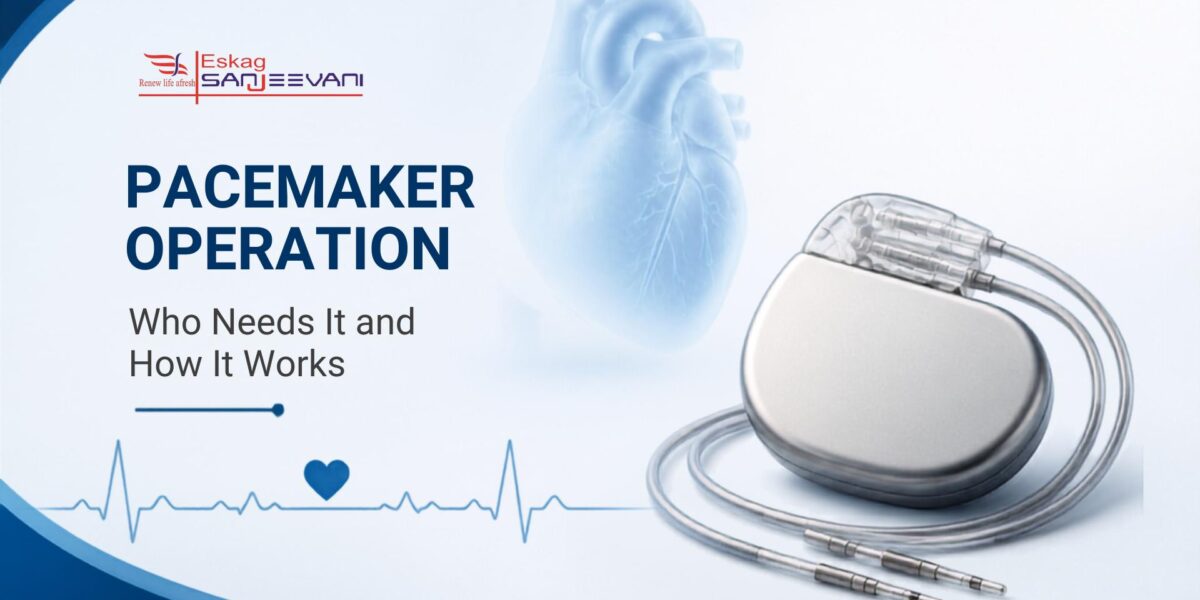
A pacemaker operation is one of the most common and effective cardiac procedures performed today. When the heart’s natural electrical system fails to keep a steady rhythm, a pacemaker steps in. It is a small device with a battery that checks your heartbeat and sends tiny electrical signals if your heart needs help beating properly [1]. It does not take over your heart. It only helps when your heart cannot keep a normal beat. For people who faint without warning, feel tired all the time, or have a very slow heartbeat, this device can make life much better. Knowing why a pacemaker is used, who may need one, and what happens during the procedure can help you feel more prepared.
This guide explains everything, from when a pacemaker is needed to the procedure and recovery, in simple, easy-to-understand words.
Key Takeaways
- A pacemaker is used when the heart beats too slowly, has a blocked electrical signal, or some heart problems do not get better with medicine.
- During the procedure, the doctor puts the small pacemaker just under the skin in the upper chest. Soft, thin wires are passed through a blood vessel and attached to the heart.
- People can usually return to their daily life and activities within a few days. The pacemaker battery lasts for many years and is replaced only after it runs low, usually after about 10 to 15 years.
Quick Answer: A pacemaker regulates a slow or irregular heartbeat using electrical pulses delivered through leads placed in the heart.
What Is the Purpose of a Pacemaker?
The heart has its own electrical system: a network of nodes and fibres that tells each chamber when to contract. The heart has its own natural signal maker called the sinoatrial (SA) node, which is found in the upper right chamber of the heart. It generates an impulse that travels to the atrioventricular (AV) node, then down the bundle of His and Purkinje fibres, producing a coordinated heartbeat.
When this system breaks down due to ageing, disease, or damage to the heart muscle, the rhythm can become too slow (bradycardia), too erratic, or blocked entirely. A pacemaker’s function is to fill that gap. It senses when the heartbeat drops below a set threshold and delivers a small electrical pulse to prompt a contraction [2].
The device does not work all the time. It only sends signals when your heart needs help beating properly. Some newer pacemakers can also make your heartbeat faster during exercise or other activities, helping your heart keep up with your body’s needs [3].
Who Needs a Pacemaker Operation?
Not every rhythm problem requires a pacemaker. The decision depends on the type of abnormality, its severity, and whether it causes symptoms. According to established cardiac guidelines, the following conditions are the most common indications:
| Condition | When a Pacemaker Is Indicated |
| Symptomatic sinus bradycardia | When the SA node fires too slowly, causing fatigue, dizziness, or fainting |
| Atrioventricular (AV) block | Mobitz II, complete, or advanced block, regardless of symptoms |
| Atrial fibrillation with slow ventricular rate | When the ventricular rate is consistently too low |
| Tachycardia-bradycardia syndrome | Alternating fast and slow rhythms that cannot be managed with medication alone |
| Heart failure (CRT candidates) | Biventricular pacing to resynchronise the heart’s chambers |
| Medication-induced bradycardia | When essential heart medications cause a dangerously low heart rate |
It is worth noting that a pacemaker for heart failure, specifically cardiac resynchronisation therapy (CRT), uses a biventricular device with three leads. This type is different from a regular pacemaker. Doctors usually use it only for people with severe heart failure when the heart’s pumping chambers do not beat together properly.
Doctors usually do not place a pacemaker if a person has a serious infection, especially one that has spread to the blood. It may also not be advised for someone with a terminal illness if the device is unlikely to improve their daily life.
Also read: Understanding Heart Health: A Complete Guide to Cardiology for Every Age
Types of Pacemakers
Choosing the right type of pacemaker depends on which chambers of the heart need to be paced.
- Single-chamber pacemaker: Uses one lead, placed in either the right atrium or right ventricle. Suitable for isolated sinus node dysfunction or simple ventricular pacing needs.
- Dual-chamber pacemaker: Uses two leads, one in the atrium and one in the ventricle, allowing the device to coordinate timing between both chambers.
- Biventricular pacemaker (CRT): Uses three leads. Two go to the ventricles, and one to the right atrium. It is used specifically as a pacemaker for heart failure with reduced ejection fraction.
- Leadless pacemaker: A newer, capsule-sized device delivered via catheter into the right ventricle, without any external leads or a chest pocket. Recovery tends to be faster.
Before surgery, the cardiology team runs some tests to confirm the indication and assess the patient’s baseline health. These typically include:
- ECG is needed to document the rhythm abnormality. An ECG test records the heart’s electrical signals and is usually the first diagnostic step.
- Holter monitoring is a 24-hour ECG worn during daily activities and is useful for detecting intermittent arrhythmias.
- Echocardiogram or ECHO, is an ultrasound of the heart to assess chamber size and pumping function. Read more about when an ECHO vs ECG is appropriate for your situation.
- A stress test is needed as it evaluates how the heart responds to physical exertion.
Patients on anticoagulants require special consideration before surgery, as the risk of pocket haematoma (a collection of blood around the device) is higher. The decision to pause or continue blood thinners is made on a case-by-case basis.
Prophylactic antibiotics are administered before the procedure, typically cefazolin 1–2 g or an equivalent, within one hour of the incision.
How a Pacemaker Operation Works?
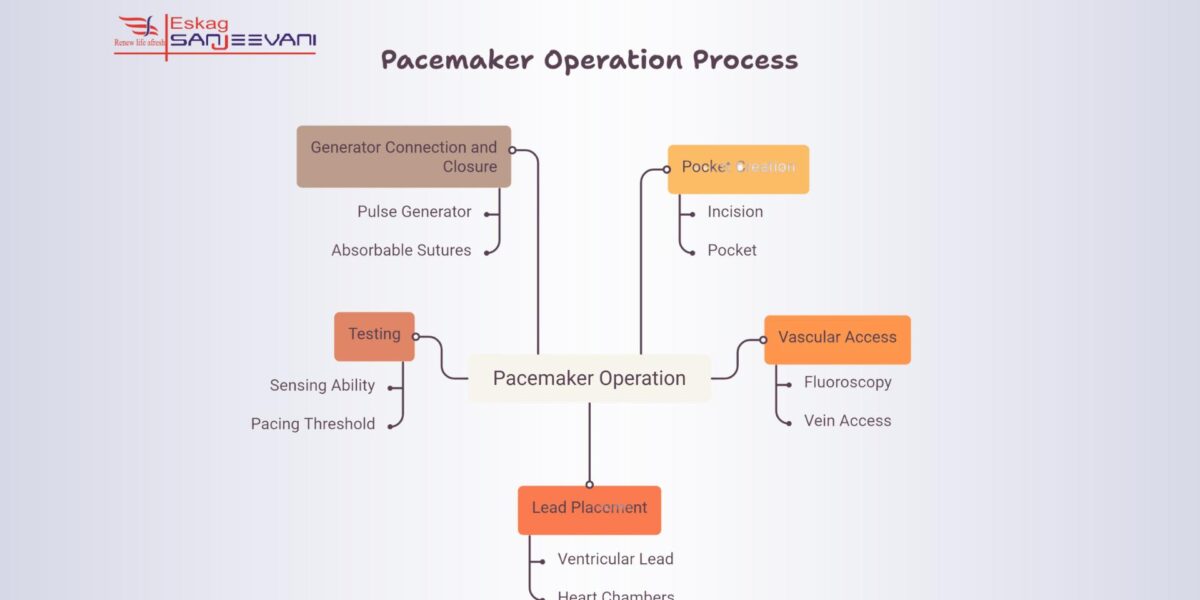
The most common type of pacemaker installation is the transvenous (through-the-vein) approach. The procedure generally takes two to five hours, and patients are awake or lightly sedated under local anaesthesia.
Here is what happens during the surgery:
1. Pocket creation
A small incision is made below the collarbone, usually on the left side. The surgeon creates a pocket beneath the skin, and sometimes beneath the pectoral muscle in lean patients, to hold the pulse generator.
2. Vascular access
The surgeon gains access to a large vein, typically the axillary or subclavian vein, using fluoroscopy (real-time X-ray) as a guide. Cephalic vein access is also used, as it carries a lower risk of pneumothorax.
3. Lead placement
One or more leads are threaded through the vein and advanced into the appropriate heart chambers under fluoroscopic guidance. The ventricular lead is placed first to provide backup pacing during the procedure. Each lead tip is screwed or clipped into the heart wall to keep it stable.
4. Testing
Once in position, each lead is tested for sensing ability and pacing threshold to confirm the device detects the heart’s signals accurately and delivers the pulse effectively.
5. Generator connection and closure
The leads are connected to the pulse generator, which is placed in the pocket. The incision is closed in two to three layers with absorbable sutures [1].
For leadless pacemakers, the entire device is delivered via a catheter inserted into the femoral vein in the groin and guided into the right ventricle. No chest incision is needed.
Risks and Complications
Pacemaker operations are generally safe with high success rates. However, as with any surgical procedure, risks exist:
- Infection: A small number of people may get an infection after the procedure. If the infection is serious, the pacemaker may need to be removed, and antibiotics will be given.
- Pocket haematoma: A small amount of blood may build up near the pacemaker after the procedure. The risk is higher if you take blood thinners.
- Lead movement: Sometimes, one of the pacemaker wires can move out of place. If this happens, the device may not work properly and may need to be adjusted.
- Pneumothorax: accidental puncture of the lung during vein access. This risk is minimised by using axillary or cephalic approach rather than subclavian puncture.
- Cardiac perforation: rare, reported in fewer than 1.5% of cases. Most occur within the first four weeks of implantation.
- Device malfunction: battery depletion or lead fracture requiring generator replacement.
Recovery After Pacemaker Surgery
Most patients are observed in hospital for one night. An X-ray is taken post-operatively to confirm correct device and lead positioning.
The recovery timeline generally looks like this:
- First 24–48 hours: Rest is advised. The arm on the side of the pacemaker should not be raised above shoulder height.
- First month: Avoid lifting anything heavier than about 4.5 kg, pushing or pulling heavy objects, and vigorous upper-body movement.
- 4–5 days post-surgery: Showering is safe.
- First few weeks: Most people return to desk-based work and light daily activity fairly quickly.
Patients receive a pacemaker identification card at discharge. This card contains device details and should be carried at all times, particularly when passing through airport security, where the device’s metal may trigger alarms.
Devices to Be Aware of After Pacemaker Installation
A pacemaker is generally resilient to everyday electromagnetic interference. However, patients should keep mobile phones at least 15 cm from the device and avoid resting the phone on the side where the pacemaker sits [3]. Medical procedures like MRI scans and some cancer radiation treatments can interfere with the device. Always inform your treating doctor that you have a pacemaker.
Pacemaker Function Over Time: Long-Term Care and Follow-Up
Most pacemaker batteries last between 10 and 15 years [2]. Battery replacement is simpler than the original surgery. The generator is swapped out while the existing leads remain in place.
Follow-up visits are typically scheduled every three to six months, and many modern pacemakers support remote monitoring, allowing the cardiology team to check device performance without the patient travelling to the clinic.
Patients with pacemakers can usually live full, active lives. Symptoms such as fatigue, dizziness, and fainting that prompted the original diagnosis are expected to resolve significantly after implantation.
If you notice bruising, swelling, or discharge at the pacemaker site, or if symptoms return, contact your cardiologist immediately. Similarly, sudden weight gain, ankle swelling, or recurrent fainting warrants prompt evaluation.
Conclusion
A pacemaker is a safe and commonly used device that helps the heart beat properly when its natural electrical system cannot keep a normal rhythm. It may be needed for a very slow heartbeat, heart block, or some types of heart failure. Knowing how a pacemaker works, what happens during the procedure, and what recovery is like can help you feel more ready and less worried. If your doctor has advised this procedure for you or a family member, talking to a cardiologist in Kolkata will help you understand your condition and clear up any questions you may have.

Microbiologist with over 2 years of experience in medical writing, specialising in evidence-based healthcare content.

Clinical experience in diagnosis, treatment, and evidence-based patient care across a range of conditions.
References
- Puette, Jeffrey A, and Matthew B Ellison. “Pacemaker Insertion.” StatPearls Publishing, 2024.
- Cleveland Clinic. “Permanent Pacemaker.” Cleveland Clinic, 28 Feb. 2022.
- Mayo Clinic (2023). Pacemaker. [online] Mayoclinic.org. Mayo Clinic.
No. Pacemaker surgery is usually a small procedure done under local anaesthesia. Most people go home within a day or two.
The pacemaker battery usually lasts about 10 to 15 years. Your doctor will check it during regular follow-up visits and replace it when needed.
Most people feel better within a few days and return to normal activities in about one to two weeks. Your doctor may ask you to avoid heavy lifting for a short time.
You may feel a little discomfort or soreness where the pacemaker is placed for a few days. Pain is usually mild and gets better with time.
Yes, but you may need to avoid sleeping on the side of the pacemaker for the first few weeks. Once the area has healed, most people can sleep comfortably in their usual position.