

 Medically Reviewed
Multi-Organ Failure: How ICU Teams Fight to Save Lives
In a recent study of 4,038 adult patients across 120 Indian ICUs, 46.4% had at least one organ failure, and mortality rose sharply with each additional organ that stopped working [1]. Multi-organ failure is a medical emergency where two or more important organ systems fail at the same time. Without immediate, specialised care, it is almost always fatal. Understanding what multi-organ failure is, what triggers it, and how intensive care units respond can make a real difference, especially for families navigating a crisis.
Key Takeaways
- Multi-organ failure occurs when two or more vital organs stop working simultaneously, making it one of the most serious emergencies managed in the intensive care unit.
- Sepsis, severe trauma, and major infections are the most common causes of multi-organ failure, and early recognition of symptoms is critical to survival.
- ICU teams support all the failing organs at once using ventilators, dialysis, and vasopressors while addressing the root cause.
Quick Answer: Multi-organ failure happens when two or more organs stop working properly, making urgent hospital treatment necessary.
- What Is Multi-Organ Failure?
- Which Organs Does It Affect?
- What Are the Multi-Organ Failure Symptoms?
- Causes of Multi-Organ Failure
- How Does the Multi-Organ System Break Down?
- How Is Multi-Organ Failure Diagnosed in the ICU?
- How Does the ICU Team Treat Multi-Organ Failure?
- What Affects the Chances of Recovery?
What Is Multi-Organ Failure?
Multi-organ failure, also called multiple organ dysfunction syndrome (MODS), is an acute illness in which two or multiple organ systems stop working as they should [2]. Organ systems are a set of organs that work together to carry out important jobs, such as helping us breathe, filtering the blood, or pumping blood around the body.
MODS may make it difficult for the body to keep working without life support, which helps do the work of the failing organs. It is not a slow, gradual process. Organs can begin to fail within hours of a triggering event. The condition is also referred to as multi-organ failure or multiple organ system failure.
MODS is common during acute critical illness. Studies report that it may occur in 28% to 88% of all critically ill people [2]. It is also the leading cause of death in people admitted to the surgical ICU.
Which Organs Does It Affect?
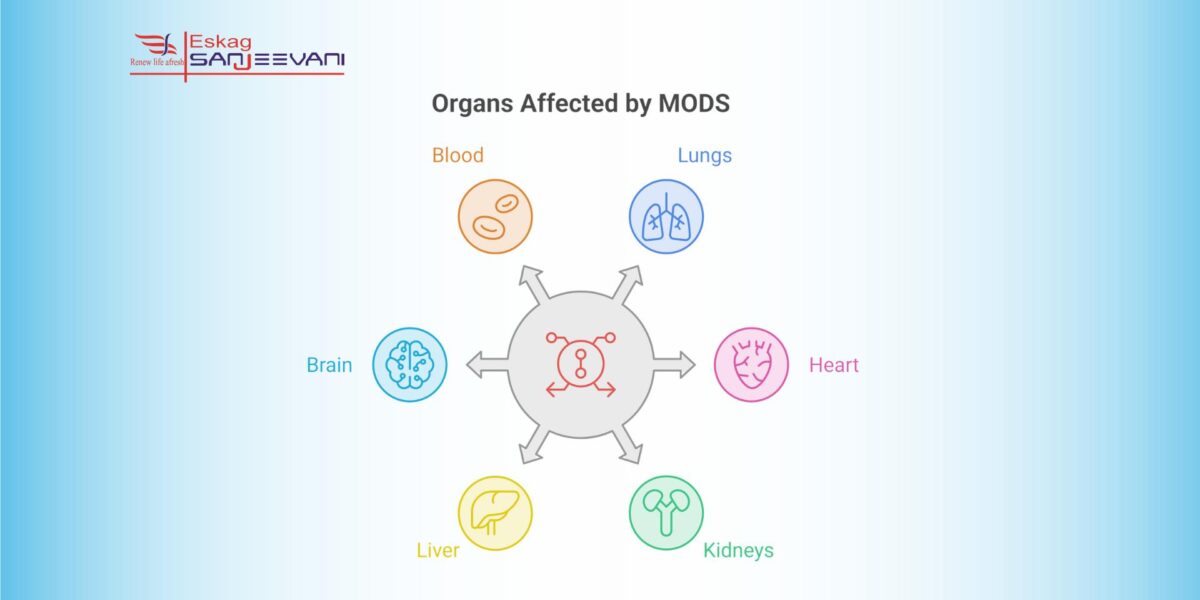
MODS can affect any organ in your body. The commonly affected organs include the lungs, heart, brain, kidneys, liver, and blood.
Here is how failure in each system presents:
| Organ System | What Happens During Failure |
| Lungs (Respiratory) | Breathing fails; mechanical ventilation may be needed |
| Heart (Cardiovascular) | Blood pressure drops; circulation weakens |
| Kidneys (Renal) | Waste products build up in the blood |
| Liver (Hepatic) | Toxins accumulate; skin may turn yellow |
| Brain (Neurological) | Confusion, delirium, or loss of consciousness |
| Blood (Haematologic) | Abnormal clotting or uncontrolled bleeding |
People with MODS initially have problems with their lungs. Healthcare providers do not yet fully understand why lung dysfunction usually comes first.
What Are the Multi-Organ Failure Symptoms?
Symptoms can be different depending on which organs are not working properly.
They may be mild in the early stages or may be severe. Families should watch for these warning signs:
- Sudden high fever or chills with no clear cause, alongside a rapid or irregular heartbeat that is not settling down on its own.
- Persistent confusion, difficulty concentrating, or an unusual change in the person’s mental alertness and responsiveness.
- Fast, shallow breathing or visible difficulty breathing, even when the person is resting or not exerting themselves.
- Yellow tint to the skin or eyes (jaundice), often paired with abdominal swelling or pain in the upper abdomen.
- Significant swelling in the hands and feet, along with blue or grey discolouration of the skin, lips, or fingernails.
If you notice any signs of MODS, go to the nearest emergency room immediately. It can become life-threatening if medical treatment is delayed.
Also read: 24×7 Advanced Emergency Facilities at Eskag Sanjeevani Hospitals, Kolkata
Causes of Multi-Organ Failure
Any major infection, illness, or injury can result in MODS. Current research suggests that widespread inflammation and decreased blood flow are often responsible. Septic shock and sepsis are the most common triggers; in Indian ICUs, patients with severe sepsis had a mortality rate of 34% [1].
MODS can develop through a series of events. A trigger such as sepsis or major trauma can cause a severe immune response and widespread inflammation. Later, infection or surgery may further worsen organ damage.
The most common causes of multi-organ failure include:
- Sepsis or septic shock from a serious bacterial or viral infection that causes body-wide inflammation and disrupts blood flow to organs.
- Severe trauma such as a road accident, major burns, or a gunshot wound that causes sudden, extreme physical damage.
- Pancreatitis, where inflammation of the pancreas triggers a cascade of immune reactions that can spread to other organ systems.
- A massive heart attack that cuts off blood supply not just to the heart but also reduces oxygen delivery to other vital organs.
- Liver failure from conditions like hepatitis B, hepatitis C, fatty liver disease, or cirrhosis that cause the liver to stop functioning.
In Indian ICUs, 28.3% of patients had severe sepsis or septic shock at some point during their ICU stay, with a mortality of 34.0%. This shows how infections can often trigger the chain of events that leads to multi-organ failure.
How Does the Multi-Organ System Break Down?
Understanding the multi-organ system helps clarify why one failing organ can pull others down with it. The body’s organs are deeply interconnected. When the lungs stop delivering enough oxygen, the kidneys suffer. When the heart cannot pump blood, the liver is starved of circulation. When the liver fails, toxins build up and reach the brain.
The spread of inflammation, clotting problems in the blood system, and low blood circulation can reduce blood flow to the brain, leading to brain damage and delirium in people with MODS.
Decreased blood flow and oxygen delivery can lead to damage across multiple organ systems simultaneously. This is why multi-organ failure is so difficult to treat; doctors must support all failing systems at once while also addressing the root cause.
How Is Multi-Organ Failure Diagnosed in the ICU?
There is no single test for multi-organ failure. ICU teams use a combination of assessments:
Healthcare providers may use blood tests, arterial blood gas analysis, liver function tests, kidney function tests, blood and tissue cultures, echocardiograms, and imaging such as ultrasound or CT scans to diagnose organ failure throughout the body.
In Indian ICUs, severity scoring tools like the APACHE II and SOFA scores are used to track how many organs are failing and how serious the condition is. In a study across 120 Indian ICUs, the mean SOFA score was 3.8, and mortality rose consistently as the number of organ failures increased [1].
How Does the ICU Team Treat Multi-Organ Failure?
ICU treatment for multi-organ failure is simultaneous, not sequential. The team does not wait for one organ to stabilise before supporting the next. Treatment targets include:
Doctors may give fluids through a vein to improve blood flow; medicines may help keep blood pressure up; antibiotics can fight infections; blood may be given if too much has been lost; oxygen can help with breathing; and a ventilator may help the patient breathe.
For kidney failure, dialysis may be used to help the body remove waste products and excess fluid from the blood. In most of the severe cases, extracorporeal membrane oxygenation (ECMO) can be used to add oxygen to the blood and remove carbon dioxide.
In Indian ICUs, 37% of patients received mechanical ventilation and 22.2% received vasopressors or inotropes on the study day. Patients who needed mechanical ventilation had a mortality of 35.6%, compared to 11.1% in those who did not.
What Affects the Chances of Recovery?
MODS survival is estimated at 50%–60%. Early recognition and treatment are crucial. Higher APACHE II and SOFA scores, severe sepsis or septic shock, respiratory failure, mechanical ventilation, and limited ICU resources are linked to higher mortality.
The quality of the ICU matters significantly. Mortality was higher in inadequately equipped ICUs compared to well-equipped ICUs, 27.8% versus 20.8%, despite similar illness severity scores [1]. For families, this reinforces the importance of choosing a hospital with the right critical care infrastructure when dealing with a potential multi-organ failure emergency.
Conclusion
Multi-organ failure is one of the most complex emergencies in intensive care medicine. When two or more vital systems shut down together, every hour matters. The multi-organ failure symptoms, from confusion and rapid breathing to jaundice and swelling, can escalate fast, and early ICU admission is critical.
At Eskag Sanjeevani, patients have access to advanced ICU care and a team of specialists to manage serious conditions like multi-organ failure. As data from Indian ICUs shows, the causes of multi-organ failure are often preventable triggers like sepsis, which accounts for a significant share of ICU deaths. Choosing the best ICU hospital one that is fully equipped, staffed by intensivists, and capable of providing mechanical ventilation, dialysis, and round-the-clock monitoring gives patients the best possible chance of survival.

Microbiologist with over 2 years of experience in medical writing, specialising in evidence-based healthcare content.

Clinical experience in diagnosis, treatment, and evidence-based patient care across a range of conditions.
References
- Divatia JV, Amin PR, Ramakrishnan N, Kapadia FN, Todi S, Sahu S, et al. Intensive Care in India: The Indian Intensive Care Case Mix and Practice Patterns Study. Indian J Crit Care Med. 2016;20(4):216–225.
- Cleveland Clinic. Multiple Organ Dysfunction Syndrome (MODS): Overview. Reviewed November 20, 2023.
Yes, recovery is possible, but it is a very serious condition. The blog estimates a survival rate of 50% to 60%. Early treatment and ICU care can improve the chances of recovery.
The lungs are usually affected first. The blog says that nearly all people with multi-organ failure initially have lung problems, although doctors do not fully know why.
Death can occur when several vital organs stop working properly. Severe sepsis, septic shock, breathing failure and the need for mechanical ventilation are linked with a higher risk of death.
The estimated survival rate for multi-organ failure is 50% to 60%. The outcome can vary based on the cause, number of organs affected and severity of illness.
The blog does not specifically state whether multi-organ failure is painful. However, symptoms can include difficulty breathing, confusion, abdominal pain, swelling and other serious changes.