

 Medically Reviewed
ERCP Explained: Procedure for Stone Removal and Bile Duct Problems
If you’re experiencing yellowing skin, persistent abdominal pain, or your doctor mentioned bile duct obstruction, endoscopic procedures can feel overwhelming. ERCP (Endoscopic Retrograde Cholangiopancreatography) is one of gastroenterology’s most effective yet misunderstood procedures. Thousands of patients undergo ERCP safely each year with high success rates, especially when performed by experienced specialists. This guide walks you through every step—from why the procedure is needed to recovery.
You’ll understand MRCP vs ERCP differences, recognise medical terminology your doctor uses, and make informed decisions about your care with confidence.
Key Takeaways:
- ERCP successfully removes bile duct stones and treats blockages in 95%+ of cases, making it the gold standard for symptomatic obstruction.
- Post-ERCP pancreatitis is the most common complication (4.6–6.6% incidence), but preventive medications like rectal indomethacin cut this risk by approximately 50%.
- MRCP is always recommended first for diagnosis; ERCP is reserved for confirmed blockages requiring active treatment to minimise unnecessary invasive procedures.
Quick Answer: ERCP is a minimally invasive procedure combining an endoscope with X-ray imaging to remove stones, place stents, and treat bile duct blockages.
Quick Links
- What Is Endoscopic Retrograde Cholangiopancreatography and When Is It Used
- ERCP Indications: Which Conditions Require This Procedure
- How the ERCP Procedure Works: Step-by-Step Process
- ERCP Risks, Complications, and What to Expect After the Procedure
- MRCP vs ERCP: Which One Does Your Doctor Recommend
What Is Endoscopic Retrograde Cholangiopancreatography and When Is It Used
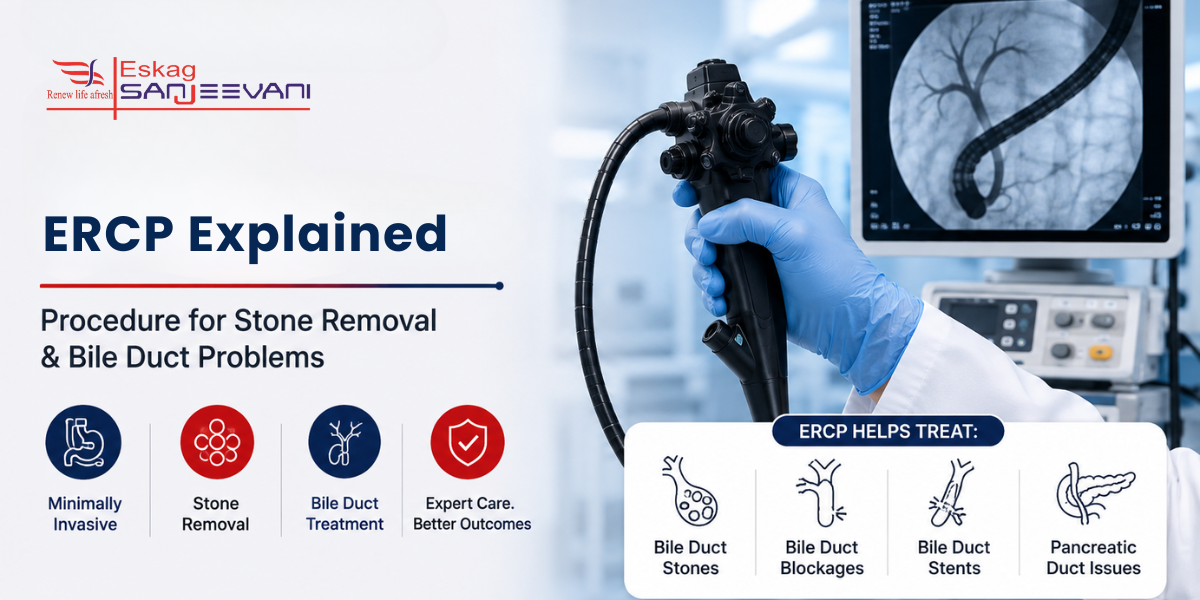
Endoscopic retrograde cholangiopancreatography, or ERCP, is a specialist procedure that combines a flexible camera with X-ray to access and treat blockages in your bile and pancreatic ducts. A doctor advances a side-viewing instrument called a duodenoscope through your mouth, past your stomach, into the first section of your small intestine. From there, the doctor enters the duct opening and injects contrast dye to identify stones, strictures, or leaks under live X-ray. ERCP was once a diagnostic test, but non-invasive scans like MRCP now handle diagnosis alone. Today, doctors recommend ERCP only when you need active treatment, stone removal, stent placement, or stricture repair.
ERCP Indications: Which Conditions Require This Procedure
Your doctor recommends ERCP only when imaging confirms a duct problem that needs active treatment.
Common Bile Duct Stones (Choledocholithiasis)
Common bile duct stones are the single most frequent ERCP indication in India. At Government Medical College Kottayam, Kerala, CBD stones were the primary indication across 216 ERCP cases, with a 93% successful cannulation rate. Globally, around 10-15% of patients with gallstone disease also develop stones in the common bile duct that require removal. A 2025 study from Sher-i-Kashmir Institute of Medical Sciences (SKIMS), North India, reported a CBD stone clearance rate of 95.3% across 682 ERCP procedures; all non-difficult stones were cleared in a single session with 100% success [1].
Obstructive Jaundice from Biliary Strictures
A narrowed bile duct from scarring, chronic inflammation, or a tumour blocks bile flow and causes jaundice. ERCP places a plastic or metal stent across the stricture to restore drainage immediately. For patients with pancreatic or gallbladder cancer, stent placement relieves both jaundice and infection without open surgery.
Acute Cholangitis
Cholangitis is a bacterial infection of the bile duct that demands urgent drainage. Without timely ERCP, the risk of sepsis and multi-organ failure rises sharply. ERCP clears the obstruction and places a drainage stent to allow infected bile to exit.
Post-Surgery Bile Leaks
Bile leaks after cholecystectomy collect inside the abdomen and cause pain and infection. ERCP places a stent inside the bile duct to remove the pressure gradient at the leak site. The stent stays in place for four to six weeks, then a doctor removes it by upper endoscopy.
Gallstone Pancreatitis
When a gallstone lodges at the shared opening of the bile and pancreatic ducts, it triggers acute pancreatitis. Around 20% of patients with symptomatic gallstone disease have a stone lodge in the bile duct and need endoscopic removal. ERCP extracts the stone early and prevents repeat episodes of inflammation [2].
Pancreatic Duct Obstruction
Chronic pancreatitis or pancreatic head tumours block the pancreatic duct and cause persistent pain and enzyme build-up. ERCP places a pancreatic duct stent or removes duct stones to restore flow. This is the only non-surgical route to pancreatic duct decompression in eligible patients.
How the ERCP Procedure Works: Step-by-Step Process
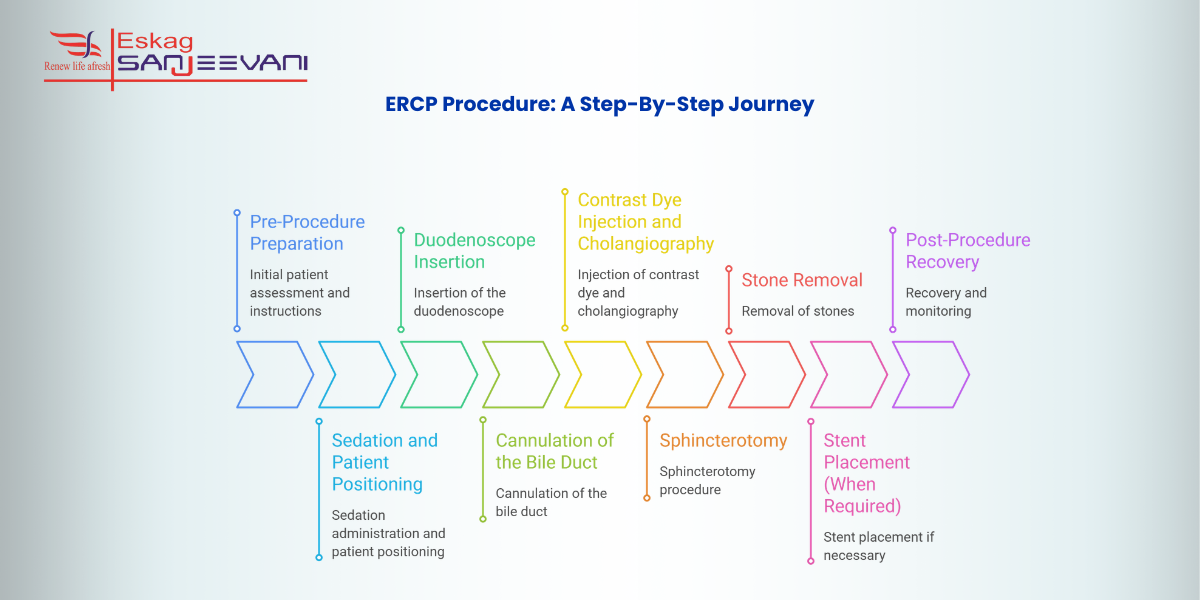
An ERCP takes between 30 and 60 minutes, and a specialist gastroenterologist performs it under sedation; you feel no pain during the procedure.
Step 1: Pre-Procedure Preparation
Your doctor asks you to fast for six to eight hours before the procedure. Blood tests, a recent ultrasound or MRCP, and a review of your current medications, especially blood thinners, are part of the standard pre-procedure assessment.
Step 2: Sedation and Patient Positioning
You receive intravenous sedation before the procedure starts. The nursing team positions you on your left side or stomach on the procedure table. The sedation keeps you comfortable and relaxed throughout the entire procedure.
Step 3: Duodenoscope Insertion
The doctor passes a thin, flexible side-viewing camera called a duodenoscope through your mouth, down your oesophagus, through your stomach, and into the first section of your small intestine, the duodenum.
Step 4: Cannulation of the Bile Duct
The doctor identifies the ampulla of Vater, the small opening where your bile and pancreatic ducts drain into the duodenum. A thin catheter passes through the duodenoscope and enters this opening under fluoroscopic X-ray guidance.
Step 5: Contrast Dye Injection and Cholangiography
The doctor injects contrast dye into the duct through the catheter. Live X-ray imaging, called cholangiography, then shows the full shape of your bile or pancreatic duct and clearly reveals any stones, strictures, or blockages.
Step 6: Sphincterotomy
If your duct opening is too narrow for stone removal or stent placement, the doctor uses a sphincterotome, a wire-tipped catheter, to make a small controlled cut at the ampulla. This widens access to the duct for treatment.
Step 7: Stone Removal
The doctor removes stones with a balloon catheter or a wire basket called a Dormia basket. For large stones above 15mm, mechanical lithotripsy breaks the stone into smaller fragments before extraction. Stones pass harmlessly into the duodenum after removal.
Step 8: Stent Placement (When Required)
If the duct has a stricture, tumour, or bile leak, the doctor places a plastic or metal stent across the narrowed area to restore drainage. Plastic stents are for temporary use; self-expanding metal stents are for long-term or malignant blockages.
Step 9: Post-Procedure Recovery
After the procedure, you rest in a monitored recovery area for two to four hours. Most patients stay one night for observation. You start on clear liquids and progress to soft food within 24 hours, with a follow-up scheduled within four to six weeks.
ERCP Risks, Complications, and What to Expect After the Procedure
Endoscopic retrograde cholangiopancreatography carries the highest complication risk of any routine endoscopic procedure; a 2025 systematic review across 380 studies confirmed an overall adverse event rate of 9.4% to 15.9% [3].
- Post-ERCP pancreatitis is the most common complication, with a 4.6% incidence globally and 6.6% in Indian studies. Rectal indomethacin before or after the procedure cuts this risk by approximately 50%.
- Post-sphincterotomy bleeding occurs in 1.5% of cases. Patients on blood thinners or with low platelet counts face the highest risk before the procedure.
- Cholangitis affects 2.5% of patients, mainly from incomplete bile duct drainage. Fever, chills, and returning jaundice within 72 hours need immediate hospital review.
- Perforation occurs in 0.5% of cases and carries a 0.2% procedure-related mortality rate. Most periampullary perforations receive management via a covered stent without open surgery.
- Most patients recover within 24-48 hours on clear liquids, progressing to soft food the next day. Severe abdominal pain, black stools, or fever after discharge needs urgent assessment.
MRCP vs ERCP: Which One Does Your Doctor Recommend
MRCP is a safe, non-invasive imaging test that diagnoses bile and pancreatic duct problems, while ERCP is an invasive therapeutic procedure that treats blockages; your doctor chooses based on whether you need diagnosis alone or active treatment.
Here’s a quick comparison table between MRCP and ERCP:
| Feature | MRCP | ERCP |
| Procedure Type | Diagnostic imaging | Therapeutic treatment |
| Invasiveness | Non-invasive | Invasive |
| How It Works | MRI scan of ducts | Endoscope enters ducts with instruments |
| Can Remove Stones? | No | Yes (95%+ success) |
| Can Place Stents? | No | Yes |
| Radiation Exposure | None | Yes (X-ray fluoroscopy) |
| Sedation Required | No | Yes (IV sedation) |
| Pancreatitis Risk | <0.1% | 4.6–6.6% |
| Best Use | Suspected problems | Confirmed blockage needing treatment |
ERCP at Eskag Sanjeevani: Expertise You Can Trust
Eskag Sanjeevani’s gastroenterology team, Dr Argha Chatterjee, Dr Deepak Kumar, Dr Amitava Dutta, and Dr Sahiz Aziz, collectively perform 6-10 ERCP procedures monthly, reflecting consistent procedural volume that directly correlates with higher cannulation success rates, lower complication rates, and better patient outcomes than low-volume centres.
Final Thoughts
ERCP has a 95% success rate for stone removal, but your individual outcome depends on finding the right specialist and centre. Before your procedure, verify your gastroenterologist’s complication rates and ask whether they’ll use rectal indomethacin; this single preventive step cuts pancreatitis risk in half. Recovery expectations matter: most patients return to normal eating within 24 hours, though some experience mild discomfort or temporary enzyme elevation. If you’re offered ERCP without prior MRCP imaging, ask why; diagnostic imaging first prevents unnecessary procedures.
Eskag Sanjeevani hospitals prioritises transparent communication about risks, success rates, and alternatives. Your health decisions improve dramatically when you partner with specialists who answer questions thoroughly rather than offering procedures as default solutions.

Microbiologist with over 2 years of experience in medical writing, specialising in evidence-based healthcare content.

Clinical experience in diagnosis, treatment, and evidence-based patient care across a range of conditions.
References
- Nazir S, Khan WA, Jan Z, Sulayman S, Gulzar GM, Sodi JS. Evaluating Endoscopic Retrograde Cholangiopancreatography (ERCP) Outcomes in the Management of Common Bile Duct Stones With a Focus on Difficult Stones: A Retrospective Single-Center Study on Bile Duct Navigation From Kashmir, North India. Cureus. 2025 Jun 29;17(6):e86956. doi: 10.7759/cureus.86956. PMID: 40734873; PMCID: PMC12306517.
- Stone, J.K., Pleskow, D. (2023). Indications for ERCP. [online] Practical Gastro.
- Bishay, K., Meng, Z.W., Khan, R., Gupta, M., Ruan, Y., Vaska, M., Iannuzzi, J., O’Sullivan, D.E., Mah, B., Partridge, A.C.R., Henderson, A.M., Guo, H., Samnani, S., DeMarco, M., Yuan, Y., Elmunzer, B.J., Keswani, R.N., Wani, S., Smith, Z.L., Bridges, R.J., Heitman, S.J., Hilsden, R.J., Brenner, D.R., Leontiadis, G.I. and Forbes, N. (2025). Adverse events associated with endoscopic retrograde cholangiopancreatography: Systematic review and meta-analysis. Gastroenterology, [online] 168(3), pp.568–586. doi:10.1053/j.gastro.2024.10.033.
ERCP typically takes 30-60 minutes depending on complexity. Recovery in the monitored area lasts 2-4 hours before discharge, with overnight observation sometimes recommended.
ERCP removes common bile duct stones successfully in 95%+ cases. Large stones above 15mm may require mechanical lithotripsy to break them into removable fragments first.
ERCP achieves a 95.3% clearance rate for common bile duct stones. Non-difficult stones clear completely in single sessions with 100% success in specialised centres.
ERCP irritates the pancreatic duct opening during sphincterotomy, triggering inflammation. Rectal indomethacin given before or after the procedure reduces the risk of post-ERCP pancreatitis by approximately 50%.
ERCP is minimally invasive with 9.4-15.9% complication rates versus open surgery’s higher morbidity. Most patients recover within 24–48 hours compared to weeks for surgical recovery.