

 Medically Reviewed
Vitamin D and Rheumatoid Arthritis: Stiff Fingers Explained
Waking up with fingers too stiff to make a fist is unsettling, and for millions of Indians, it happens every morning without explanation. Blaming ageing is instinctive, but rheumatoid arthritis and vitamin D deficiency are far more frequently responsible, and they require entirely different responses. Both conditions are common in India, frequently coexist, and share overlapping symptoms that even physicians sometimes conflate without targeted testing. The relationship between vitamin D and rheumatoid arthritis is immunological, not merely nutritional.
In this blog, we break down how to distinguish the two and what Indian patients can concretely do about it.
Key Takeaways:
- Vitamin D deficiency and RA frequently coexist in Indian patients; testing for both simultaneously is clinically essential.
- Morning stiffness lasting beyond 60 minutes strongly signals RA; resolving within 15 minutes suggests vitamin D deficiency.
- Vitamin D supplementation improves RA disease activity scores but must be clinician-guided, not self-prescribed.
Quick Answer: Vitamin D deficiency worsens rheumatoid arthritis by amplifying autoimmune inflammation; 80% of Indian RA patients are deficient, with serum levels averaging just 19.99 ng/mL, measurably raising disease activity scores and joint tenderness independent of standard RA treatment.
Quick Links
Vitamin D and Rheumatoid Arthritis: The Core Link
Vitamin D is not just a bone nutrient; in rheumatoid arthritis, it functions as an immune-modulating hormone whose deficiency directly amplifies the autoimmune activity driving joint destruction.
- Vitamin D regulates Th17 lymphocytes, the immune cells responsible for producing pro-inflammatory cytokines like IL-17 that perpetuate synovial inflammation in RA joints; low vitamin D removes this regulatory brake, worsening disease activity measurably.
- An Indian meta-analysis of 15 studies found the mean serum vitamin D level in RA patients was just 19.99 ng/mL, well below the clinical sufficiency threshold of 30 ng/mL, with 80% of Indian RA patients classified as deficient despite India’s year-round sun exposure.
- The relationship is inverse and dose-dependent: as serum 25(OH)D levels fall, DAS28 disease activity scores rise, meaning sicker joints consistently correspond with lower vitamin D, not coincidentally but mechanistically.
- Vitamin D receptors are expressed directly on T-cells, B-cells, and dendritic cells, the exact immune cells that malfunction in RA, making deficiency a systemic immune problem, not merely a nutritional gap.
- Critically, the association between vitamin D and RA is well-established; whether supplementation alone reverses disease activity remains debated, requiring clinical management rather than self-supplementation.
Stiff Fingers in the Morning: RA or Vitamin D Deficiency?
Morning finger stiffness sounds like one symptom, but its duration, pattern, and accompanying signs point toward entirely different diagnoses, and confusing the two leads to months of incorrect management.
- RA-related stiffness typically persists beyond 60 minutes after waking and correlates directly with tenosynovial inflammation; a study in PLOS ONE confirmed that morning stiffness severity on awakening independently associated with tenosynovial power Doppler scores (ρ = 0.503–0.561, p < 0.001) [1]. Vitamin D deficiency stiffness, by contrast, resolves within 10-15 minutes of movement and lacks any synovial involvement on imaging.
- Rheumatoid arthritis characteristically affects the same joints bilaterally, both hands, both wrists, both MCP joints simultaneously, whereas vitamin D deficiency produces more diffuse, non-specific musculoskeletal aching without this mirrored joint pattern.
- Vitamin D deficiency stiffness is bone and muscle-driven, stemming from impaired calcium metabolism and softened periosteal nerve endings; it is accompanied by generalised fatigue, proximal muscle weakness, and bone tenderness on pressure, none of which are primary RA features.
- Elevated ESR and CRP, positive anti-CCP antibodies, and rheumatoid factor confirm inflammatory RA; a low serum 25(OH)D below 20 ng/mL with normal inflammatory markers points toward deficiency as the primary driver.
Also read: 5 Specialised Tests to Upgrade Your Annual Screen.
How Vitamin D Deficiency Affects RA Disease Activity
Vitamin D deficiency does not merely accompany active rheumatoid arthritis; it measurably worsens joint inflammation, accelerates bone loss, and drives disease activity scores higher through specific, well-documented immunological mechanisms.
- A 2020 systematic review and meta-analysis published in Frontiers in Medicine found that vitamin D supplementation significantly improved DAS28 scores by a weighted mean difference of −0.41 [2]. It confirms that low vitamin D is not a passive bystander but an active contributor to measurable disease progression.
- It increases tender joint count independently: The same meta-analysis found tender joint count (TJC) improved significantly with vitamin D supplementation, meaning deficiency is directly sustaining joint tenderness beyond what RA inflammation alone accounts for.
- It accelerates bone loss in ways that compound RA damage: RA patients on long-term glucocorticoids already face elevated osteoporosis risk; vitamin D deficiency compounds this by impairing calcium absorption and increasing bone turnover, with ≥1,000 IU/day supplementation shown to produce significantly higher lumbar spine BMD gains than standard 800 IU doses.
- Low serum 25(OH)D correlates with persistently raised ESR and CRP in RA patients; vitamin D supplementation produced a statistically significant reduction in ESR, suggesting deficiency actively maintains the systemic inflammatory environment that keeps RA flares going.
- Subgroup analyses show Asian RA patients respond primarily with improvements in tender joint count and serum vitamin D levels at doses ≤50,000 IU, while higher doses additionally improve pain VAS and DAS28, meaning supplementation in Indian patients requires clinician-guided dosing rather than a one-size-fits-all approach.
Facts About Vitamin D and Rheumatoid Arthritis
Most people understand vitamin D as a bone nutrient and rheumatoid arthritis as a joint disease, but the clinical relationship between the two is far more specific, immunologically driven, and actionable than either label suggests.
- A cohort study of 29,368 women followed over 11 years found higher vitamin D intake was inversely associated with RA incidence, suggesting vitamin D’s protective role begins well before diagnosis [3].
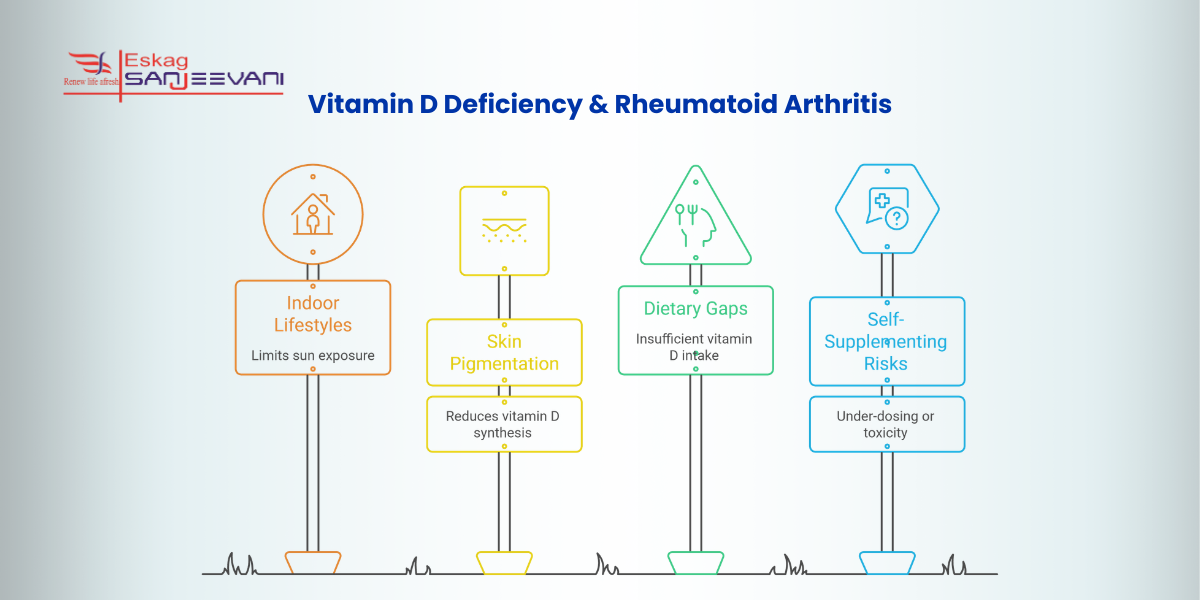
- Despite year-round sunlight, 80% of Indian RA patients are vitamin D deficient, with a mean serum level of just 19.99 ng/mL, driven by indoor lifestyles, skin pigmentation, and dietary gaps.
- It suppresses Th17 activity and modulates TNF-α and IL-6, the precise inflammatory pathways driving RA, making deficiency an immunological problem [4].
- A cross-sectional analysis confirmed a significant negative correlation between DAS28 and serum vitamin D; the sicker the joints, the lower the vitamin D, consistently.
- Vitamin D works adjunctively alongside DMARDs; self-supplementing without first testing serum 25(OH)D risks under-dosing or toxicity above 150 ng/mL, which carries serious clinical consequences.
Top Vitamin D Foods and Treatment Options for RA
For Indian RA patients, dietary vitamin D sources include fatty fish like rohu, mackerel, and hilsa, alongside egg yolks, fortified milk, paneer, and sun-exposed mushrooms. Ragi and moringa, staples in South Indian diets, support bone health through calcium rather than vitamin D directly. Sunlight remains the most efficient source; 15 minutes of midday sun exposure generates approximately 2,000-4,000 IU, though patients on biologic DMARDs should consult their rheumatologist first given elevated skin cancer risk. Clinically, serum 25(OH)D testing should precede any supplementation decision, with dosing individualised based on deficiency severity, current DMARD regimen, and concurrent osteoporosis risk rather than standardised over-the-counter dosing.
Final Thoughts
If you wake up with stiff fingers daily, get a targeted blood panel, ESR, CRP, anti-CCP antibodies, and serum 25(OH)D- before self-medicating. The connection between vitamin D and rheumatoid arthritis is well-established, yet vitamin D testing remains underutilised in Indian clinical practice. If deficient, correct it under medical supervision with dosing matched to your serum levels and DMARD regimen. If stiffness resolves within minutes without swelling, a vitamin D workup may be all that’s needed before escalating to rheumatology. Our team at Eskag Sanjeevani has worked with specialists to ensure this guidance reflects current evidence, helping you take the right next step confidently.

Microbiologist with over 2 years of experience in medical writing, specialising in evidence-based healthcare content.

Clinical experience in diagnosis, treatment, and evidence-based patient care across a range of conditions.
References
- Kobayashi Y, Ikeda K, Nakamura T, Yamagata M, Nakazawa T, Tanaka S, Furuta S, Umibe T, Nakajima H. Severity and Diurnal Improvement of Morning Stiffness Independently Associate with Tenosynovitis in Patients with Rheumatoid Arthritis. PLoS One. 2016 Nov 16;11(11):e0166616. doi: 10.1371/journal.pone.0166616. PMID: 27851825; PMCID: PMC5113064.
- Guan Y, Hao Y, Guan Y, Bu H, Wang H. The Effect of Vitamin D Supplementation on Rheumatoid Arthritis Patients: A Systematic Review and Meta-Analysis. Front Med (Lausanne). 2020 Oct 30;7:596007. doi: 10.3389/fmed.2020.596007. PMID: 33195358; PMCID: PMC7661491.
- Johns Hopkins Arthritis Center (2005). Arthritis news: Vitamin D intake is inversely associated with rheumatoid arthritis. [online] Johns Hopkins Arthritis Centre.
- Xu X, Luo H, Chen Q, Wang Z, Chen X, Li X, Chen H, Wang M, Xu Y, Dai M, Wang J, Huang X, Wu B, Li Y. Detecting potential mechanism of vitamin D in treating rheumatoid arthritis based on network pharmacology and molecular docking. Front Pharmacol. 2022 Nov 30;13:1047061. doi: 10.3389/fphar.2022.1047061. PMID: 36532774; PMCID: PMC9749856.
Yes. When vitamin D levels are low, RA symptoms and pain worsen, and studies confirm that the lowest vitamin D levels consistently correspond with more severe disease, greater disability, and poorer quality of life in RA patients.
Normal vitamin D levels are between 30-40 ng/mL. Deficiency is a level less than 20 ng/mL, while toxic levels are anything greater than 150 ng/mL. Most Indian RA patients average just 19.99 ng/mL, firmly in the deficient range.
There is no universal dose. Deficient adults may benefit from up to 2,000 IU a day, or up to 4,000 IU if over 75. Dosing must be based on your serum 25(OH)D levels and current DMARD regimen, always clinician-guided, never self-prescribed.
Not reliably. Just 15 minutes of direct sun exposure can give the equivalent of 2,000 to 4,000 IU; however, doctors may discourage this because of the risk of skin cancer, which occurs more frequently in RA patients on some biologic drugs. Oral supplementation is generally the safer, more consistent option.
Both directions are plausible. While studies show an association between RA and vitamin D deficits, researchers don’t yet have solid evidence of causality, meaning deficiency may worsen RA, RA may impair vitamin D metabolism, or both processes may occur simultaneously in the same patient.