
Obstructive Jaundice: When Gallstones Block the Path to Health
Ramesh, a 48-year-old schoolteacher from Kolkata, ignored his mild right-side abdominal pain for months — dismissing it as acidity. Then his wife noticed his eyes had turned yellow. By the time he reached a hospital, his bilirubin was dangerously elevated. The culprit? A single gallstone that had silently slipped into his bile duct, causing obstructive jaundice. A condition that is entirely treatable — but only if caught in time.
Jaundice in adults often gets written off as a liver problem. But one of the most overlooked causes — especially in adults over 40 — is a blocked bile duct caused by gallstones. Understanding this connection could be the difference between a timely cure and a life-threatening complication.
Key Takeaways
- Yellow eyes and dark urine together are a red flag — they may signal obstructive jaundice caused by a blocked bile duct, often from gallstones, and require urgent medical evaluation.
- Obstructive jaundice is highly treatable with procedures like ERCP or laparoscopic surgery — early diagnosis dramatically improves outcomes and prevents complications like cholangitis or liver damage.
- Seeking care at a specialised centre like Eskag Sanjeevani Hospitals with dedicated gastroenterology, ERCP, and surgical expertise ensures accurate diagnosis and comprehensive management.
What Is Obstructive Jaundice?
Obstructive jaundice occurs when the bile duct — the tube that carries bile from the liver and gallbladder to the small intestine — gets blocked. This blockage causes bile, which contains bilirubin (a yellow pigment), to back up into the bloodstream. The result: that unmistakable yellowing of the skin and eyes.
Unlike hepatic jaundice (caused by liver disease) or haemolytic jaundice (caused by excess red blood cell breakdown), obstructive jaundice is a mechanical problem. And one of the most common mechanical causes in India is cholelithiasis — gallstones. [1]
Did you know? India has one of the highest rates of gallstone disease in Asia, with studies estimating a prevalence of 4–11% in the general population, and significantly higher in women and people over 40 years of age. [4]
The Gallstones–Jaundice Connection
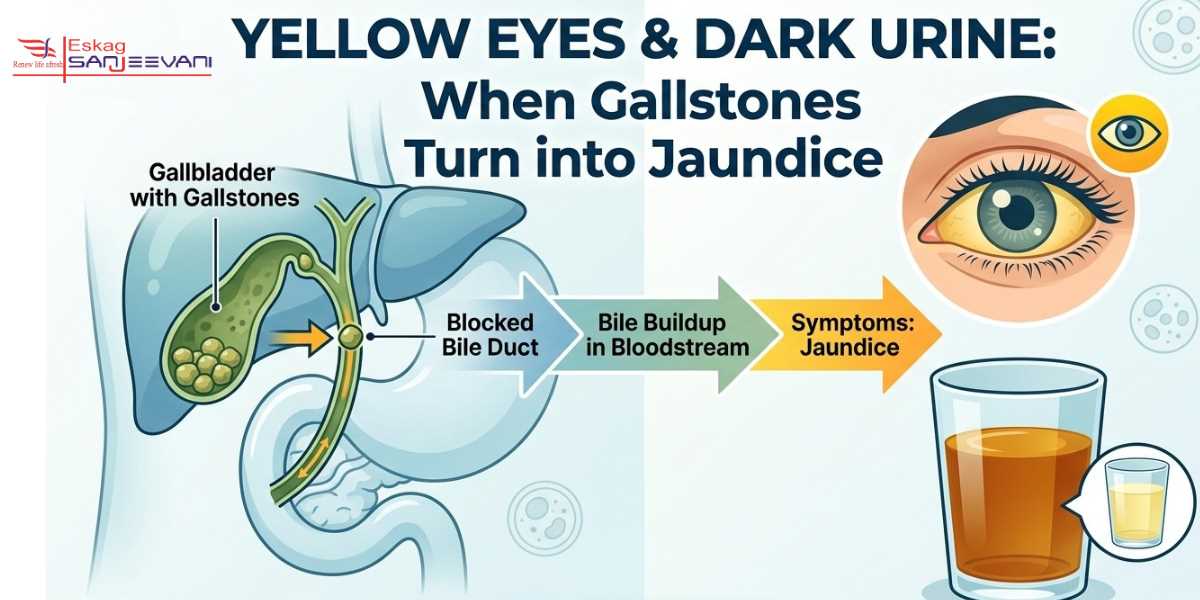
Most people with gallstones never develop jaundice. Trouble begins when a stone migrates out of the gallbladder and lodges in the common bile duct (CBD). This is called choledocholithiasis. When the CBD is blocked:
- Bile cannot flow into the small intestine
- Bilirubin accumulates in the blood
- The skin and whites of the eyes (sclera) turn yellow
- Urine turns dark amber or tea-coloured; stools become pale [3]
This is not just a cosmetic change — it signals a dangerous build-up that can lead to cholangitis (infection of the bile duct), acute pancreatitis, or liver damage if left untreated.
Symptoms You Should Never Ignore
The warning signs of gallstones causing jaundice often appear gradually. Recognising them early is critical — especially in adult jaundice cases where the cause isn’t immediately obvious.
- Yellow eyes: Scleral icterus — often the first visible sign
- Dark urine: Cola or tea-coloured due to excess bilirubin
- Pale stools: Clay-coloured, due to the absence of bile pigment
- Fever & chills: May indicate bile duct infection (cholangitis)
- Right-side pain: Upper right abdomen — classic biliary colic
- Itchy skin: Bile salts deposited in the skin cause pruritus
If you or a family member notices yellow eyes combined with dark urine — even without pain — see a jaundice specialist immediately. [2]
Painless jaundice, in particular, requires urgent evaluation as it may also indicate a tumour in the pancreatic head.
How Is Obstructive Jaundice Diagnosed?
- Blood Tests: Liver function tests (LFTs) will show elevated direct bilirubin, alkaline phosphatase (ALP), and gamma-GT — a pattern distinct from hepatitis or haemolytic jaundice.
- Imaging: Ultrasound of the abdomen is usually the first step and can detect gallstones and a dilated bile duct. For more detail, MRCP (Magnetic Resonance Cholangiopancreatography) is the gold standard non-invasive investigation for visualising the bile duct and locating stones precisely.
- Endoscopic Evaluation: In some cases, EUS (Endoscopic Ultrasound) may be recommended — particularly to rule out malignancy or to assess small stones not visible on routine imaging.
Obstructive Jaundice Treatment: What to Expect
The good news is that gallstone-related obstructive jaundice is highly treatable when diagnosed early. Treatment focuses on relieving the blockage.
ERCP (Endoscopic Retrograde Cholangiopancreatography)
ERCP is the most widely used treatment for bile duct stones in India. A flexible scope is passed through the mouth into the bile duct, the stone is retrieved, and bile flow is restored — all without surgery. It is minimally invasive with a high success rate.
Laparoscopic Surgery
In cases where ERCP is not feasible, or the gallbladder also needs to be removed (cholecystectomy), laparoscopic surgery is preferred. It is minimally invasive, involves small incisions, and patients typically recover within a few days. [1]
Supportive Care
Antibiotics for cholangitis, IV fluids for dehydration, and careful monitoring of liver function are standard supportive care measures during treatment.
Experiencing Yellow Eyes or Dark Urine?
At Eskag Sanjeevani Hospitals, our gastroenterology and hepatology specialists provide rapid diagnosis with advanced MRCP and ERCP facilities. [2] Don’t wait — obstructive jaundice is a medical urgency. Our team is experienced in managing complex bile duct conditions and offers compassionate, evidence-based care under one roof.
Who Is Most at Risk?
Gallstone disease — and by extension, obstructive jaundice — is more common in certain groups.
In India, the “5 F” rule is a useful clinical mnemonic: Female, Forty, Fat, Fertile, and Fair.
However, men and younger adults are not exempt, particularly with diets high in refined carbohydrates and low in fibre. [3]
Other risk factors include rapid weight loss, long-term total parenteral nutrition, diabetes, and a family history of gallstones.
Prevention: Can You Reduce Your Risk?
Not all gallstones can be prevented, but healthy habits can lower your risk significantly. Maintaining a healthy weight through gradual, steady weight loss (not crash dieting), eating a diet rich in fibre and healthy fats (like mustard oil and fish — common in Bengali cuisine), and staying physically active are all protective. Regular abdominal ultrasound checkups are advisable for high-risk individuals above 40.

Expert medical content writer with a 3-year background in healthcare communications. Specializing in turning complex evidence into credible health content.
References
- Choudhuri G, Minocha A. Gallstone disease in India: epidemiology and risk factors. Indian J Gastroenterol. 2021.
- Costi, R. (2014). Diagnosis and management of choledocholithiasis in the golden age of imaging, endoscopy and laparoscopy. World Journal of Gastroenterology, 20(37), p.13382.
- Tenner S, et al. American College of Gastroenterology Guideline: Management of Acute Pancreatitis. Am J Gastroenterol. 2013. journals.lww.com
- Indian Council of Medical Research (ICMR). Consensus guidelines on management of common bile duct stones.
Gallstones (choledocholithiasis) are the most common cause of obstructive jaundice in adults in India, particularly in those over 40. Other causes include bile duct strictures, tumours of the pancreatic head or bile duct, and parasitic infections like ascariasis.
When bilirubin builds up in the blood (as happens in obstructive jaundice), the kidneys try to filter it out. Bilirubin then passes into the urine, turning it dark amber, brown, or tea-coloured. This is often one of the earliest and most reliable warning signs of jaundice.
Yes, obstructive jaundice should be treated as a medical urgency. If bacteria infect the blocked bile duct, it causes acute cholangitis — which can progress to septic shock within hours. Fever, yellow eyes, and right-sided pain together (Charcot’s triad) require immediate hospital attention.
Once the obstruction is relieved — through ERCP or surgery — bilirubin levels typically begin to drop within 24–48 hours. The yellow discolouration of the eyes and skin gradually fades over 1–3 weeks. Full recovery depends on any underlying liver damage and associated complications.
Yes! We offer you the best affordable prices for blood tests, MRI, CT scan and more investigations throughout the year. For more information, check out our website- www.eskagsanjeevani.com.