

 Medically Reviewed
Dry Cough Without Fever: Symptoms, Causes, & Treatment
A persistent dry cough without fever can be quietly exhausting, disrupting your sleep, straining your throat, and leaving you wondering why nothing seems to help. What makes it particularly frustrating is that most people reach for cough syrups that only mask the symptom while the real trigger continues untouched. The absence of fever is actually a meaningful diagnostic clue; it shifts focus away from active infections toward causes like silent acid reflux, allergies, or even a blood pressure medication you’ve been taking for years. Understanding what’s actually irritating your airway makes the difference between weeks of guesswork and finding relief that genuinely holds.
In this blog, we break down the most clinically accurate causes, symptoms, and evidence-based treatments for dry cough without fever, so you can stop suppressing and start solving.
Key Takeaways:
- Dry cough without fever often signals non-infectious triggers, GERD, allergies, or ACE inhibitors, not a cold.
- Nighttime worsening strongly suggests acid reflux or asthma as the underlying driver worth investigating first.
- Identifying the root cause before treating is the only approach that delivers lasting, effective relief.
Quick Answer: A dry cough without fever signals non-infectious airway irritation, from acid reflux, allergies, or medications, and resolves only when the specific underlying trigger is accurately identified and treated.
Quick Links

What Is a Dry Cough Without Fever?
A dry cough without fever is a non-productive cough that generates no mucus or phlegm and occurs without any measurable rise in body temperature, making it distinctly different from infection-driven coughs where fever and mucus production typically appear together.
- Doctors categorise dry cough as acute (under 3 weeks), subacute (3-8 weeks), or chronic (beyond 8 weeks), and each duration bracket points toward entirely different underlying causes requiring different treatment pathways.
- Fever absence effectively rules out most active bacterial and viral respiratory infections, shifting the diagnostic focus toward structural, allergic, environmental, or medication-related triggers that are frequently missed without targeted investigation.
- A dry cough without fever is the body’s reflex response to irritation or inflammation in the airway lining, not an illness itself. Treating the cough without identifying the trigger only suppresses the symptom temporarily while the underlying cause continues.
- Dry cough without fever activates through the vagus nerve when irritants, inflammation, or pressure stimulate cough receptors in the larynx, trachea, and bronchi, which is why conditions as seemingly unrelated as acid reflux and blood pressure medications both produce identical dry cough symptoms.
- Unlike infection-driven coughs that are consistent throughout the day, a dry cough without fever characteristically worsens at night due to postnasal mucus pooling, reduced cortisol levels between 2-4 AM, and lying flat, which allows acid reflux to reach throat cough receptors more easily.
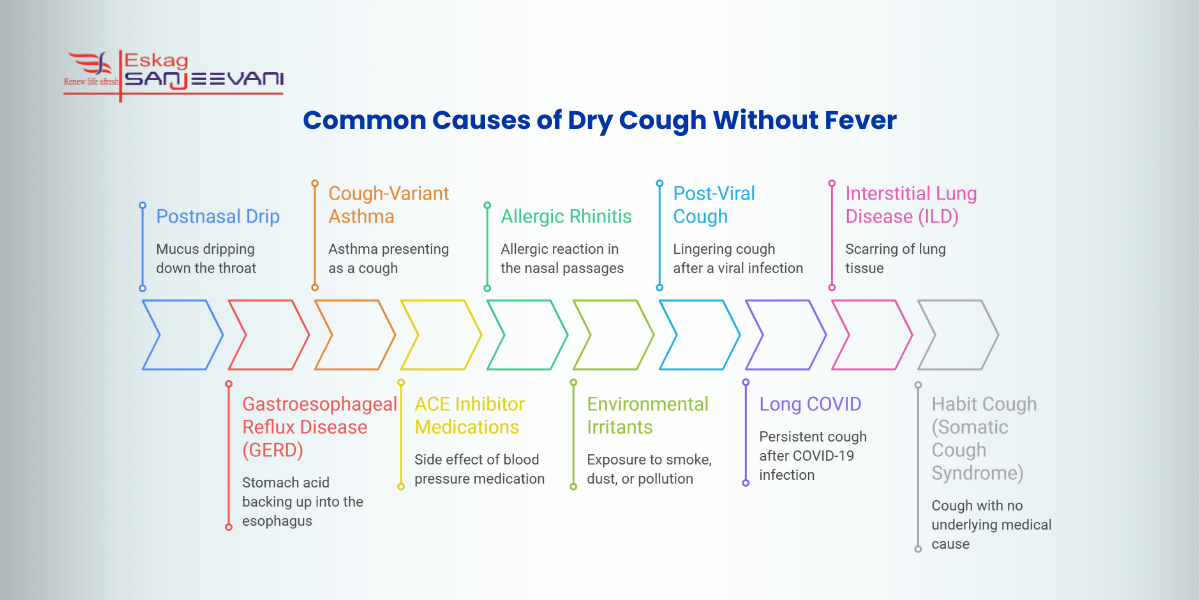
Dry Cough Without Fever: 10 Most Common Causes
A dry cough without fever rarely has one obvious cause-postnasal drip, silent acid reflux, and asthma frequently coexist, making accurate diagnosis essential before treatment rather than trial-and-error symptom suppression.
1. Postnasal Drip
Excess mucus dripping down the throat from inflamed sinuses continuously triggers the cough reflex. It accounts for up to 41% of chronic dry cough cases globally.
2. Gastroesophageal Reflux Disease (GERD)
Stomach acid reaching the throat irritates cough receptors without producing heartburn in 75% of cases, called silent reflux [1]. Worsens after meals and when lying flat at night.
3. Cough-Variant Asthma
Dry cough is the sole symptom, no wheeze, no breathlessness. Accounts for 25% of chronic cough cases. Triggered by cold air, exercise, and allergens; confirmed by spirometry.
4. ACE Inhibitor Medications
ACE inhibitor medications cause dry cough in 10-15% of patients through bradykinin accumulation [2]. Resolves completely within 1-4 weeks of switching to an ARB.
5. Allergic Rhinitis
Seasonal or perennial allergens (pollen, dust mites, pet dander) inflame nasal passages, triggering postnasal drip and direct airway irritation simultaneously. Antihistamines and nasal steroids resolve it effectively.
6. Environmental Irritants
Dry air, smoke, air conditioning, chemical fumes, and indoor pollution directly irritate the bronchial lining. Studies show indoor air is 2–5 times more polluted than outdoor air.
7. Post-Viral Cough
Heightened cough receptor sensitivity after respiratory infections, cold, flu, COVID-19, persists 3-8 weeks after all other symptoms resolve. Airway inflammation significantly outlasts the infection itself.
8. Long COVID
A 2022 Lancet study found 17.8% of long COVID patients reported persistent dry cough at 12 weeks post-infection. Airway neuroinflammation drives cough receptors’ hypersensitivity long after viral clearance.
9. Interstitial Lung Disease (ILD)
Progressive dry cough with gradual breathlessness in patients over 50, without fever, warrants urgent HRCT chest scan. Often misdiagnosed as asthma for months before correct diagnosis emerges.
10. Habit Cough (Somatic Cough Syndrome)
Repetitive, honking dry cough with no identifiable physical cause, disappears completely during sleep. More common in adolescents but occurs across all ages; behavioural therapy achieves high resolution rates.
Also read: Home Air Quality Index Audit: A Pulmonologist’s Guide.
Dry Cough Symptoms: What to Watch For
A dry cough rarely appears alone; the accompanying symptoms are often more diagnostically useful than the cough itself, pointing directly toward the underlying trigger your doctor needs to identify.
- Persistent throat tickle or scratch without mucus production, typically worsening in dry or air-conditioned environments, signals direct airway irritation rather than infection.
- Nocturnal worsening that disrupts sleep, particularly between 2-4 AM, suggests cough-variant asthma or GERD, where acid reflux peaks in the supine position.
- Voice hoarseness alongside dry cough indicates laryngeal irritation from silent reflux or prolonged airway inflammation requiring prompt ENT or gastroenterology evaluation.
- Cough triggered by specific exposures, cold air, exercise, dust, or pets, strongly points toward allergic rhinitis or asthma rather than environmental or post-viral causes.
- Progressive breathlessness accompanying dry cough without fever in patients over 50 is a red flag for interstitial lung disease requiring urgent HRCT chest investigation.
How to Get Rid of Dry Cough: Treatment by Cause
Treating dry cough without identifying the underlying cause first is the single most common reason patients cycle through multiple medications without relief; the correct treatment depends entirely on what’s driving the cough, not the cough itself.
- GERD-related dry cough requires proton pump inhibitors alongside strict dietary changes, eliminating caffeine, alcohol, and late meals, because studies show GERD accounts for 21-41% of chronic dry cough cases [3], yet cough suppressants alone provide zero relief when acid reflux is the actual trigger driving symptoms.
- Postnasal drip from allergic rhinitis responds best to second-generation antihistamines combined with intranasal corticosteroid sprays; consistent daily use over 2-4 weeks is required before maximum benefit is achieved, given postnasal drip drives up to 41% of all chronic cough presentations.
- Cough-variant asthma requires inhaled corticosteroids as first-line treatment, not cough syrups or antihistamines, because bronchial inflammation responds only to anti-inflammatory therapy; a 2020 ERS guideline confirms cough-variant asthma accounts for 25% of chronic cough cases, with measurable improvement within 1-2 weeks of correct inhaler technique.
- ACE inhibitor-induced cough has only one effective treatment: stopping the medication and switching to an angiotensin receptor blocker (ARB) under your doctor’s supervision. With 10-15% of patients on ACE inhibitors developing this cough, it remains the most underdiagnosed and easily reversible cause of dry cough in clinical practice.
- Post-viral dry cough in Indian patients, particularly post-COVID-19, persists in 17.8% of patients at 12 weeks post-infection; steam inhalation twice daily, honey with warm water before bed, and avoiding cold beverages significantly accelerate mucosal recovery compared with antibiotic prescriptions, which are frequently but incorrectly prescribed for this self-limiting condition.
Best Home Remedy for Dry Cough: Evidence-Based Options
Not every home remedy for dry cough is equal; most lack clinical evidence, while a handful have robust peer-reviewed data supporting their use. Knowing the difference saves time, money, and weeks of ineffective self-treatment.
1. Honey
A 2021 BMJ systematic review found honey more effective than usual care for upper respiratory symptoms, significantly reducing cough frequency and severity. Take 1-2 teaspoons in warm water before bed. Never give honey to children under 12 months due to botulism risk.
2. Steam Inhalation
Steam hydrates inflamed, dry airways and directly reduces cough receptor sensitivity. Inhale steam from hot water for 10-15 minutes twice daily; adding 2-3 drops of eucalyptus oil enhances bronchodilation through cineole, its pharmacologically active compound with documented airway-relaxing properties.
3. Ginger and Honey Tea
Gingerols and shogaols in ginger demonstrate proven anti-inflammatory and bronchodilatory properties in airway smooth muscle. Combined with honey’s mucosal coating effect, ginger tea before bed addresses both airway inflammation and cough receptor hypersensitivity simultaneously without pharmaceutical side effects.
4. Saline Gargling
A 2020 Scientific Reports study confirmed saline gargling significantly reduces upper respiratory tract symptoms by clearing postnasal mucus and reducing throat inflammation. Dissolve half a teaspoon of salt in warm water; gargle for 30 seconds twice daily, particularly after waking and before sleeping.
5. Turmeric Milk
Curcumin, turmeric’s active compound, demonstrates well-documented anti-inflammatory properties relevant to airway mucosal inflammation in multiple peer-reviewed trials. Half a teaspoon in warm milk before bed reduces inflammatory cough without pharmaceutical interaction risks, making it particularly suitable for elderly Indian patients on multiple medications.
Final Thoughts
A dry cough without fever is rarely just an inconvenience; it’s your airway consistently signalling that something specific needs attention. Start by tracking when your cough worsens: after meals, during sleep, near allergens, or following a viral illness; these patterns narrow the cause faster than any over-the-counter remedy can. If your cough has persisted beyond three weeks, see a doctor before self-medicating further, since conditions like cough-variant asthma and interstitial lung disease are frequently mismanaged without clinical assessment.
Meanwhile, evidence-backed home approaches- honey in warm water before bed, steam inhalation twice daily, and saline gargling- offer genuine, low-risk support while you investigate the root cause. Our doctors have worked closely with clinicians to ensure the guidance shared here reflects current evidence, and we hope it helps you make informed, confident decisions about your health.

Microbiologist with over 2 years of experience in medical writing, specialising in evidence-based healthcare content.

Clinical experience in diagnosis, treatment, and evidence-based patient care across a range of conditions.
References
- Morice AH, Millqvist E, Bieksiene K, Birring SS, Dicpinigaitis P, Domingo Ribas C, Hilton Boon M, Kantar A, Lai K, McGarvey L, Rigau D, Satia I, Smith J, Song WJ, Tonia T, van den Berg JWK, van Manen MJG, Zacharasiewicz A. ERS guidelines on the diagnosis and treatment of chronic cough in adults and children. Eur Respir J. 2020 Jan 2;55(1):1901136.
- Dicpinigaitis PV. Angiotensin-converting enzyme inhibitor-induced cough: ACCP evidence-based clinical practice guidelines. Chest. 2006 Jan;129(1 Suppl):169S-173S. doi: 10.1378/chest.129.1_suppl.169S. PMID: 16428706.
- Irwin RS, French CL, Chang AB, Altman KW; CHEST Expert Cough Panel*. Classification of Cough as a Symptom in Adults and Management Algorithms: CHEST Guideline and Expert Panel Report. Chest. 2018 Jan;153(1):196-209. doi: 10.1016/j.chest.2017.10.016. Epub 2017 Nov 10. PMID: 29080708; PMCID: PMC6689094.
Yes. A dry cough without fever lasting beyond 8 weeks is classified as chronic and is most commonly driven by GERD, postnasal drip, or cough-variant asthma, none of which produce fever. Persistent cough beyond 3 weeks warrants clinical evaluation rather than continued self-medication.
It can be. GERD causes silent reflux in 75% of cases, meaning no heartburn, just a dry cough that worsens when lying flat as stomach acid reaches throat cough receptors more easily. Nocturnal cough that improves when sleeping upright strongly points toward GERD as the trigger.
Yes. ACE inhibitors cause persistent dry cough in 10–15% of patients through bradykinin accumulation. It is one of the most underdiagnosed and easily reversible causes; switching to an ARB under medical supervision resolves the cough completely within 1-4 weeks.
Honey has the strongest clinical evidence; a 2021 BMJ systematic review confirmed it reduces cough frequency and severity more effectively than usual care. Steam inhalation twice daily and saline gargling offer additional evidence-backed relief, particularly for post-viral and irritant-driven dry cough.
Progressive breathlessness alongside dry cough in patients over 50 is a red flag for interstitial lung disease requiring urgent HRCT chest investigation. Any dry cough persisting beyond 3 weeks, consistently disrupting sleep, or accompanied by hoarseness and weight loss needs prompt medical evaluation rather than symptomatic home management.