

CT Scan Missed Diagnoses: Getting It Right the First Time
Dealing with unexplained, persistent pain can be exhausting, especially when you are looking for clear answers from a diagnostic test. Unfortunately, rigid imaging protocols can sometimes create a form of clinical tunnel vision, leading to CT scan missed diagnoses. When this happens, important adjacent findings may be overlooked, resulting in unresolved symptoms, delayed treatment, added expense, and repeat radiation exposure.
In this blog, we explain why these diagnostic gaps happen and how a more adaptable approach can help ensure a more complete diagnosis the first time.
Key Takeaways
- Strict scan boundaries can cause important findings outside the prescribed field to be overlooked.
- Incomplete imaging may lead to unnecessary repeat scans, extra costs, and additional radiation exposure.
- Patients can reduce the risk of missed findings by sharing all symptoms clearly and confirming the exact scope of the scan.
Quick Answer: Rigid imaging boundaries can lead to missed diagnoses, but sharing complete symptom information and choosing an adaptable imaging team can improve accuracy on the first visit.
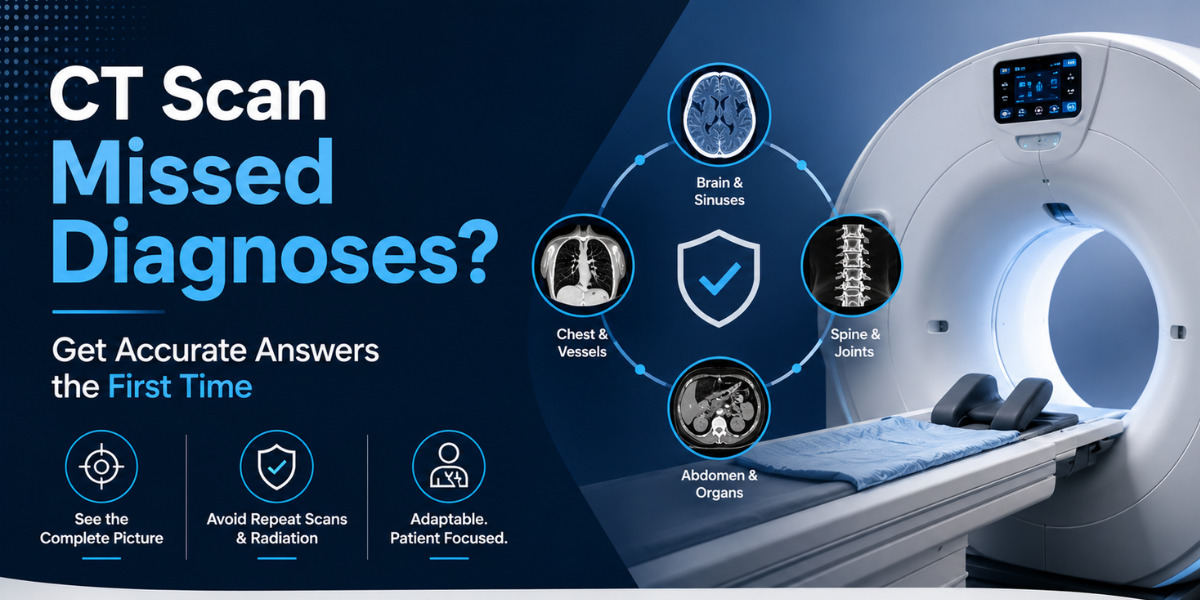
What is a “Missed Diagnosis” in Medical Imaging?
When people hear “missed diagnosis,” they often think of a broken CT machine or a doctor misreading the scan. In reality, it is usually more about limited scanning scope and lack of flexibility in protocol.
Doctors order scans based on a specific clinical question, and the scan is performed within a defined field of view. However, disease does not always stay neatly within those boundaries. If the actual cause of pain is visible just outside the intended area, it may be overlooked simply because it was not the original focus of the study.
At its core, a missed diagnosis happens when the medical team does not gather enough information to see the full picture. For example, an abdominal CT for severe stomach and back pain may show normal abdominal organs but miss a lower spinal problem located just beyond the intended focus. Similarly, if contrast is needed to assess a liver lesion but is not used, the scan may remain incomplete.
Why Incomplete Scans Can Harm Patients
When a technician strictly follows a narrow field of view without adapting to the clinical situation, CT scan reporting accuracy may suffer. This can lead to delayed treatment, repeated procedures, an extra financial burden, and avoidable anxiety for patients.
The Double Radiation Risk
Returning for a second CT scan increases radiation exposure unnecessarily. According to a study cited by the European Society of Radiology, repeated CT examinations can lead to a cumulative effective dose exceeding 100 mSv in some patients. Over time, this can increase long-term health risk.
Time, Cost, and Stress
Incomplete scans often result in repeat appointments, additional fees, and longer waiting times for answers. For patients already coping with pain or uncertainty, this can be emotionally draining. A more complete scan from the beginning can help reduce both the financial and psychological burden.
Real-World Scenarios: When Symptoms Hide in Plain Sight
Medical imaging is performed within strict procedural boundaries, but the true source of a patient’s symptoms may lie just beyond those limits. The following examples show how missed findings on CT scan evaluations can occur when protocols are not adjusted in real time.
Case 1: Brain Pain That Starts in the Sinuses
A patient presents with severe headache, nausea, and vomiting, so a CT head or brain scan is ordered.
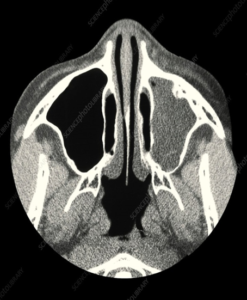
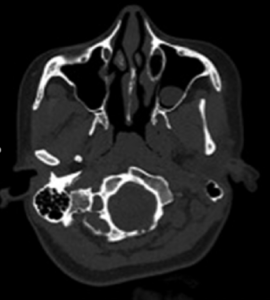
The scan is typically centered on the cerebral parenchyma and cranial vault. However, the first axial slices often include part of the facial structures, including the sinuses.
If a left maxillary polyp or significant mucosal thickening is visible in those slices, a brain-only interpretation may miss the true cause of the symptoms. The patient may receive a normal brain report while the sinus disease responsible for the pain remains unaddressed.
Better approach: If sinus pathology is suspected, a dedicated CT PNS scan should be performed.
Case 2: Abdominal Pain Caused by a Spinal Problem
Referred pain can easily point attention to the wrong anatomical region. A patient with abdominal pain, vomiting, and posterior lumbar discomfort may undergo an NCCT abdomen.
Although the scan evaluates the abdominal organs well, the edge of the field may also capture the lower spine. If the spine is not reviewed carefully using multiplanar reconstruction, important findings such as disc bulges at L4-L5 or L5-S1 may be missed.
The abdominal report may then appear normal, while the actual cause of pain remains hidden.
Better approach: Adjacent structures should also be reviewed, and 3D or multiplanar reconstructions should be used when appropriate.
Case 3: A Liver Lesion That Needs Contrast
A patient undergoes an NCCT abdomen for general abdominal discomfort.
The unenhanced scan may reveal a hypodense lesion in the liver, prompting the question: can a CT scan detect cancer? The answer is that CT can detect suspicious lesions, but without contrast enhancement, it may not be possible to distinguish benign from malignant disease with confidence.
If the scan stops there, the diagnosis remains incomplete. Identifying a lesion is not enough if its nature is still unclear.
Better approach: Depending on the clinical question, the scan may need to be extended to a triphasic liver CT, CECT whole abdomen, or CT angiography for proper characterization.
Case 4: A Hidden Pulmonary Embolism
Symptoms from respiratory illness can sometimes mask a life-threatening vascular event. A patient with a history of COVID-19 may present with chest pain, haemoptysis, fatigue, and shortness of breath, and an HRCT thorax may be advised.
HRCT is excellent for evaluating lung parenchyma and scarring, but it is a non-contrast study and does not adequately assess the pulmonary vessels. If the true problem is a clot in the pulmonary artery, HRCT may miss it entirely.
The patient may go home with a falsely reassuring report while the actual condition remains dangerous.
Better approach: If pulmonary embolism is suspected, CT pulmonary angiography is the appropriate study.
The Eskag Sanjeevani Approach
At Eskag Sanjeevani, we believe in a more responsive approach to imaging rather than a rigid assembly-line model that can leave patients with incomplete answers. Our advanced 128-slice CT scanner produces high-resolution images quickly, helping reduce scan time and radiation exposure while improving detail.
If a hidden abnormality appears during the scan, the protocol can be adapted in real time to evaluate it more completely. This helps ensure that patients receive a more accurate and comprehensive diagnosis in a single visit, while avoiding unnecessary repeat scans and their associated radiation and cost.
How to Be an Empowered Patient
Taking an active role in your healthcare can improve the chance of a complete diagnosis on the first visit.
- Share your complete medical context: Before your appointment, note all symptoms, even those that seem unrelated. Pain can radiate from another region, and the full story helps the technologist and radiologist target the scan better.
- Understand the scope of your scan: Ask which anatomical areas will be covered so you know whether the scan is broad enough to capture the likely source of symptoms.
- Ask about contrast requirements: Some CT or MRI studies need contrast dye to assess blood vessels or soft tissue properly. Clarifying this in advance may prevent missed findings.
- Speak up during the procedure: If you remember an important symptom while being positioned, inform the technologist right away.
- Request a thorough review: It is reasonable to ask whether the team checks adjacent structures and the outer edges of the scan before you leave.
Final Thoughts
To reduce the risk of incomplete testing, always share your full symptom history before imaging. If your pain radiates across multiple regions, do not hesitate to ask whether adjacent structures should also be reviewed. Choosing an imaging centre that values real-time adaptability is one of the best ways to reduce missed findings on CT scan evaluations.
Eskag Sanjeevani uses advanced 128-slice technology and a proactive diagnostic approach to help tailor scans to each patient’s needs. With the right team and the right communication, you can improve the chance of getting a precise answer on your first visit.
A missed diagnosis in body CT usually happens when the scan is limited to a narrow field of view and the true cause of symptoms lies just outside it.
A scan may miss a condition if the scan boundaries are too narrow or if contrast is needed but not used.
Share your complete symptom history, especially any radiating pain, so the technologist can adapt the scan if needed.
A repeat scan increases radiation exposure, adds cost, and delays treatment.
Yes. Asking about your symptoms and scan scope can help the technologist adjust the protocol in real time.