

 Medically Reviewed
Treadmill Stress Test (TMT)
A Treadmill Stress Test (TMT) is a commonly used test that helps doctors assess how your heart performs during physical activity. Some heart problems may not be apparent when you are resting but can become noticeable during exercise. The treadmill starts at a slower pace and then speeds up, making your heart work harder, much like it does during a walk or when climbing stairs. Doctors may recommend a TMT if you have symptoms such as chest pain, breathlessness, or unusual fatigue. The test can help detect heart-related issues and support treatment planning [1].
This blog explains who may need a TMT test and what happens during the procedure. It also covers how to read the results and what they may mean.
Key Takeaways
- A treadmill stress test detects coronary artery disease with an average sensitivity of 68% and specificity of 77%.
- A Duke Treadmill Score above +5 places a patient in the low-risk group, with a four-year survival rate of approximately 99% and an annual mortality rate of just 0.25%.
- The TMT test procedure takes 30–45 minutes in total, though active treadmill time is typically 8–12 minutes, depending on how long you last on the treadmill.
Quick Answer: A treadmill stress test is required to know how your heart performs during physical activity. This, in turn, helps to detect potential heart problems.
What Is a Treadmill Stress Test?
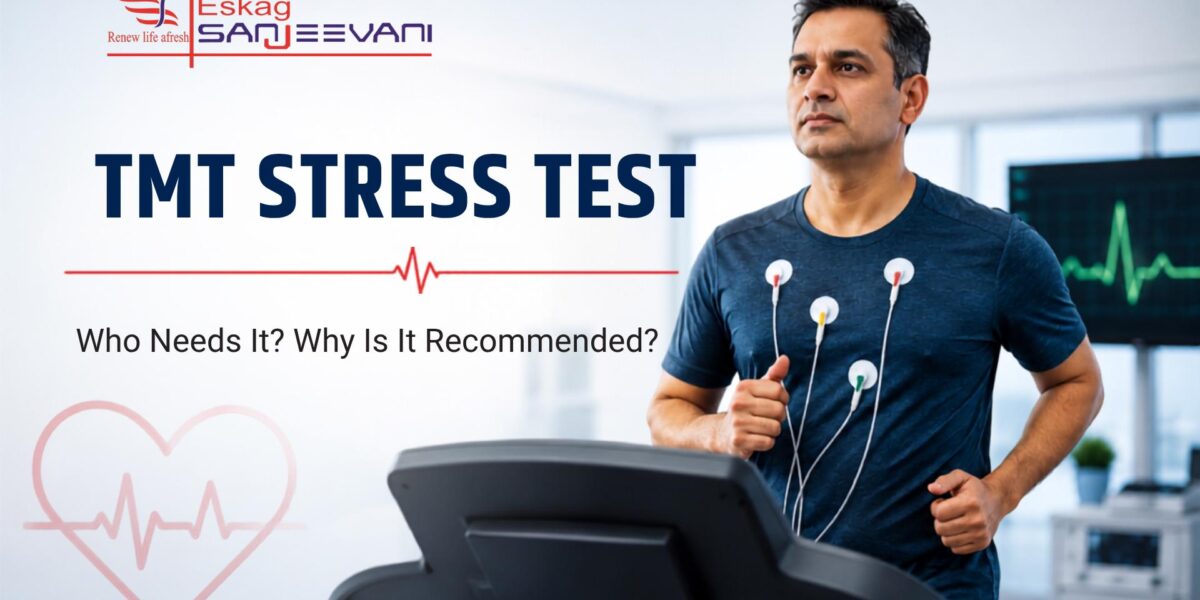
A treadmill stress test (TMT) is a non-invasive diagnostic procedure that records your heart’s electrical activity, blood pressure, and rhythm while you walk or jog on a treadmill under progressively increasing workloads. Because coronary artery narrowing may not restrict blood flow at rest but becomes apparent once oxygen demand increases, exercise provokes the very conditions under which cardiac ischaemia reveals itself.
In most cases, the test follows what doctors call the Bruce Protocol. You start by walking slowly on the treadmill. Every few minutes, the speed and incline are increased incrementally. This helps doctors assess how your heart responds as the level of effort increases. If someone is older or not used to physical activity, an easier version of the test may be used, with gentler starting stages before the pace is increased [2].
The result is presented as a detailed report with several measurements. It looks at more than just ECG changes during exercise. The report also considers when the changes appeared, how severe they were, and whether any symptoms occurred during the test. These findings are used to calculate the Duke Treadmill Score (DTS), a tool that helps doctors estimate cardiac risk.
Who Needs a TMT Test?
The TMT test is recommended for anyone whose heart symptoms or risk profile warrants evaluation of coronary blood flow under physical stress. It is not appropriate for every patient, and, likewise, not every high-risk patient receives one without prior assessment.
The following situations represent validated indications for referral to a treadmill stress test:
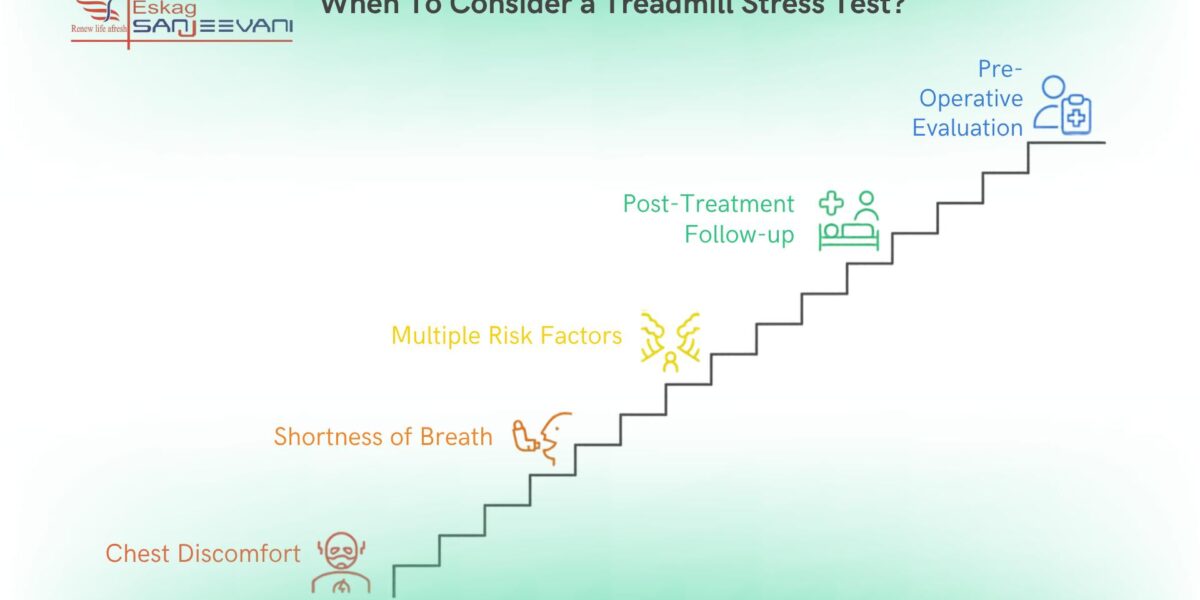
- Chest pain, pressure, or tightness that occurs during physical activity and eases with rest may be a sign of reduced blood flow to the heart and often requires further evaluation.
- Feeling out of breath more often than usual while walking, climbing stairs, or doing routine activities, especially if you are above 40 and have diabetes, high blood pressure, or high cholesterol.
- People who do not have symptoms but have several risk factors for heart disease, such as a family history of early heart problems, smoking, high
- blood pressure, diabetes, high cholesterol, or excess weight.
- Follow-up assessment after procedures such as angioplasty, stent placement, or heart surgery to check recovery progress and help guide safe levels of physical activity.
- Cardiac fitness evaluation before certain non-heart surgeries to understand how well the heart can handle physical stress and support surgical planning.
TMT is not suitable for people with unstable heart conditions, recent heart attack, severe valve disease, or certain ECG abnormalities.
TMT Test Procedure: Step by Step
The TMT test procedure is performed in a controlled clinical environment with crash cart access and supervised directly by a cardiologist or trained technician. The full appointment lasts 30–45 minutes, with 8–12 minutes of active treadmill time. Preparation before you arrive matters. Patients are advised to avoid heavy meals, caffeine, and tobacco for at least three hours before the test.
The step-by-step TMT test procedure unfolds as follows:
Step 1: A resting 12-lead ECG is recorded first, along with baseline blood pressure and heart rate, to confirm that the patient is suitable to proceed and to establish a baseline for comparison.
Step 2: Ten electrodes are placed across the chest, arms, and legs. The ECG leads are secured with adhesive patches and connected to a monitor that streams real-time cardiac electrical activity throughout the test.
Step 3: The treadmill begins at a slow pace and low incline, corresponding to stage 1. Speed and gradient increase every three minutes according to the protocol; the patient walks or jogs for as long as safely tolerated.
Step 4: Blood pressure is recorded at the end of each stage. The supervising physician watches continuously for ST-segment changes, arrhythmias, abnormal blood pressure responses, or symptom development that may necessitate stopping the test early.
Step 5: After the active phase, the patient continues walking slowly for approximately 5-10 minutes during the recovery period. ECG and blood pressure monitoring continues because ischaemic changes sometimes appear or peak only during recovery.
Step 6: The test may end when the target heart rate is reached, if significant ECG changes occur, symptoms develop, dangerous arrhythmias appear, blood pressure responds abnormally, or the patient wishes to stop.
The results, ECG tracings, blood pressure trend, heart rate curve, MET level achieved, and symptom documentation are compiled into a report scored using the Duke Treadmill Score formula.
TMT Test Time: What to Expect
One of the most common questions patients have is how long the TMT test actually takes, and the answer depends on what you include in the count.
The active treadmill time in a standard Bruce Protocol test ranges from 8 to 12 minutes for most adults. Completing all seven stages, which almost no patient achieves, would take 21 minutes. In practice, most tests end between Stages 3 and 5.
The exercise portion of the test lasts a few minutes, but the entire appointment generally takes around 30–45 minutes. This includes preparation, ECG setup, the test itself, and post-test monitoring. It is best to allow about 45 minutes for your visit.
How long you last on the treadmill is diagnostically meaningful in itself. Achieving fewer than five minutes on the standard Bruce Protocol signals significantly reduced exercise capacity. Reaching 10 METs or more, regardless of minor ECG changes, is associated with an excellent cardiovascular prognosis.
TMT Test Normal Range: How to Read Your Report
Understanding the TMT test normal range requires looking at three parallel parameters simultaneously: MET level, heart rate response, and ECG behaviour. Your report will contain all three.
| Parameter | Normal Range / Interpretation |
| Peak METs achieved | Heart rate should reach at least 85% of the maximum expected for your age (220 − age). For example, a 50-year-old should reach 144 bpm or higher [3]. |
| Maximum heart rate | The ECG should not show ST-segment depression greater than 1 mm. An upward-sloping ST change above 2 mm may also need attention. |
| ST-segment change | Systolic blood pressure should increase during exercise. A drop of more than 10 mmHg or failure to rise is considered abnormal. |
| Blood pressure response | A Duke Treadmill Score (DTS) of +5 or more indicates low risk, –10 to +4 suggests intermediate risk, and –11 or lower indicates high risk. |
| Duke Treadmill Score and Symptoms during exercise | No chest pain, severe shortness of breath, dizziness, or feeling faint during the test is generally considered a normal response. |
Doctors may also use the Duke Treadmill Score (DTS) to better understand your test results. It takes into account how long you exercised, any ECG changes, and whether you felt chest pain during the test. In general, a higher score is reassuring, while a lower score may mean more tests are needed.
The MET score measures your exercise capacity during the test. A higher MET score generally indicates better heart and fitness levels. Research published in Circulation found that each 1-MET increase is linked to about a 12% lower risk of death. A score of 5–8 METs suggests fair fitness, 9–11 METs indicates good fitness, and above 11 METs is considered excellent for most adults. [3].
Also read: Stress at work? Doctors see rise in heart diseases among young executives
TMT Test Results: Positive vs Negative
After the test, your doctor reviews all the findings and classifies the result as negative, positive, or indeterminate. A negative result means your heart responded normally to exercise, making significant heart artery blockage less likely. A positive result means the test showed changes that may suggest a heart problem, but additional tests may be needed to confirm the cause. An indeterminate result means the test could not provide a clear answer, often because the target heart rate was not reached. In such cases, your doctor may recommend another type of stress test or heart imaging study.
Limitations of the Treadmill Stress Test
The treadmill stress test is useful and widely available, but it does not provide all the answers. Understanding its limitations can help you interpret the results more accurately.
- A treadmill stress test is helpful, but it is not perfect. It has an average sensitivity of 68% and specificity of 77%. In some people with heart disease, the test may appear normal. On the other hand, some people without a heart problem may still get an abnormal result [3].
- The test can sometimes miss blockages affecting a single heart artery, especially when the changes are too small to show up clearly on the ECG during exercise.
- Women have a higher rate of false-positive results than men, due in part to hormonal effects on the ST segment, which is why guidelines increasingly recommend imaging-based stress tests as the first-line investigation in symptomatic women with intermediate risk.
- Patients on beta-blockers achieve a lower peak heart rate, which may produce a technically submaximal, and therefore non-diagnostic, test without reflecting true cardiac limitation.
Important Consideration: The test provides no anatomical information; it cannot tell the cardiologist which artery is narrowed, by how much, or whether the plaque is stable or vulnerable. A CT coronary angiogram is required for that level of detail.
To know more about CT Scan facilities, visit: CT Scan – 128 Slice Cardiac CT at Eskag Sanjeevani Hospital
Why Choose Eskag Sanjeevani?
Eskag Sanjeevani has a dedicated cardiology department that focuses on complete heart care, from basic evaluation to advanced testing. Every patient gets a proper consultation where the doctor explains the ECG result and the next steps in simple terms, so you clearly understand your condition. Our cardiology team also brings together various cardiac investigations in one place, including ECG, echocardiography, Holter monitoring, and cardiac CT imaging.
To Sum Up
A treadmill stress test helps doctors check how your heart works when you are active and can reveal problems that may not show up at rest. It is best understood in the context of your symptoms and risk factors. If you have chest discomfort, unexplained breathlessness, or other warning signs, it is better not to ignore them and get checked by a cardiologist early. Early evaluation can help prevent complications and guide appropriate treatment. For cardiac consultation and heart care, you can reach out to the cardiology team at Eskag Sanjeevani.

Microbiologist with over 2 years of experience in medical writing, specialising in evidence-based healthcare content.

Clinical experience in diagnosis, treatment, and evidence-based patient care across a range of conditions.
References
- Gianrossi, R., et al. “Exercise-Induced ST Depression in the Diagnosis of Coronary Artery Disease. A Meta-Analysis.” Circulation, vol. 80, no. 1, 1 July 1989, pp. 87–98,
- Vilcant, Viliane, and Roman Zeltser. “Treadmill Stress Testing.” Nih.gov, StatPearls Publishing, 20 June 2023
- Myers, J., Prakash, M., Froelicher, V., Do, D., Partington, S. and Atwood, J.E. (2002). Exercise Capacity and Mortality among Men Referred for Exercise Testing. New England Journal of Medicine, [online] 346(11), pp.793–801.
A normal TMT result means your heart receives enough blood and oxygen during exercise. It also suggests there are no significant ECG changes that indicate reduced blood flow to the heart.
There is no way to pass a TMT test because it is a diagnostic examination. Following your doctor’s instructions, wearing comfortable clothing, and avoiding heavy meals before the test can help ensure accurate results.
A treadmill stress test helps doctors evaluate how your heart responds to physical activity. It can identify abnormal heart rhythms, reduced blood flow, and signs of underlying coronary artery disease.
The exercise portion usually lasts around 10–15 minutes, depending on your fitness level and heart response. Including preparation and recovery time, the entire test generally takes 30–45 minutes.
A TMT test cannot directly show a blockage inside the arteries. However, it can reveal signs of reduced blood flow that may indicate significant coronary artery narrowing.