

 Medically Reviewed
Swasthya Sathi Scheme: Cashless Dialysis Explained
Kidney failure does not just affect your health; it reshapes your entire family’s financial reality within months. Regular dialysis is a lifelong commitment, and for most families in West Bengal, the recurring cost becomes impossible to manage without support. The Swasthya Sathi scheme exists precisely for this situation, offering cashless treatment coverage of up to ₹5 lakh per year at empanelled hospitals across the state. What many patients do not realise is that dialysis, including haemodialysis and peritoneal dialysis, is explicitly covered under the scheme as a Day Care Treatment.
In this blog, you will find a clear, step-by-step guide to accessing cashless dialysis, what the scheme covers, and how to find the right empanelled centre near you.
Key Takeaways:
- Dialysis is covered under Swasthya Sathi as a Day Care Treatment, with pre-existing kidney conditions covered from day one.
- The scheme provides up to ₹5 lakh per family per year, fully funded by the West Bengal government with zero premium.
- Pre-authorisation is 100% online with a 24-hour turnaround, and no cash payment is required at any point.
Quick Answer: The Swasthya Sathi scheme covers cashless dialysis as a Day Care Treatment at empanelled hospitals, with a yearly coverage limit of ₹5 lakh and zero out-of-pocket cost.
Quick Links

Why Dialysis Is Costly and How Swasthya Sathi Helps
Kidney failure is a lifelong condition that demands treatment three times a week, every week, without pause. The financial weight of regular dialysis pushes most Indian families into debt or forces them to stop treatment altogether.
- Most kidney patients need approximately 10 to 12 dialysis sessions per month, and the monthly cost of dialysis in India ranges between ₹4,000 and ₹15,000, a recurring expense that never stops.
- Every year, about 2.2 lakh new patients of End-Stage Renal Disease are added in India, creating an additional demand of 3.4 crore dialysis sessions annually [1]. The majority cannot afford private care.
- Research shows that the average cost to a dialysis patient across India is approximately ₹1,100 per session, beyond the reach of more than 90% of the population [2].
- The Swasthya Sathi scheme provides cashless, paperless, smart card-based health cover of up to ₹5 lakh per family per year, with all pre-existing diseases covered from day one and no cap on family size [3].
- The West Bengal government bears the entire premium under the scheme, meaning there is zero financial contribution from the beneficiary, making quality treatment genuinely free at the point of care.
Understanding the scheme’s structure is only half the picture; what matters most for a kidney patient is knowing exactly which treatments are covered and to what extent.
Does Swasthya Sathi Scheme Cover Dialysis Treatment?
The Swasthya Sathi scheme covers dialysis as a recognised medical treatment, giving kidney patients in West Bengal access to care without out-of-pocket costs.
Knowing exactly what the scheme covers helps you plan your treatment without financial stress.
What Type of Dialysis Does the Scheme Cover?
The Swasthya Sathi scheme covers dialysis under its Day Care Treatment category, which includes procedures that do not require a full day of hospitalisation. Both haemodialysis and peritoneal dialysis are covered under this category. It means you can attend regular dialysis sessions at an empanelled hospital without being formally admitted each time.
Are Pre-Existing Kidney Conditions Covered?
All pre-existing diseases are covered under the Swasthya Sathi scheme from the day of enrolment, with no waiting period attached to any condition. Chronic kidney disease, which is often diagnosed years before dialysis becomes necessary, qualifies under this provision. You do not need to prove a recent diagnosis or meet any exclusion criteria related to kidney disease.
What Related Expenses Does the Scheme Pay For?
The scheme covers expenses for doctor consultations, diagnostic tests, and medicines incurred within 1 day before hospitalisation and up to 5 days after discharge. It includes blood tests, nephrologist fees, and prescribed medications directly connected to your dialysis treatment. The scheme does not cover standalone OPD consultation charges, but if that consultation leads to hospitalisation or a day care procedure, those costs become payable.
What is the Coverage Limit for Dialysis Treatment?
The Swasthya Sathi scheme provides health coverage of up to ₹5 lakh per family per year, covering both secondary and tertiary care, with cashless hospitalisation and zero premium. Since dialysis is a recurring treatment, the annual limit resets each year, providing continuous coverage for long-term kidney patients.
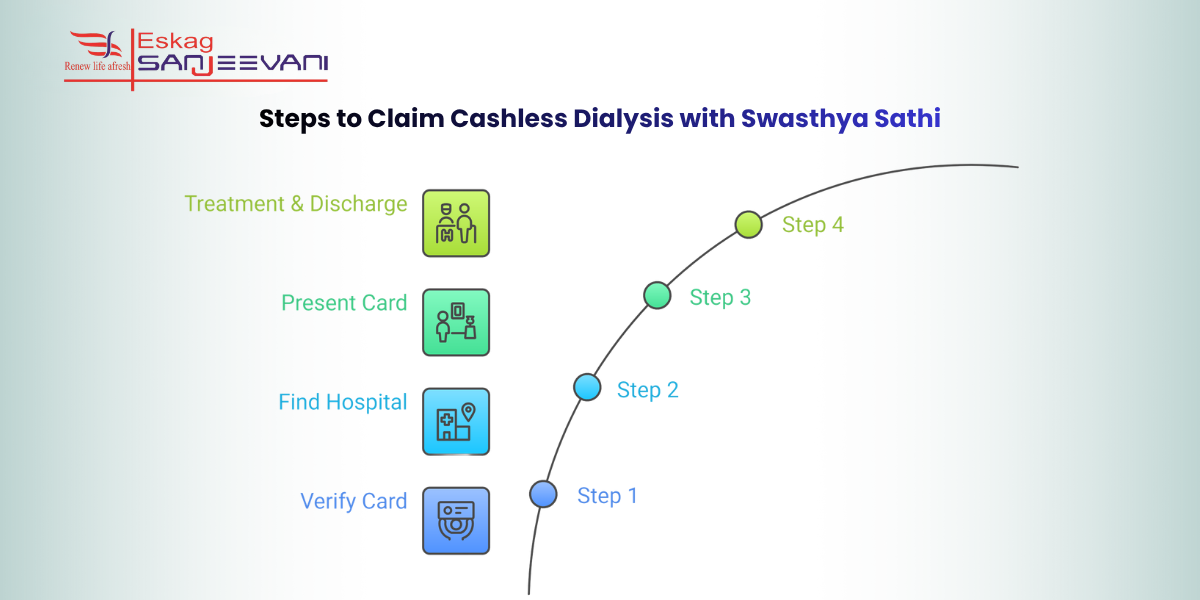
How to Claim Cashless Dialysis with Swasthya Sathi
Claiming cashless dialysis under the Swasthya Sathi scheme is a straightforward process once you know the exact steps. Each stage is managed digitally, so there is minimal paperwork and no upfront payment at any point.
Step 1: Verify Your Swasthya Sathi Card is Active
You can verify your Unique Registration Number online by visiting the official Swasthya Sathi portal, clicking on ‘Find Your Name’, and entering your URN or registered mobile number. This confirms your eligibility before you arrive at the hospital, saving time at the helpdesk.
You can also call the 24×7 toll-free helpline at 1800-345-5384 or use the Swasthya Sathi mobile app to check your card status instantly.
Step 2: Locate an Empanelled Dialysis Hospital
Visit the official Swasthya Sathi website at swasthyasathi.gov.in, go to the ‘Hospital Information’ section, and filter by your district to see all approved hospitals in your area.
Check whether the hospital specifically offers dialysis services using the hospital facility status portal at helpline.swasthyasathi.gov.in. Kolkata alone has around 96 empanelled hospitals listed under the Swasthya Sathi scheme, including private NABH-accredited Grade I hospitals.
Step 3: Present Your Card at the Hospital Helpdesk
Carry your Swasthya Sathi smart card to the hospital and present it at the dedicated helpdesk. If you forget your card, you must submit it within 24 hours of admission to remain eligible for cashless treatment [4].
A dedicated Swasthya Sathi Mitra counter at each empanelled hospital will guide you through the admission process. Fingerprint verification of any enrolled family member is required at this stage to prevent fraud and confirm your identity before treatment begins.
Step 4: Pre-Authorisation, Treatment and Discharge
All medical treatments under the scheme are 100% pre-authorised online, with a turnaround time of 24 hours, and SMS alerts are sent directly to your registered mobile number at each stage. Once pre-authorisation is approved, your dialysis session proceeds with zero out-of-pocket payment at any point.
Before leaving the hospital, collect your Swasthya Sathi card, ask for a discharge slip, and confirm how much of your annual balance remains on the card.
Eskag Sanjeevani Hospital is a Swasthya Sathi empanelled with a dedicated team that handles the entire pre-authorisation process, from card verification to discharge documentation, on your behalf.
How to Find a Swasthya Sathi Dialysis Unit in Kolkata
Choosing the right dialysis unit in a hospital that is Swasthya Sathi empanelled requires checking beyond the official list; dialysis availability, machine capacity, and pre-authorisation support all vary significantly across centres.
Not every empanelled hospital offers every speciality, so confirming dialysis availability at your chosen centre before your first visit is essential.
Here are some of the considerations to note while checking dialysis units:
- Being on the empanelled list does not automatically mean a hospital offers dialysis. Use the hospital facility status portal at helpline.swasthyasathi.gov.in specifically to filter for nephrology and dialysis services.
- At each network hospital, a dedicated Swasthya Sathi Mitra helpdesk is available to assist with the cashless admission process, and ask specifically whether this desk handles dialysis day-care pre-authorisation.
- Check the number of functional dialysis machines at the centre, as high patient demand at popular empanelled hospitals can result in long waiting times for scheduled sessions.
- Proximity matters for dialysis patients who attend sessions three times a week. A centre within a reasonable distance reduces long-term physical strain and travel costs.
Eskag Sanjeevani Hospitals are Swasthya Sathi-empanelled hospitals in Kolkata. The centre manages the full pre-authorisation and discharge process for cardholders, so patients attend their sessions without administrative burden.

Microbiologist with over 2 years of experience in medical writing, specialising in evidence-based healthcare content.

Clinical experience in diagnosis, treatment, and evidence-based patient care across a range of conditions.
References
- National Health Mission Tamil Nadu (2025). National Dialysis Programme (NDP). Department of Health & Family Welfare, Govt. of Tamil Nadu, India.
- Khanna, U. (2009). The Economics of Dialysis in India. Indian Journal of Nephrology, [online] 19(1), pp.1–4.
- Swasthya Sathi Official Portal
- Swasthya Sathi scheme, Swasthya Sathi Scheme | Uttar Dinajpur District, West Bengal | India.
No, the Swasthya Sathi scheme covers all pre-existing conditions, including chronic kidney disease, from the first day of enrolment with no waiting period. This makes it one of the few government health schemes in India where kidney patients can access cashless treatment immediately after card activation.
Yes, you can use your Swasthya Sathi card at any empanelled hospital across West Bengal, not just the one where you first registered. This is particularly useful if you relocate, travel, or need to switch centres due to capacity or quality concerns.
The ₹5 lakh limit resets at the start of each policy year, but if it is exhausted before renewal, any further treatment cost must be borne by the patient until the next cycle begins. Planning your sessions and tracking your remaining balance after each visit helps you avoid an unexpected gap in covered care.
First-time claimants should verify their card status on the official portal, locate a Swasthya Sathi empanelled dialysis centre in their district, and present their smart card at the dedicated helpdesk on arrival. The hospital raises the pre-authorisation request online on your behalf, and once approved within 24 hours, your dialysis session proceeds with zero out-of-pocket payment.
Eskag Sanjeevani Dialysis manages the entire pre-authorisation and discharge documentation process on behalf of Swasthya Sathi cardholders, so patients do not need to handle administrative tasks between sessions. The centre’s dedicated team ensures card verification, SMS confirmation, and balance tracking are completed at each visit without adding to the patient’s burden.