

 Medically Reviewed
Cochlear Implant in India: Surgery, Cost & Early Treatment
Hearing loss can feel overwhelming, especially when it affects your ability or your child’s ability to communicate clearly. If hearing aids no longer help, you may look for more advanced solutions.
Cochlear implants offer a clinically proven option for people with severe to profound hearing loss who need more than sound amplification. These devices differ from hearing aids and require evaluation, surgery, and structured rehabilitation for best outcomes.
In this blog, you will understand how cochlear Implants in India work, who needs them, and what to expect from treatments.
Key Takeaways:
- Cochlear implants bypass damaged inner ear structures and directly stimulate the auditory nerve, unlike hearing aids that amplify sound only.
- Early implantation, especially before age 3.5, significantly improves speech development, auditory outcomes, and long-term communication abilities in children.
- The total cochlear implant treatment cost in India includes the device, surgery, therapy, and follow-up care, with government support available for eligible patients.
Quick Answer: Cochlear implants restore hearing by directly stimulating the auditory nerve, providing effective treatment for severe hearing loss.
Quick Links
Cochlear Implant vs Hearing Aid: Key Differences
A cochlear implant is a small electronic device that restores hearing to people with severe or profound hearing loss. Unlike hearing aids, which amplify sound, a cochlear implant bypasses damaged inner ear structures and sends electrical signals directly to the auditory nerve.
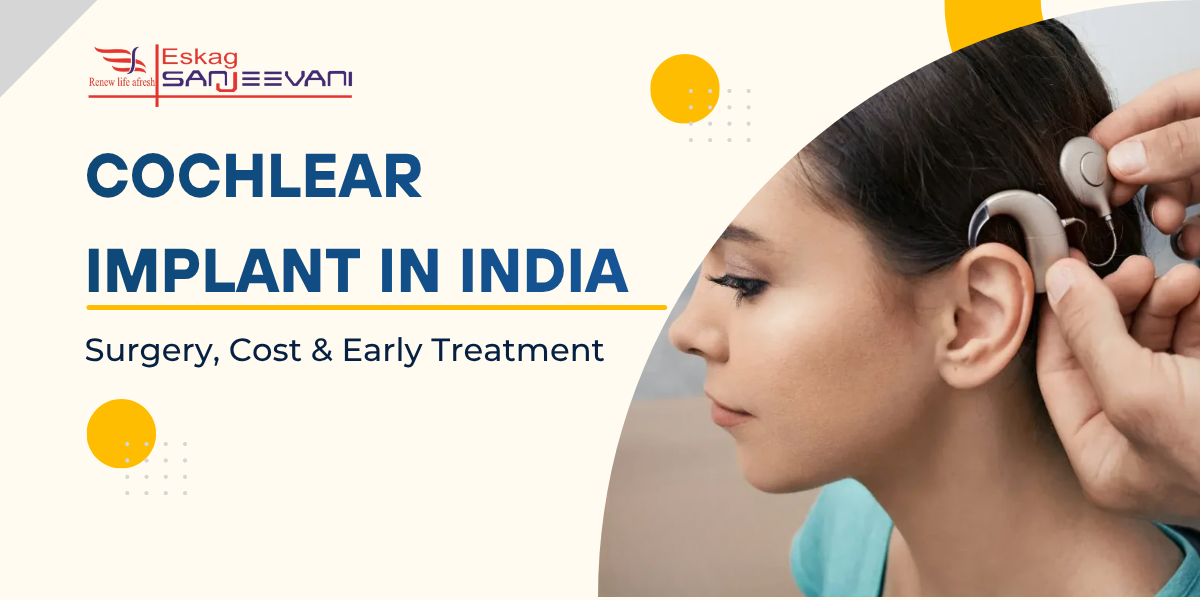
The device has two main components that work together to deliver sound. The external sound processor sits behind the ear, captures environmental sounds, and converts them into digital signals. The internal implant, surgically placed under the skin, receives those signals and sends electrical pulses via an electrode array inside the cochlea.
Here is a close examination of what cochlear implants can and cannot do:
- They do not restore completely natural hearing; the sounds perceived differ from those in normal hearing.
- They allow users to understand speech, hear environmental sounds, and take part in conversations.
- In a clinical study, cochlear implant users understood sentences 8 times better than with hearing aids.
- They are most effective when combined with structured auditory verbal therapy after surgery.
- Children implanted early reach speech and language milestones comparable to hearing peers.
- Hearing aids amplify sound for a damaged ear; cochlear implants perform the entire function of the ear.
Here is a tabular representation for the appropriate evaluation of the differences:
| Feature | Hearing Aid | Cochlear Implant |
| Function | Amplifies sound | Bypasses the inner ear and stimulates the auditory nerve |
| Suitable for | Mild to moderate hearing loss | Severe to profound hearing loss |
| Sound clarity | Limited in severe cases | Improves speech understanding significantly |
| Surgery required | No | Yes |
| Outcome | Depends on residual hearing | Works even when the inner ear is damaged |
Understanding who qualifies for cochlear implants in India helps you take the next informed step toward effective hearing care.
Who Needs a Cochlear Implant in India?
Candidacy for cochlear implants is determined through a structured evaluation by an ENT specialist. A medical professional must always confirm final candidacy.
Children as candidates
Children with bilateral severe-to-profound sensorineural hearing loss are the primary candidates for cochlear implantation. The key criteria include no meaningful improvement after a 3-6-month hearing aid trial and an intact auditory nerve confirmed by imaging [1]. In India, implantation is performed in children as young as 6-12 months of age.
The Government of India’s ADIP scheme sets the eligible age range for funded implantation at 1-5 years for prelingually deaf children [2]. Children in this age group still benefit from cochlear implants, though government reimbursement is reduced to 50-80% of the total device cost. Medical fitness for surgery under general anaesthesia is also a requirement for all paediatric candidates.
Adults as candidates
Adults with severe-to-profound sensorineural hearing loss in both ears are strong candidates for cochlear implantation. A commonly used screening benchmark is the “60/60 rule”: adults with a pure-tone average of 60 dB or greater and speech understanding of 60% or less should be referred for formal evaluation [3]. Adults who score 50% or less on sentence recognition tests in the ear to be implanted typically meet the criteria for surgery.
Single-sided deafness
Single-sided deafness (SSD), where one ear has profound hearing loss and the other functions normally, is a recognised indication for cochlear implantation. It improves the ability to locate sounds and understand speech in noisy environments.
Your ENT specialist will determine whether you are eligible for SSD benefits.
The scale of unmet need in India
A 2026 study at the All India Institute of Speech and Hearing in Mysuru reviewed 1,000 adult patient files. It found that 5% of adults presenting for audiological evaluation were probable cochlear implant candidates [4]. This points to a substantial number of people across India who could benefit from the procedure but remain undiagnosed and untreated.
Once eligibility is confirmed, it is important to understand how cochlear implant surgery is performed step by step in India.
Cochlear Implant Surgery Process in India
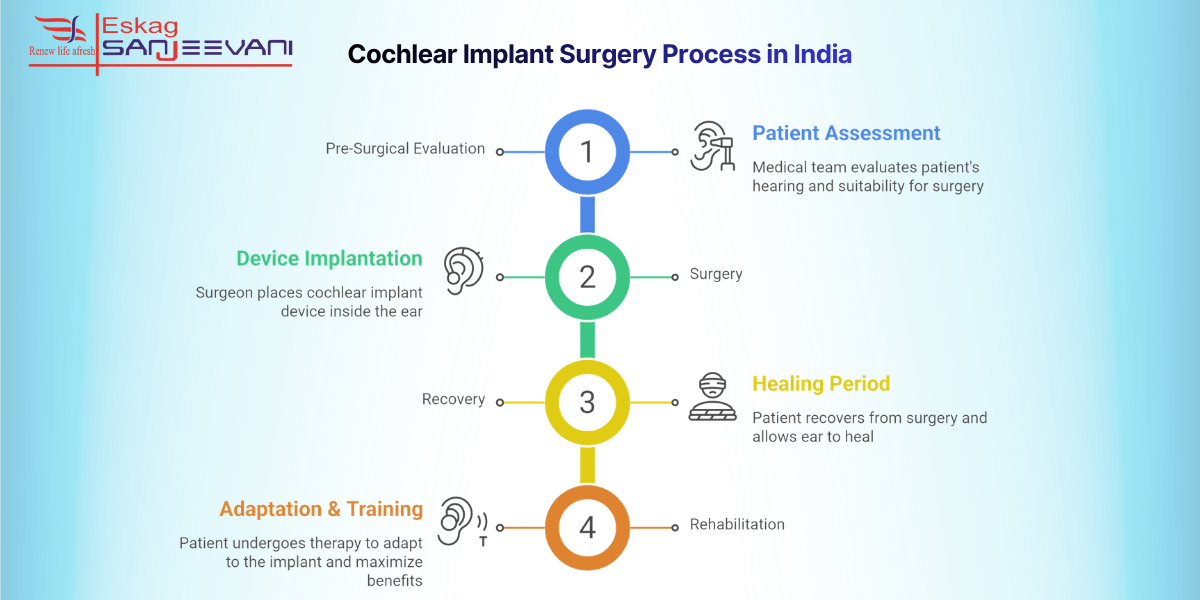
Cochlear implant surgery in India is a well-established ENT procedure performed at specialist centres. The process follows a structured pathway from evaluation to rehabilitation.
The step-by-step surgical process includes:
- Pre-surgical evaluation: The team conducts audiological tests (pure-tone audiometry, OAE, ABR), CT and MRI scans to assess inner-ear anatomy, and provides counselling for the patient and family.
- The surgery: General anaesthesia is administered, and a small incision is made behind the ear. The surgeon performs a mastoidectomy to access the inner ear structures.
- Electrode insertion: The electrode array is gently threaded through the round window into the cochlea and positioned to directly stimulate the auditory nerve.
- Device placement: The internal receiver-stimulator is placed under the skin and secured in place. Neural responses are measured intraoperatively to confirm proper device function.
- Wound closure: The incision is closed, often with dissolvable stitches. The procedure takes one to two hours per ear.
- Recovery period: The wound heals over 3-4 weeks, and the patient is monitored for any post-operative complications.
- Device activation: Two to four weeks after surgery, the audiologist connects the external processor and conducts the first mapping session.
- Rehabilitation: Auditory verbal therapy over one to two years trains the brain to interpret electrical signals as meaningful sound. This phase is essential for good speech outcomes.
Also read: Best Treatment for Sinusitis in Kolkata: Medical Options Explained.
Cochlear Implant Cost in India: Price & Options
The total cost of cochlear implant treatment in India goes well beyond the device price alone. Understanding each component helps you plan and explore financial support options.
Here is a complete cost breakdown:
| Cost Component | Estimated Cost (INR) |
| Cochlear implant device (unilateral) | ₹5,00,000 – ₹17,00,000 |
| Surgical charges (excluding device) | ₹2,00,000 – ₹4,00,000 |
| Auditory verbal therapy (2 years) | ₹1,00,000 – ₹2,00,000 |
| Device activation & mapping – Year 1 (5–6 sessions) | ₹10,000 – ₹15,000 |
| Annual follow-up mapping sessions | ₹1,500 – ₹3,000 per session |
| Spare parts and accessories (annual) | ₹3,000 – ₹30,000 |
| Speech processor replacement (every 3–5 years) | ₹3,00,000 – ₹7,00,000 |
| Complete unilateral package (all-inclusive) | ₹8,00,000 – ₹24,00,000 |
| Complete bilateral package (both ears) | ₹14,50,000 – ₹30,50,000 |
Note: These figures are indicative. Actual costs depend on the device brand, hospital, surgeon, and individual medical requirements. Please contact Eskag Sanjeevani for a personalised estimate.
If you are unsure about eligibility, consider a clinical evaluation by our doctors to clarify your options.
India vs Global Cost Comparison
India’s cochlear implant costs are 50-60% lower than the same procedure in the United States or the United Kingdom. A single-ear procedure in the US ranges from $ 50,000 to $ 100,000, compared to approximately $ 12,000-18,000 in India for a complete package. This cost difference, combined with experienced surgeons and accredited hospitals, makes India a preferred destination for both domestic and international patients.
Government Schemes and Financial Support
Several national and state-level schemes significantly reduce the financial burden of cochlear implantation in India. The ADIP Scheme, managed by the Ministry of Social Justice and Empowerment, provides eligible candidates with free surgery, the basic device, medicines, and therapy. Terms and conditions apply, and scheme coverage is subject to revision by the Government of India.
Why Early Cochlear Implant Treatment Matters in Children
The age at which a child receives a cochlear implant is the single most important factor in their long-term speech and hearing outcomes.
- Children implanted before age 2 show auditory performance scores that normalise within 3 months of device activation.
- 81% of children who receive a cochlear implant early go on to attend mainstream schools.
- A Mumbai-based study confirmed that the P1 auditory marker was age-appropriate in children implanted before 3.5 years, but abnormal in those implanted after age 7 [5].
- India currently lacks a mandatory universal newborn hearing screening programme, resulting in many children receiving a late diagnosis.
- The long-term financial and social cost of raising a profoundly deaf child without intervention far exceeds the one-time cost of surgery [6].
- Financial constraints remain the most commonly reported barrier to timely cochlear implantation in Indian families.
Warning signs parents should watch for:
- No response to sounds or voices by 6 months of age
- No babbling or imitation of speech sounds by 12 months.
- No single words by 15-18 months.
- No consistent turning toward a sound source.
If your child shows any of these signs, request a formal hearing evaluation without delay. Early evaluation is a straightforward step, while delayed action can cost your child critical years of language development.
Also read: Diagnosis and Relief: Ear Pain in Children During the Cold.
Final Thoughts
If you suspect hearing loss, do not delay a proper evaluation with an ENT specialist and audiologist. Early diagnosis gives you more options and improves long-term hearing and speech outcomes, especially for children.
You should also understand the full treatment journey, including surgery, device activation, and consistent therapy after implantation. When you explore cochlear implants in India, consider the clinical experience of reputable ENT specialists, rehabilitation support, and long-term follow-up care before making a decision.
A structured, patient-focused approach at centres such as Eskag Sanjeevani Hospitals can help you move forward with clarity and confidence.

Microbiologist with over 2 years of experience in medical writing, specialising in evidence-based healthcare content.

Clinical experience in diagnosis, treatment, and evidence-based patient care across a range of conditions.
References
- Manrique, M. and Ramos, A. (2019). Summary of the Clinical Practice Guideline. [online] American Speech-Language-Hearing Association
- Gaurav, V., Sharma, S. and Singh, S. (2019). Effects of Age at Cochlear Implantation on Auditory Outcomes in Cochlear Implant Recipient Children. Indian Journal of Otolaryngology and Head & Neck Surgery.
- Zeitler, D.M., Prentiss, S.M., Sydlowski, S.A. and Dunn, C.C. (2023). American Cochlear Implant Alliance Task Force: Recommendations for Determining Cochlear Implant Candidacy in Adults. The Laryngoscope, 134(S3).
- Nayagam, N.N. and Chinnaraj, G. (2026). Prevalence of Probable Adult Cochlear Implant Candidates at a Tertiary Audiology Centre in India. Indian Journal of Otolaryngology and Head & Neck Surgery.
- Karandikar, P. and Deepa Aniket Valame (2020). Auditory Performance in Late Implanted Congenitally Hearing Impaired Children: A Reality Check. Indian Journal of Otolaryngology and Head & Neck Surgery, 72(3), pp.313–319.
- Kothari, S., Keshree, N.K. and Bhatnagar, S. (2015). Pediatric Cochlear Implantation—Why the Delay. Indian Journal of Otolaryngology and Head & Neck Surgery, [online] 67(2), pp.165–169.
Children can receive cochlear implants as young as 6–12 months old. The ADIP scheme covers children aged 1-5 years, and CGHS provides 100% cost reimbursement for them.
A hearing aid amplifies sound for a partially working ear. A cochlear implant replaces the function of the damaged inner ear by directly stimulating the auditory nerve with electrical signals.
The surgery itself takes one to two hours. The wound heals over 3-4 weeks, after which the device is activated, and programming begins.
Adults with severe-to-profound hearing loss who score 50% or below on speech recognition tests are strong candidates. Outcomes are positive, particularly for those who had hearing before losing it.
Cochlear implant surgery has a well-established safety record globally. In India, studies show that the majority of recipients achieve significant improvement in auditory perception scores within 12 months of surgery, with outcomes highly dependent on age at implantation and consistency with rehabilitation therapy.