

Is Heart Attack Genetic?
Is Heart Attack Genetic? Exploring the Link Between DNA and Heart Health
When we think about our heart’s health, we often imagine gym sessions, salads, and avoiding the salt shaker. While these choices are extremely important, many of us wonder about the factors we can’t see, the ones related to our genes.
A common question that arises while being worried about one’s heart is: Is a heart attack genetic? If your father or grandmother had a heart condition, does that mean you are destined for the same path?
Understanding the connection between your genes and your heart is not just about looking at the past; it is about taking control of your future. Science has come a long way in showing that while we cannot change our ancestry, knowing our genetic risks for heart attack can be a literal lifesaver.
Key Takeaways
- Heritage Matters: Genetics can account for 40% to 60% of the risk for coronary artery disease, which often leads to heart attacks [1][2].
- Environment vs DNA: Even if heart attack runs in your family, lifestyle choices like diet and exercise can significantly reduce the likelihood that these genes “turn on” [2].
- Early Detection is Power: Knowing your family history allows a cardiovascular doctor to start preventive screenings early, catching issues before they become emergencies.
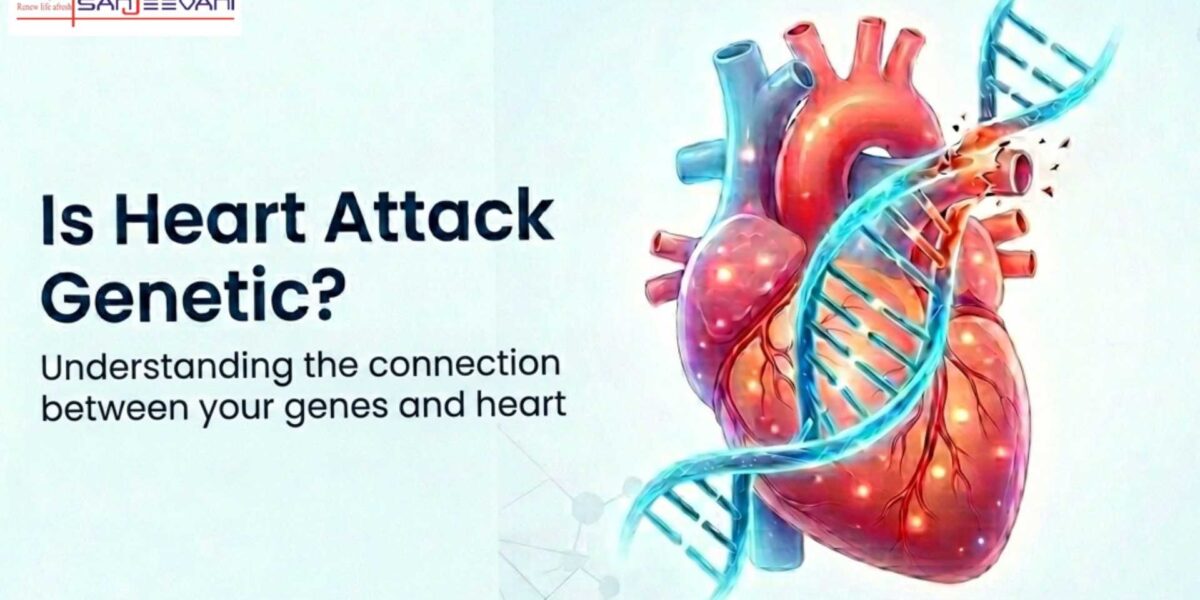
Understanding the Basics: Is Heart Disease Genetic?
To answer the primary concern, “Is a heart attack genetic?”, we first need to look at the broader picture of heart health. Is heart disease genetic? The short answer is yes, but it is complicated. Most heart issues are polygenic, meaning they are caused by tiny variations in many genes rather than a single bad gene [2][5].
Research involving twins and large family groups has shown that the heritability of coronary artery disease (the main cause of heart attacks) is roughly 50% [2][3].
This means that about half of your risk comes from your parents, while the other half comes from your environment, such as what you eat, whether you smoke, and how much you move [2].
Interestingly, genetic influences are often most visible in younger people. If a male relative had a heart attack before age 55 or a female relative before age 65, the genetic risks for heart attack for their children and siblings are much higher than in the general population [2][3].
Recognising the Warning Signs: Genetic Heart Disease Symptoms
Often, people with a genetic predisposition do not feel sick until a major event occurs. However, there are certain genetic heart disease symptoms and physical signs that might suggest your DNA is playing a role in your cardiovascular health.
- Early Onset Angina: Chest pain or discomfort that happens at a relatively young age (30s or 40s) without a clear lifestyle cause.
- Unexplained Shortness of Breath: Feeling winded during basic activities like climbing a flight of stairs, which could indicate a hereditary thickening of the heart muscle [4].
- Physical Markers of High Cholesterol: Some people with a genetic condition called Familial Hypercholesterolemia may develop yellowish bumps around their eyes or on their tendons (xanthomas), which are actually cholesterol deposits [5].
- Palpitations: A racing or fluttering heart could be a sign of inherited rhythm disorders like Brugada syndrome or Arrhythmogenic Cardiomyopathy [4].
If you notice any of these genetic heart disease symptoms, it is a sign that your body is asking for a professional evaluation [4].
Identifying Specific Genetic Risks for Heart Attack
When asking if a heart attack is genetic, doctors look at specific markers. Some people carry variations on Chromosome 9 (specifically the 9p21 region), which is one of the strongest known markers for heart risk [1][5]. This specific variant can increase the risk of early-onset heart disease by up to 40% in individuals who carry two copies of the risk-associated allele [1].
Other genetic risks for heart attack include:
- Lipoprotein(a) Levels: This is a type of protein in your blood determined almost entirely by your genes. High levels can lead to blockages even in people who are otherwise very fit [1].
- Blood Pressure Regulation: Certain genes control how your kidneys handle salt and how your blood vessels constrict, making some families naturally more prone to hypertension [1][3].
- Muscle Structure: Some inherited conditions cause the heart walls to become too thick or too thin, affecting their ability to pump blood effectively [4].
Management and Care: What Can You Do for Your Heart?
What you need to know is that your genes or DNA can never be your destiny. Genetic heart disease treatment has advanced rapidly, moving toward precision medicine. This means treatments are tailored to fit your genes.
Common approaches to genetic heart disease treatment include:
- Advanced Lipid Therapies: For those whose high cholesterol is purely genetic, standard statins might not be enough. Newer injectable medications can help lower cholesterol levels that diet alone cannot touch [2][5].
- Gene Editing Research: While still in the early stages, technologies like CRISPR are being studied for their potential to fix or disable genes that cause hereditary heart disorders [1].
- Screening and Monitoring: If a specific mutation is found in one family member, doctors often perform cascade screening to test siblings and children, enabling early intervention before symptoms develop [4].
When to Consult with a Cardiovascular Doctor?
Navigating family history can be overwhelming. This is where a cardiovascular doctor becomes your most important ally. Instead of waiting for a crisis, a specialist can perform genetic testing and detailed imaging to see exactly what is happening inside your arteries.
By identifying your genetic risks for heart attack early, a cardiovascular doctor can create a personalised shield for your heart. This might include a specific exercise plan, targeted medications, or simply more frequent monitoring.
As a leading hospital in North Kolkata, Eskag Sanjeevani has experts who have been taking care of people’s hearts for several years. Remember, even if it’s a heart attack that’s genetic in your family, you have the power to change the outcome through proactive care, and our team is right here to help you at every step.
Conclusion
So, is a heart attack genetic? The evidence from years of medical research confirms that our genes play a very important role in our heart health. From the way our bodies process fat to the strength of our heart muscle, DNA provides the blueprint.
However, that blueprint can be modified by the lives we lead. While the question “Is heart disease genetic?” and the answer, “yes,” indicate that the risk can be managed. By recognising genetic heart disease symptoms early and consulting a doctor, you can overcome your family history and live a long, healthy life. Why are you still hesitant? Book your appointment with us and see the change for yourself.
References
- Schunkert, H., Erdmann, J., & Samani, N. J. (2010). Genetics of myocardial
Dai, X. (2016) - Genetics of coronary artery disease and myocardial infarction. World Journal of Cardiology, 8(1), 1–23.
- Okda, S. M., Kassem, A. B., Salahuddin, A., & El-Bassiouny, N. A. (2023). Genetic Polymorphisms and Risk of Cardiovascular Disease. International Journal of Clinical Medical Research, 2(1), 1–10.
- Ma, H., Wang, Y., Jia, Y., Xie, L., Liu, L., Zhang, D., … & Xu, R. (2025). Advances in genetic diagnosis and therapy of hereditary heart disease: a bibliometric review from 2004 to 2024. Frontiers in Medicine.
Not necessarily. While you may have a higher genetic risk, your lifestyle choices—like not smoking and staying active- can significantly reduce the chance of that risk turning into a reality.
Yes, some genetic conditions like Familial Hypercholesterolemia can cause high cholesterol regardless of how healthy you eat. In these cases, medical intervention is often needed.
Genetic testing can identify if you have a higher polygenic risk score, meaning you have more risk genes than average. It doesn’t predict a specific date but tells you to be more cautious.
Many genetic issues and symptoms are silent, but early chest pain, fainting during exercise, or extreme shortness of breath are key signs to watch for.
It is more personalised. It often involves specific medications targeted at genetic mutations or more frequent screenings starting at a much younger age.
You should book an appointment if you have a first-degree relative (parent or sibling) who suffered a heart attack or stroke before age 55 (for men) or 65 (for women).