

 Medically Reviewed
67% Heart Risk: The Danger of Ultra-Processed Foods
Packaged biscuits, instant noodles, chips, sugary drinks and ready-to-eat foods have become increasingly common in many urban households. While not every processed food is unhealthy, research has raised concerns about higher consumption of ultra-processed foods (UPFs) and their link to cardiovascular health. A 2026 study presented at the American College of Cardiology’s Annual Scientific Session reported that adults consuming approximately nine servings of ultra-processed foods per day had a 67% higher risk of heart attack, stroke or cardiovascular death compared with those consuming about one serving per day. However, this observational association does not establish that ultra-processed foods directly caused these cardiovascular events [1].
Other large observational studies and reviews have also reported associations between higher UPF consumption and cardiovascular disease. The evidence is therefore useful for understanding dietary patterns and potential risk, but it should not be interpreted as meaning that eating a particular packaged food will directly cause a heart attack or stroke.
For Indian households, the practical approach is not to eliminate every packaged food. Instead, make minimally processed or nutritious foods the foundation of your diet. This blog explains all of these.
Key Takeaways
- Higher consumption of ultra-processed foods has been associated with greater cardiovascular risk in observational research.
- The reported 67% figure represents an association between different levels of UPF consumption, not a guaranteed increase in an individual’s personal risk.
- Ultra-processed foods are defined by the nature and purpose of their processing, not simply by the number of ingredients on a label.
- A heart-healthy diet focuses on overall dietary patterns, including vegetables, fruits, pulses, whole grains, nuts, seeds and appropriate protein sources.
In short: Higher intake of ultra-processed foods is associated with greater cardiovascular risk, but it does not prove that these foods directly cause heart attacks or strokes.
Quick Links
What Are Ultra-Processed Foods and How May They Affect Heart Health?
Ultra-processed foods are not simply “unhealthy snacks”. They’re a distinct category of industrial food products that your body responds to very differently than whole or minimally processed foods.
Here are some of the key factors to understand ultra-processed foods:
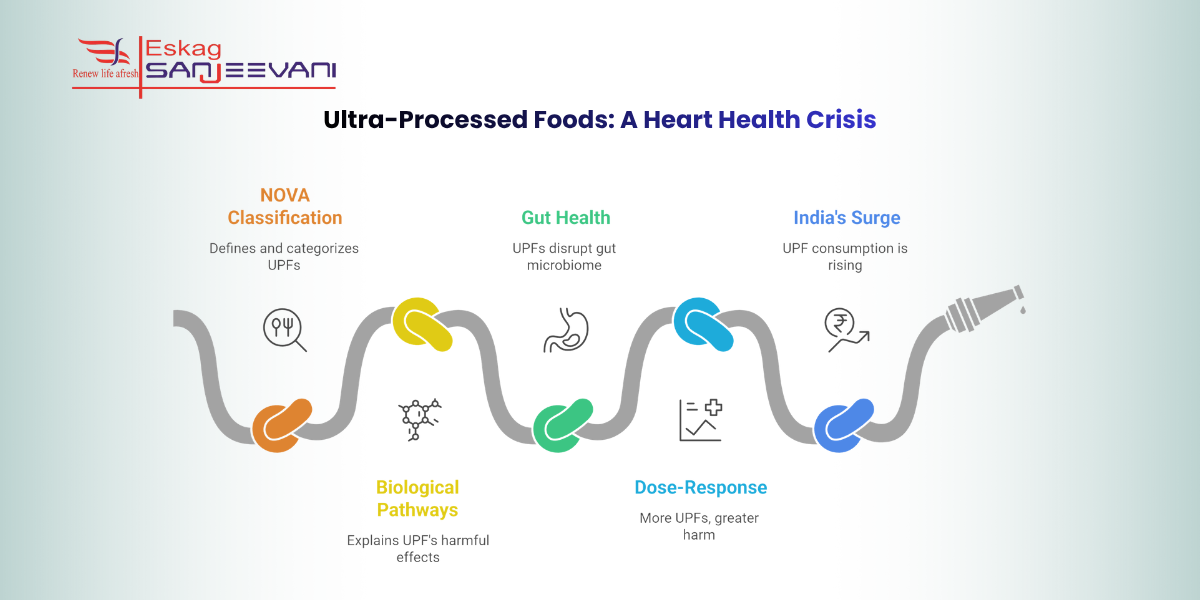
1. The NOVA Classification
The NOVA system groups foods according to the extent and purpose of processing, rather than simply labelling foods as good or bad.
Ultra-processed foods are generally industrial formulations made with multiple ingredients and processing techniques, and may contain substances such as flavourings, colourings, emulsifiers, sweeteners, or other additives that are uncommon in home cooking.
Examples can include the following:
- Some packaged biscuits and cakes
- Sugar-sweetened beverages
- Instant noodles
- Packaged savoury snacks
- Some ready-to-eat meals
- Processed meat products
- Some confectionery and highly formulated breakfast products
However, the number of ingredients alone does not determine whether a food is ultra-processed. A long ingredient list is not a reliable substitute for understanding the NOVA classification [2]. Similarly, not every processed food is ultra-processed. Foods such as pasteurised milk, canned vegetables, frozen vegetables or traditionally processed foods can still fit within a healthy dietary pattern.
2. Five Biological Pathways
Ultra-processed foods harm cardiometabolic health through five distinct pathways: altered blood lipid profiles, disrupted gut microbiota, insulin resistance, systemic inflammation, and endothelial dysfunction. They cause damage to the inner lining of blood vessels. Importantly, these harms occur independently of total calorie intake, meaning low-calorie ultra-processed options still carry measurable cardiovascular risk.
3. Ultra-Processed Foods Destroy Gut Health
Emulsifiers and artificial sweeteners in ultra-processed foods reduce beneficial gut bacteria, such as Akkermansia muciniphila and Faecalibacterium prausnitzii, while promoting pro-inflammatory microbial strains that stress arterial walls. The gut dysbiosis contributes to increased intestinal permeability, commonly called “leaky gut”, which allows inflammatory compounds to enter the bloodstream and accelerate cardiovascular damage [3].
4. Dose-Response Relationship
A 2024 meta-analysis of over 1.1 million participants across 20 studies confirmed a clear linear relationship between ultra-processed food intake and cardiovascular diseases. Each additional 100 grams per day raised cardiovascular event risk by 1.9%, hypertension risk by 14.5%, and all-cause mortality by 2.6% [4].
5. India’s UPF Surge
A Lancet Regional Health series confirmed that rising ultra-processed food consumption in India is directly linked to the expanding burden of cardiovascular diseases, type 2 diabetes, and premature death. Professor Srinath Reddy of PHFI described these products as driving “diminished immunity, aggravated inflammation, and an unprecedented rise in life-threatening chronic disease” across Indian populations.
The 67% Risk: What the Research Actually Says
The 2026 study presented at the American College of Cardiology included 6,814 adults aged 45-84 years without previously diagnosed cardiovascular disease. Participants with the highest reported intake-approximately nine servings of ultra-processed foods per day- had a 67% higher risk of heart attack, stroke or cardiovascular death compared with those consuming about one serving per day [1].
This is an important finding, but it needs context.
The study was observational, meaning researchers examined relationships between reported food consumption and later health outcomes. Such studies can identify associations but cannot establish that UPF consumption itself caused the cardiovascular events.
Other factors, including overall diet, lifestyle, health conditions and socioeconomic characteristics, can also influence cardiovascular risk.
What Other Research Shows?
A 2024 analysis of three large US cohorts involving more than 200,000 health professionals reported associations between higher UPF consumption and cardiovascular disease and coronary heart disease [5].
A 2024 BMJ umbrella review also found associations between higher exposure to ultra-processed foods and several adverse health outcomes, including cardiovascular disease. However, the authors noted limitations in the underlying evidence, including the predominantly observational nature of the research [6].
Taken together, the evidence supports focusing on overall UPF consumption and dietary quality, while avoiding the conclusion that every ultra-processed food independently causes cardiovascular disease.
Also read: What Recent Research Found About Heart Health in India?
How to Reduce Cardiovascular Risk Through Everyday Food Choices
You don’t need to eliminate packaged foods completely to improve your diet. Here are a few steps mentioned below to reduce cardiovascular risk:
Step 1: Look Beyond Calories
When reading food labels, consider the following:
- Added sugars
- Sodium
- Saturated fat
- Fibre
- Protein
- Portion size
- The overall ingredient composition
Do not assume that a food is unhealthy simply because it contains several ingredients, or healthy simply because it is labelled “baked” or “low calorie.”
Step 2: Reduce Sugary Drinks
Regular consumption of sugar-sweetened beverages can add substantial amounts of free or added sugar to the diet.
For everyday hydration, the following options can help reduce added sugar intake:
- Water
- Unsweetened buttermilk
- Plain tea or coffee
- Unsweetened beverages
Coconut water can also be part of a balanced diet, but it should not be presented as a treatment for high blood pressure or heart disease.
Step 3: Choose More Whole or Minimally Processed Grains
You can include the following foods as part of a balanced diet:
- Oats
- Brown rice
- Whole-wheat roti
- Jowar
- Bajra
- Ragi
Oats are particularly useful because they contain beta-glucan, a soluble fibre associated with modest reductions in LDL cholesterol when consumed regularly in sufficient amounts [7].
However, no single grain automatically prevents heart disease, and dietary choices should also consider portion size and the rest of the meal.
Step 4: Replace Packaged Snacks More Often
Instead of relying regularly on chips, biscuits or highly processed namkeen, consider:
- Roasted chana
- Unsalted or lightly salted nuts
- Fresh fruit
- Homemade poha
- Sprouts
- Vegetable-based snacks
Nuts can contribute unsaturated fats, fibre and other nutrients to the diet. Evidence supports including nuts as part of a healthy dietary pattern, but eating almonds or walnuts should not be described as a guaranteed way to prevent coronary events.
Step 5: Build a Balanced Indian Meal
A practical Indian meal can include:
Whole grain or traditional staple + dal/pulses + vegetables + appropriate protein + curd or another suitable dairy option.
The exact combination can vary by dietary preference, culture, health conditions, and nutritional needs.
Diet for Heart Health: A Practical Indian Meal Plan
No single meal plan suits everyone. The following is an example of a balanced pattern, not a treatment diet.
Here is a tabular representation of the diet chart:
| Meal | Example | Why Include It? |
| Morning | Water + a small portion of nuts | Provides hydration and nutrient-rich unsaturated fats |
| Breakfast | Oats upma, moong dal chilla or vegetable poha | Provides fibre and/or protein |
| Mid-morning | Guava, apple, papaya or another seasonal fruit | Provides fibre and micronutrients |
| Lunch | Brown rice or roti + dal + vegetables + curd | Combines whole/minimally processed foods, fibre and protein |
| Evening | Roasted chana, fruit or unsalted nuts | An alternative to frequent packaged snacks |
| Dinner | Roti or another whole-grain option + vegetables + fish, dal, paneer or another protein source | Supports a balanced overall meal |
Disclaimer: If you have diabetes, kidney disease, heart failure or another medical condition, your dietary needs may differ. A registered dietitian or healthcare professional can help adapt the meal pattern to your individual requirements.
Final Thoughts
Research increasingly finds an association between higher consumption of ultra-processed foods and cardiovascular disease, but the evidence should be interpreted carefully. The 67% figure from the 2026 study describes an association between different levels of UPF intake; it does not mean that eating nine servings automatically causes a 67% increase in an individual’s personal risk of a heart attack or stroke. Rather than focusing on one food or following an extreme diet, aim for a sustainable pattern built around vegetables, fruits, pulses, whole grains, nuts, seeds and appropriate protein sources. At Eskag Sanjeevani Hospitals, cardiovascular evaluation and cardiology services are available for patients who require assessment based on their symptoms and individual risk profile.

Microbiologist with over 2 years of experience in medical writing, specialising in evidence-based healthcare content.

Clinical experience in diagnosis, treatment, and evidence-based patient care across a range of conditions.
References
- American College of Cardiology. (2026). Ultra-processed foods linked with serious heart problems – American College of Cardiology. [online]
- Medin AC, Gulowsen SR, Groufh-Jacobsen S, Berget I, Grini IS, Varela P. Definitions of ultra-processed foods beyond NOVA: a systematic review and evaluation. Food Nutr Res. 2025 Jun 16;69. doi: 10.29219/fnr.v69.12217.
- Rondinella D et al. The Detrimental Impact of Ultra-Processed Foods on the Human Gut Microbiome and Gut Barrier. Nutrients. 2025 Feb 28;17(5):859. doi: 10.3390/nu17050859.
- Qu, Y., Hu, W., Huang, J., Tan, B., Ma, F., Xing, C. and Yuan, L. (2024). Ultra-processed food consumption and risk of cardiovascular events: A systematic review and dose-response meta-analysis. eClinicalMedicine, 69, p.102484. doi:10.1016/j.eclinm.2024.102484.
- Mendoza K, et al. Ultra-processed foods and cardiovascular disease: analysis of three large US prospective cohorts and a systematic review and meta-analysis of prospective cohort studies. Lancet Reg Health Am. 2024 Sep 2;37:100859. doi: 10.1016/j.lana.2024.100859.
- Lane MM, et al. Ultra-processed food exposure and adverse health outcomes: umbrella review of epidemiological meta-analyses. BMJ. 2024 Feb 28;384:e077310. doi: 10.1136/bmj-2023-077310.
- Whitehead A, Beck EJ, Tosh S, Wolever TM. Cholesterol-lowering effects of oat β-glucan: a meta-analysis of randomized controlled trials. Am J Clin Nutr. 2014 Dec;100(6):1413-21. doi: 10.3945/ajcn.114.086108. Epub 2014 Oct 15.
They raise cardiovascular risk by driving chronic inflammation, disrupting the gut microbiota, elevating LDL cholesterol, and inducing insulin resistance. These effects are independent of calorie intake, meaning even low-calorie ultra-processed options still carry measurable cardiovascular risk.
ACC 2026 research found that high daily intake raises heart attack and stroke risk by 67% compared to minimal intake. Each additional daily serving increases the risk of cardiovascular events regardless of overall diet quality.
Sugar-sweetened beverages and processed meats carry the strongest links to cardiovascular diseases. Packaged salty snacks follow closely, as their high sodium content directly and progressively elevates blood pressure over time.
A traditional Indian diet built on dal, whole grain rotis, and seasonal vegetables is naturally heart-protective. Research shows a healthy dietary pattern reduces heart disease risk by up to 35%, with greater benefit when combined with regular physical activity.
See a cardiologist if you have high blood pressure, elevated LDL, diabetes, central obesity, or a family history of heart attacks, even without symptoms. Early assessment allows your doctor to quantify actual risk and recommend both dietary and medical interventions before a cardiac event occurs.