
Trauma Care at Eskag Sanjeevani Hospitals
A serious injury or medical emergency requires prompt assessment and the right medical support. Trauma care focuses on the rapid evaluation, stabilisation and treatment of injuries caused by road accidents, falls, burns and other emergencies. Timely intervention, coordinated care and access to emergency services can help reduce complications and support recovery. Our trauma care team at Eskag Sanjeevani Hospitals provides emergency and trauma care services to support patients who need urgent medical attention.
What Is Trauma Care?
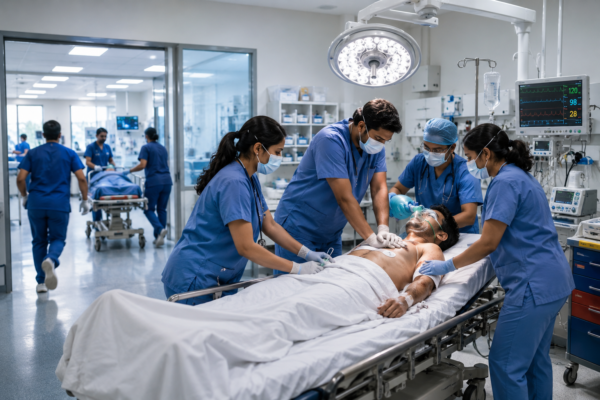
Trauma care means rapidly assessing, stabilising, and treating physical injuries caused by accidents, falls, or other incidents. This unit focuses on identifying life-threatening injuries, supporting essential body functions, and starting appropriate treatment. Emergency and trauma care may involve wound management, fracture assessment, imaging, surgery or critical care, depending on the patient’s condition.
When Is Trauma Care Needed?
Ask for immediate medical attention following an accident or injury if there is concern about serious harm, particularly in cases involving the following:
- Road traffic accidents or major falls
- Head injuries or suspected spinal injuries
- Suspected fractures or dislocations
- Severe bleeding or deep wounds
- Chest or abdominal injuries
- Loss of consciousness or confusion following an injury
Do not delay asking for care while trying to determine how serious an injury is.
How Does Trauma Care Management Work?
Trauma care management follows a structured process. The exact steps depend on the patient’s injuries and medical condition.
Step 1. Rapid Assessment
The emergency team assesses breathing, circulation, consciousness and signs of serious injury.
Step 2. Initial Stabilisation
Treatment may include airway support, bleeding control, pain relief and measures to protect an injured limb or the spine.
Step 3. Diagnostic Investigations
Depending on the suspected injury, doctors may request X-rays, CT scans, ultrasound or laboratory tests.
Step 4. Specialist Treatment
Patients may need assessment by orthopaedics, neurology, neurosurgery, general surgery or other relevant specialists.
Step 5. Critical Care And Recovery
Patients with severe injuries may require ICU or HDU monitoring, surgery, rehabilitation or follow-up care.
Trauma Care Facility at Eskag Sanjeevani Hospitals
Our emergency and trauma care offers the below-mentioned facilities and services designed to support patients with serious injuries.
- 24×7 emergency services: Emergency assessment and initial treatment are available around the clock.
- Dedicated trauma unit: Supports the initial assessment and stabilisation of patients with traumatic injuries.
- Ambulance services: Emergency transport is available, with trained staff and life-support equipment as described on our facility pages.
- Diagnostic support: Emergency investigations include X-rays, CT scans, ultrasound and pathology services.
- Specialist access: Patients may receive specialist input based on the nature of their injuries.
- Critical care support: ICU and HDU facilities provide close monitoring and medical support for patients with serious conditions.
Looking for a Trauma Care Hospital in Kolkata?
If you need emergency treatment after an accident or serious injury, immediate assessment is important. Eskag Sanjeevani Hospitals provides emergency and trauma care, along with diagnostic and critical care support. For emergency assistance, call us or visit the hospital directly.
Explore Our Trauma Care at Eskag Sanjeevani Hospitals Kolkata
Trusted care and convenient access for all your healthcare needs.
Visit us at: www.eskagsanjeevani.com
Call to learn more about our Trauma Care
Frequently Asked Questions on: Trauma Care
Ask for immediate medical attention if someone has been involved in a serious accident or fall, even if the injuries are not immediately obvious. Warning signs include heavy bleeding, confusion, difficulty breathing, severe pain, suspected fractures, or head, neck, chest or abdominal injuries.
Keep the injured person still in case of head, neck or spinal injuries. If there is external bleeding, apply firm pressure using a clean cloth or dressing, unless an object is embedded in the wound. Avoid giving food or water, as some cases may require emergency surgery.
The tests depend on the injury type and severity. Doctors may recommend X-rays to check for fractures, CT scans to assess head injuries or internal damage, and ultrasound to look for certain internal injuries. Blood tests may also be required to assess the patient’s condition.
No. Treatment depends on the nature and severity of the injuries. Some patients may need wound care, medicines, fracture immobilisation or observation before going home. Others may require surgery, blood transfusion or admission to an intensive care unit (ICU) for close monitoring and support of essential body functions.
Recovery time varies depending on the type and severity of the injury. Minor injuries may heal within days or weeks, while serious fractures, head injuries or injuries involving multiple body parts may require months of treatment and rehabilitation.